



 BBC News
Borrowing was £17.4bn last month, the second highest October figure since monthly records began in 1993.
Iris Spark
If we are inclined to believe that artistic revolutions happen suddenly, with a single brushstroke or manifesto, then John Constable’s 250th anniversary invites a different kind of lesson — one about slowness, apprenticeship, patience, and the long gestation of vision. It is fitting that Gainsborough’s House, in the Stour Valley which shaped him, is marking the occasion with exhibitions that place Constable in dialogue not only with Gainsborough and Turner, but with contemporary painters who still feel his gravitational pull. For Constable is one of those artists whose influence works quietly, like weather on stone: persistent, natural, unshowy, but transformative.
The exhibition Gainsborough, Turner and Constable, opening in April 2026, will assemble over forty oils, watercolours and drawings — many hidden in private collections for decades — alongside works by Alexander Cozens, Francis Towne, Girtin, and European precedents such as Vernet and Joli. For the first time, Constable’s The Leaping Horse will return to Suffolk, the landscape that formed him. To see this painting among the fields and skies that once surrounded the young Constable will be to understand an essential truth: he painted the landscape of his childhood not with nostalgia, but with workmanlike observation, with the patience of someone who knew the sky by heart.
Constable’s achievements can too easily be simplified: the painter of the “chocolate-box” England, the man of locks, barges, meadows and clouds. Yet he was, in his own way, a radical. Not in the manner of Turner, who dazzled with sunbursts and storms, but through a quieter, more stubborn form of revolution: an insistence on experience as the primary truth of painting. His realism was not the sharp-edged, proto-photographic sort that artists would later pursue; it was the realism of feeling.
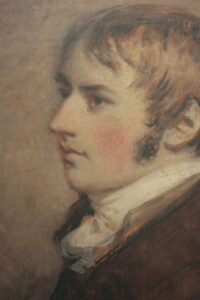
It can be instructive, for instance, to visit in person the scenes which he painted: they’re nothing like as interesting as Constables. Constable understood that sometimes the most revelatory depiction comes not from stating everything but from leaving something out — that what you don’t see can create a more vivid sensation of what you do. His clouds dissolve into atmosphere; his foliage trembles with motion rather than detail. Those unfinished passages — those quick flicks of light on wet leaves, those rapid gestures in his cloud studies — are not failures of completion but triumphs of immediacy.
Martin Gayford once wrote that Constable’s smallest cloud sketch contains more weather than most artists’ grandest canvases, and he is right. Constable observed the sky not as backdrop but as protagonist. He recorded in his notebook that the sky was “the keynote” and “the chief organ of sentiment.” It was not an accessory but the emotional engine of a painting — the element that gave a landscape its inner temperature.
What is extraordinary is how long he waited for recognition. Constable was fifty-three when he finally became a Royal Academician. Today, in an age that prizes precocity sometimes to the point of absurdity, his slow rise feels almost miraculous. There is something moving in this: a man painting his home fields for decades while London critics misunderstood him, while Turner dazzled the public with molten seas. Constable refused to adjust his palette to fashion. He would not warm his greens or prettify his mud. He would not suppress the English dampness, the intermittent sun, the melancholy that hovers even in beauty.
Instead, he cultivated patience — a virtue unfashionable in the art world then and now. Constable used to say that painting was like farming: you could not force it; you worked steadily and trusted the seasons. His method was to sketch obsessively outdoors and then to rework, refine and re-understand his material back in the studio. The studio was not a place of invention so much as a place of distillation.
One of the remarkable qualities of Constable’s work is how it embodies a realism built not on exhaustive detail but on suggestion. Darkness becomes a space not of absence but of possibility; an incompletion becomes a form of invitation. Light appears to arrive and vanish simultaneously. The canvases breathe. This is a realism that acknowledges atmosphere, emotion, memory — a realism that hints rather than declares, that evokes rather than catalogues. It is the opposite of photographic: it is human.
And yet, Constable could be meticulous. The patient man was also capable of ferocious industry. He maintained a cloud diary in Hampstead where he described each formation with meteorological precision. He painted quickly, but he observed slowly. He walked the fields near East Bergholt not as a dreamer but as a surveyor. There is a kind of pragmatism in Constable that people miss: those beloved hay wains and locks were not pastoral fantasies; they were scenes of labour. Constable saw that the English countryside was not a stage set but a workplace.
This connection between labour and landscape is one of the intriguing threads of the new anniversary exhibitions. How did Gainsborough, Turner and Constable, all shaped by the Stour Valley, interpret work, nature and time? Gainsborough’s Landscape with Cattle, returning to the UK for the first time since 1952, reminds us that pastoral scenes once carried moral and social weight. Turner’s Abergavenny Bridge, unseen publicly since 1799, will reappear like a long-forgotten comet. And then there is Constable’s The Leaping Horse, in which equine muscle and human determination strain against the very edge of the canvas.
Constable’s landscapes are about effort — wind effort, water effort, human effort. They are not still but dynamic, full of energy. If Turner shows us the sublime, Constable shows us what it takes to live with it.
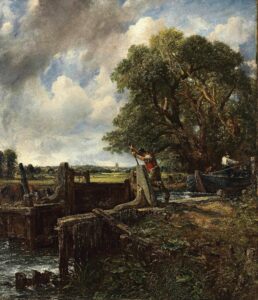
If we want to understand how revolutionary Constable was, we need only compare him to his predecessors. Claude’s landscapes shimmer with golden idealism; Vernet’s seas are spectacular; the Baroque masters fill their scenes with mythological clarity. Constable does the opposite: he insists on the ordinary. He paints the exact tree outside his childhood home, the specific lock-keeper’s cottage, the precise glitter of rain on a canal. And he elevates them not by idealising them but by attending to them. The humility of his subject matter is his rebellion.
There is something about this humility — this patience, this quiet devotion — that makes Constable feel especially relevant now. In our own age, which prizes speed, novelty, instant commentary and restless reinvention, Constable’s slowness feels instructive. He teaches us that the poetic dimension of art is found not in flamboyance but in attention: the careful noticing of the world. The real subject of a landscape is not always the river or the tree but the time spent looking.
His skies are not metaphors; they are meteorology. His foliage is not ornamental; it is botany. His water is not allegory; it is hydrology. And yet all of these accumulate into something profoundly emotional, as if accuracy itself were a form of devotion.
We often imagine that artists must seek foreign lands to achieve greatness — Turner in Venice, Poussin in Rome, Monet in London. Constable did the opposite: he stayed home. His greatest works are not Mediterranean fantasies but Suffolk truths. Gayford has pointed out that Constable’s refusal to flatter the English landscape, his insistence on painting it as it is, changed the course of European art. Delacroix saw The Hay Wain in Paris and marvelled at its freshness – yes his work is often dependent on Orientalist motifs. Impressionism was unthinkable without Constable’s cloud studies. Even the Expressionists found something in his atmospheric turbulence.
At a moment when modern and contemporary art often emphasise shock, speed, novelty and provocation, Constable’s patience reads almost as a countercultural gesture. He was not impatient with the world. He did not demand a style before he was ready. He waited, like his clouds, to form.
What these anniversary exhibitions at Gainsborough’s House will reveal is that Constable belongs not only to the past but to the present. Contemporary painters such as David Dawson and Kate Giles — both included in the programme — continue to find in Constable’s work a model of how to ground the self in nature. Their landscapes, like his, are attentive to weather, to the slow changes of light, to the idea that what we see is always only part of what we feel.
In the end, Constable’s art survives because it is about the experience of living in time. The English weather shifts; the seasons turn; the river rises after rain. Constable captures that movement not with bombast but with fidelity. He reminds us that patience is not passivity but attention stretched across seasons.
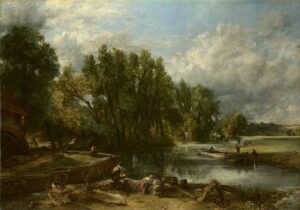
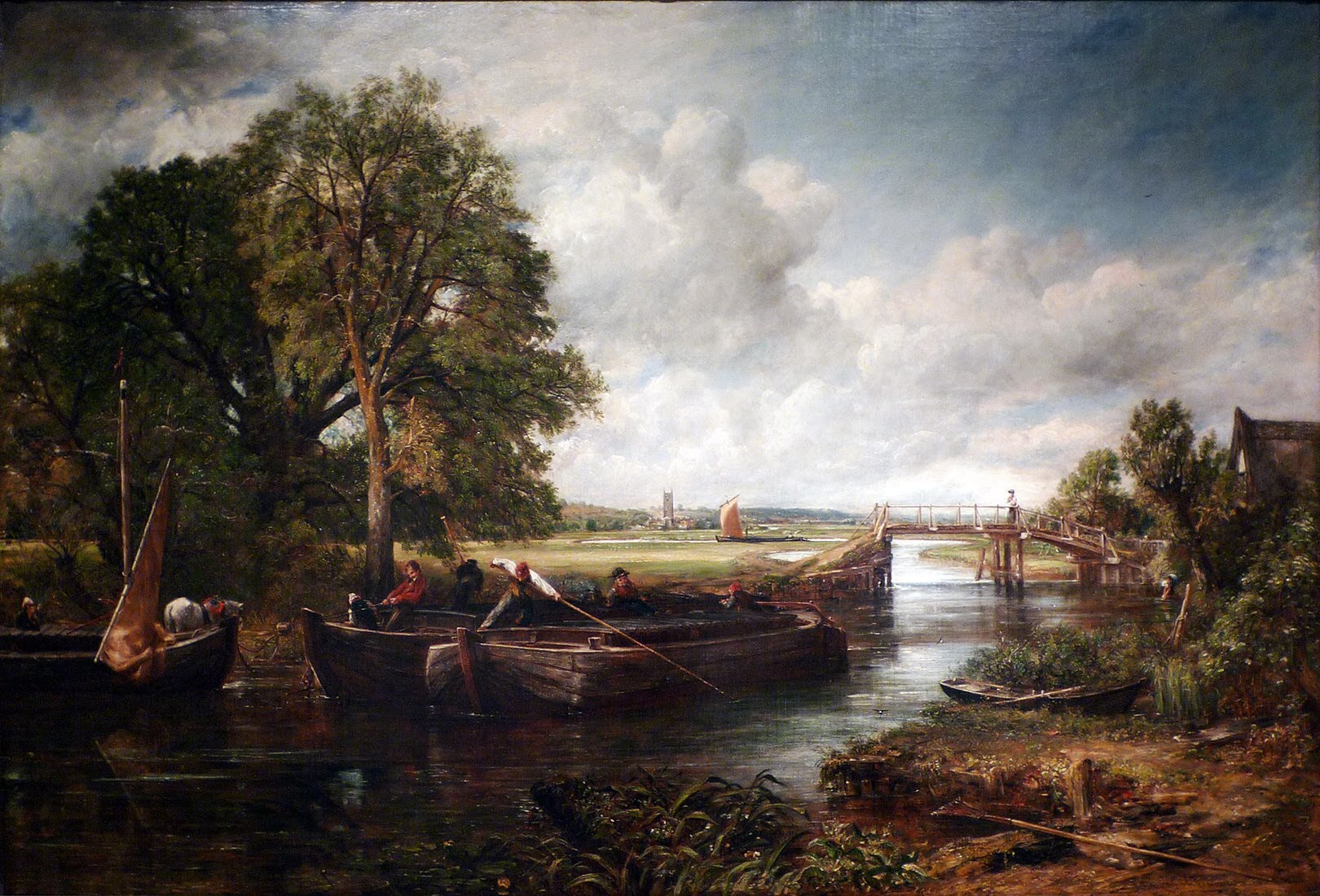
Constable, John; Stratford Mill; The National Gallery, London; http://www.artuk.org/artworks/stratford-mill-115358
And so, as Suffolk prepares to celebrate its most patient son, it is hard not to feel that Constable’s real subject was never the Stour Valley but the art of perseverance itself: the long apprenticeship to nature, the years of being overlooked, the willingness to let a painting’s completion wait until the feeling was right. Constable teaches us that the great works of art are not explosions but accretions — built moment by moment, decision by decision, cloud by cloud.
His revolution was quiet, but it lasted. And as The Leaping Horse finally returns to the county that gave birth to it, we may recognise that the spirit of Constable’s work is not nostalgia but endurance: a painter who trusted nature, trusted time, and trusted that the patient eye would one day be seen for what it was — visionary.