



 BBC News
Borrowing was £17.4bn last month, the second highest October figure since monthly records began in 1993.
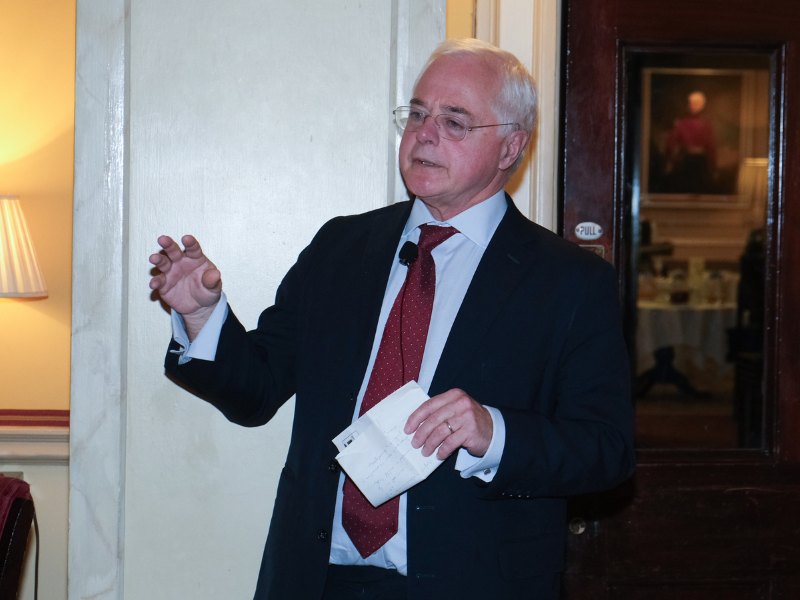
The legendary banker gives his insights on the banking industry and what it takes to keep it in the family
I have found myself thinking lately about my father. He was a banker, as was his father before him, and he never spoke about clients. That was simply understood: discretion was the job. Only after he died did I begin to meet people he had helped. They spoke of him with a kind of quiet reverence, often about moments I had never heard of. It struck me that the true work of banking is rarely visible at the time. It reveals itself later, in other people’s memories.
More than once, I have been asked to distil twenty years of experience into a few neat conclusions. The only one I really trust is this: ownership matters. If you want something to last, it must be small enough and simple enough that the next generation will actually want to take care of it. If it becomes too large, too complicated, it ceases to feel like something to be stewarded and becomes something to be sold. Affection, in the end, is as important as strategy.
I tend to fall back on a couple of simple mantras. “Keep it simple” is one. The other is “small is beautiful,” which is often taken the wrong way. It isn’t a sentimental attachment to smallness. It is a recognition that systems work better when they remain comprehensible, when people can still see themselves in what they are doing. Once things become too large, it becomes very easy to forget that people are the point of the whole exercise.
There is also something unfashionable, perhaps, in the idea of restraint. We do not try to do everything. In fact, we spend a good deal of time deciding what not to do. Complexity has a way of creeping in by degrees—one new system, one new product, one new exception—and before long you are running something no one fully understands. It takes effort to resist that drift, but without that effort, longevity becomes very difficult.
Much of what we do, in practice, is say no. We turn away perfectly reasonable opportunities with some regularity. That sounds counterintuitive, but the aim is not to maximise activity; it is to preserve quality over time. We are trying to build something that survives difficult periods, not something that merely prospers in easy ones. Years ago, we adopted—half seriously, half not—a rule to avoid what we called “potentates.” It cost us in the short term. It proved rather useful later.
The question of time comes up repeatedly. Not in the abstract, but in how decisions are actually made. If you are thinking in five-year increments, you behave one way; if you are thinking in generations, you behave quite differently. The difficulty is that most modern structures reward the former while depending, quietly, on the latter. That tension is not easily resolved, but it is worth at least being aware of it.
I sometimes think modern capitalism has become slightly confused about what success looks like. There is an assumption that scale is inherently good, that growth is always the objective. I am not convinced. Small things can endure in ways that large things cannot. The deeper problem, perhaps, is time: too many decisions are made with the next quarter in mind, when in reality most people are thinking decades ahead, even if they don’t say so.