



 BBC News
Borrowing was £17.4bn last month, the second highest October figure since monthly records began in 1993.
Candice Krieger
When it comes to startups, one question comes up again and again: what matters more – the idea, or the founder?
Few are better placed to answer than Uri Levine, the two-time unicorn builder and co-founder of Waze, the go-to navigation app used by millions of drivers worldwide. Yet according to the serial entrepreneur, it’s neither. “There’s no doubt that the team is the most important,” says Levine, and specifically, the CEO.
Levine founded Waze in 2007 to deal with congestion in Tel Aviv, his hometown. The app became well known for helping drivers avoid troublesome jams by refining routes using real-time information from its users. Google acquired the company in 2013 for $1.15 billion. Then came Moovit, a king of Waze for public transport, which was bought by Intel in 2020 for $1 billion (£830 million).
Building and selling companies at that level would be enough for most people to retire happy. But not Levine. “I want to continue adding value to the world,” he says. “Solving problems is the way to do this.”
Today, Levine is invested in around ten active start-ups, including Pontera, a fintech platform that helps financial advisers manage and optimise clients’ retirement accounts – a business he believes has the potential to reach unicorn status. Earlier this year, Levine launched his Double Down fund, alongside long-time friends and business partners Ariel Sacerdoti and Pasha Romanovski. The fund, designed to invest in his most promising portfolio companies, is targeting a total size of around $30–40 million, and plans close its first round in January.
And while he continues to build and invest, he is just as focused on helping others navigate their own journey to success.
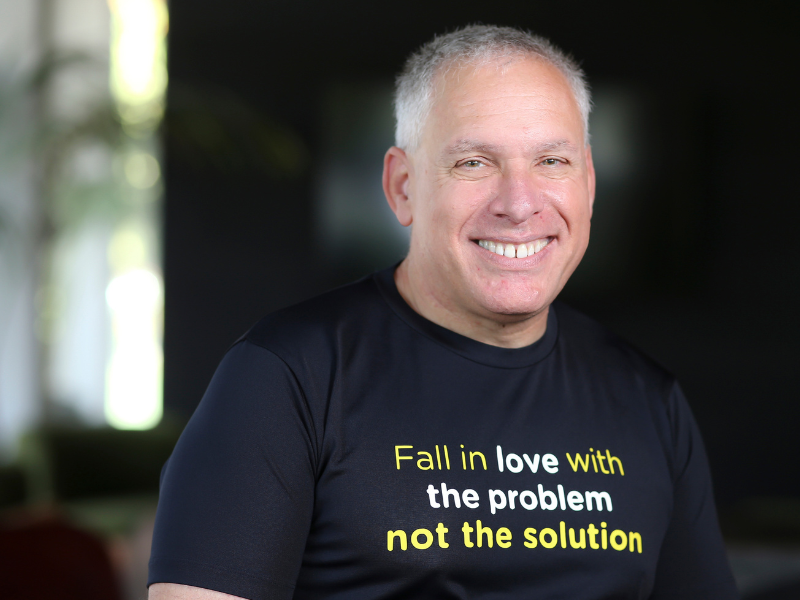
A serial entrepreneur turned investor turned teacher, Levine now spends much of his time mentoring founders, coaching CEOs and lecturing at universities. He has also distilled his approach into Fall in Love with the Problem, Not the Solution: A Handbook for Entrepreneurs, designed to guide others as they build highly valued firms. The book draws directly on Levine’s experience, offering readers access to his advice and hard-won lessons.
Some of his key takeaways: focus on the problem, stay close to the people building the solution, and be prepared to make uncomfortable decisions early.
Asked what consistently separates founders who succeed from those who don’t, Levine says: “There are very few behaviours that really make the difference,” he says.
The first is persistence. “Never give up. Never leave.” Building a company, he argues, is not about avoiding failure but surviving it. “As long as you keep going, you will keep failing. That’s part of the journey.”
The second is decision-making, particularly when it’s uncomfortable. Founders often know early on when something isn’t working, but delay acting. “People don’t like to make hard decisions,” Levine says. “But if the CEO doesn’t make them, you end up keeping people who shouldn’t be there.”
To counter that instinct, he advises a simple rule. “When you’re hiring someone new, put a reminder in your calendar for 30 days later and ask yourself one question: knowing what you know today, would you hire this person again?” If the answer is no, he says, “then fire them.” Waiting longer only makes the decision harder and more damaging.
“If the answer is yes,” he adds, “tell them they’ve exceeded your expectations. And give them more equity.” Clarity, in either direction, is what keeps organisations healthy.
The third behaviour, Levine says, is leadership, not as a title, but as a set of actions. “It’s about building awesomeness into the organisation,” he says. “That means creating an environment where strong people stay, trust each other and adapt as the company evolves. If the management team trusts each other, they’re strong. If they don’t, nothing else matters.”
Adaptation is a theme Levine returns to when talking about technology, particularly AI. Waze itself, he notes, was built on AI long before many people had even heard the term. What’s different now is the pace and scale of change. “You can do a job today five to ten times faster using AI,” he says. “If you’re not using it, you will lose to your competition, regardless of the space.”
Still, Levine is cautious about over-promising. For now, he believes the most effective systems are supervised – AI that accelerates work but remains under human oversight. That balance, he says, will evolve over time, much like autonomous vehicles. “Ten years ago, everyone was talking about self-driving cars. Now we’re seeing the beginning of it and in ten years’ time, all cars will be driverless. There’s no doubt we’ll have fewer casualties on the road because of it.”
When it comes to scaling globally, Levine is equally pragmatic. Many founders, he says, default to the biggest markets first, usually the US or the UK, without appreciating how competitive they are. “The UK is not easy to win,” he says. “Competition is high, customer acquisition is expensive, and it’s hard to be successful.”
Instead, he often advises starting in markets where it’s easier to gain traction and learn quickly. “Pick a market that’s easier to win,” he says, pointing to countries such as Spain, Italy, Mexico or Brazil. “Build there first, then expand.”
These days, Levine divides his time between Madrid, Israel and the rest of the world, moving between boardrooms, lecture halls and meeting rooms, alongside time with his family. A father of five, the Waze co-founder shows no signs of slowing down, remaining driven by a desire to create value and make a difference.
“I don’t want to stop,” he says. “My purpose is about value creation.”
Even after building and selling two unicorns, Levine remains firmly focused on the journey ahead and on helping the next generation of founders find their way.
Uri Levine is the founder of Waze and author of Fall in Love with the Problem, Not the Solution: A Handbook for Entrepreneurs