

 BBC News
Borrowing was £17.4bn last month, the second highest October figure since monthly records began in 1993.
Christopher Jackson
It is the Global Conference for Media Freedom in London, July 2019. Amal Clooney approaches the podium, her presence commanding the attention of government ministers, diplomats, and journalists from around the world. When she speaks, her voice carries the weight of years spent in the world’s most challenging courtrooms.
“I am a human rights lawyer,” she begins, her tone steady but urgent, “and my work has shown me that advocacy for human rights is often a fight for the next generation. It is not just about the here and now – it is about whether the people who come after us will live in freer, safer societies, or whether we will allow those freedoms to be eroded under our watch.”
Her tone sharpens as she pivots to the heart of her address. “In many countries, journalists are being jailed, harassed, or even killed for doing their jobs,” she says, scanning the room. “Without a free press, there can be no democracy, no accountability, no lasting peace. Without truth, the powerful will never be held to account, and injustice will spread – quietly, efficiently, and often irreversibly.”
The hall is silent. These are not the platitudes of a politician; they are the convictions of someone who has stood beside the accused, the exiled, and the silenced, and argued for their freedom in front of the world’s most formidable legal bodies.
At 47, Amal Clooney has argued before the International Court of Justice, challenged dictators in global tribunals, and fought for the release of political prisoners whose names the world might otherwise never know. There’s a strong case for her being the most famous lawyer alive – though she is not famous only, or even predominantly, for being a lawyer.
Hers is a complex story about fame and substance. Tina Fey once summed up the paradox at the Golden Globes: “Amal is a human rights lawyer who worked on the Enron case, was an adviser to Kofi Annan on Syria, and served on a UN commission investigating violations of the rules of war in Gaza—so tonight her husband is getting a lifetime achievement award.” The line worked because it inverted the usual celebrity dynamic, making George the “plus-one” to his far more globally consequential spouse.
But the paradox runs deeper. Amal Clooney’s work is rooted in moral seriousness, yet she inhabits a public sphere that thrives on glamour, fashion spreads, and red carpets. The psychology of this is intricate: she must carry the weight of defending those whose lives hang in the balance while existing in an industry space that can, at times, feel shallow by comparison.
For Clooney, celebrity is both a burden and a weapon. It subjects her to a level of superficial scrutiny that might derail a lesser figure, but it also grants her a megaphone powerful enough to influence international conversations. In her hands, fame becomes a vehicle – not an end in itself – to advance causes that dwarf the allure of any Hollywood premiere.
As she concluded that day in London, her voice softened but lost none of its force. “If we do not stand up for journalists today, we will lose the battle for truth tomorrow. And once truth is gone – when facts are drowned out by propaganda – there is no way back.”
The applause that followed was long and loud, but her expression remained steady, even solemn. Clooney is one of those people both ubiquitous and in some way mysterious. She is known of far more than she is really known. So who is she really?
Displacement and Upbringing
Let’s start with the facts. She was born Amal Alamuddin in Beirut in 1978, her earliest years were shaped by war and the disorienting experience of displacement. When she was just two, her family fled the escalating violence of the Lebanese Civil War, leaving behind their home, extended family, and the life they had built in Lebanon. They resettled in Gerrards Cross, a well-heeled suburb of Buckinghamshire. Compared with the chaos they had left behind, their new life offered comfort and stability – her father, Ramzi, was an academic, and her mother, Baria, a respected political journalist. The family’s home was a far cry from the refugee experience of poverty and uncertainty that so many others endured.
In some sense it was a lucky escape. But this relative privilege did not shield Amal from the emotional reality of being uprooted. Her parents’ decision to leave was born from necessity, not choice, and Amal grew up aware that the safety and prosperity of their British home came at the cost of the loss of a homeland. Cousins recall that she adapted quickly, throwing herself into school and excelling academically, but also that she carried an early curiosity about the wider world.
Her later life in Britain alongside George Clooney, in another quiet and affluent village, echoed those early years in Gerrards Cross. There was a certain continuity: safe surroundings, a measure of privacy, and the ability to live globally while rooted in a place that offered calm. But the through-line was not simply wealth. Her advocacy for press freedom, in particular, carries a personal dimension. Growing up as the daughter of a journalist, Amal saw first-hand both the value and vulnerability of those who pursue the truth. Her mother’s career meant she understood the courage it takes to challenge powerful narratives. When she stands before ministers and diplomats calling for the protection of reporters, she is not speaking in the abstract.
It’s clear that in the Alamuddin household, ideas were currency and debate was a daily ritual. Baria, Amal’s mother, was not the kind of journalist who softened her opinions to please her audience: this is fearless street-fighting journalism. Her columns took aim at corruption, sectarianism, and authoritarianism with the precision of someone who knew the stakes were not academic – they were life and death. She wrote unflinchingly about Hezbollah’s stranglehold on Lebanon (‘should be banished from politics altogether’), the way its corruption and parallel systems bled the country dry while ordinary people went without medicine. In other essays she railed against the erosion of secular democracy in places like India, and was highly critical of the recent 2024 election under Narendra Modi.
All of this meant that, even as a child in the quiet safety of Gerrards Cross, she grew up in a home where the news was not background noise but the pulse of daily life. It was a household in which the world’s conflicts were never comfortably “elsewhere” – and where the duty to confront them was assumed, not exceptional.
Early Education
Amal attended Dr Challoner’s High School, a selective girls’ grammar school in Buckinghamshire known for its high academic standards. People we spoke to for this piece remember her as exceptionally bright, combining natural intelligence with a disciplined work ethic. Former classmates describe someone who excelled in the classroom but also had an instinctive ease in front of an audience – whether delivering a debate or stepping onto the stage for a school production. One recalls a play in which Amal, with just a subtle gesture, seemed to draw every eye in the hall; another notes that she had a way of asking questions that cut to the heart of the issue, even as a teenager.
From there, she progressed to St Hugh’s College, Oxford, to read jurisprudence. Friends from those years tell us she was equally at home buried in case law or in lively conversation over coffee, her charm and quick wit making her a natural connector of people. Tutors recall her not just learning the law but testing it – asking how it applied to real lives, and whether it could be made better.
After Oxford, she crossed the Atlantic to New York University School of Law for her Master of Laws degree, serving as editor of the NYU Law Review. In New York, she came under the mentorship of leading figures including Judge Sonia Sotomayor (then on the U.S. Court of Appeals) and Judge Gerard Lynch, experiences that would help shape her approach to the most complex and high-stakes cases of her later career.
Her early career took her to Sullivan & Cromwell, one of New York’s most prestigious law firms. It was a rare associate position at a highly prestigious New York firm – an uncommon feat for a foreign LLM graduate. At the time, this firm was at the forefront of white-collar criminal defence, and for Clooney, it quickly became both a proving ground and a turning point. One partner there, Samuel Seymour, recalls working closely with her on the high-profile Enron and Arthur Andersen cases, including representing David Duncan, an Arthur Andersen partner and government witness in the Enron prosecutions.
After that she moved to the International Court of Justice in The Hague as a judicial assistant – an experience that would prove crucial to her understanding of how international law could be used as a tool for justice.
Now, decades later, she returns to that educational foundation as a visiting professor at Columbia Law School. Speaking there in 2019, she emphasized her belief that systemic change requires systematic monitoring: “We measure corruption by governments, but not courts.”
To understand Amal Clooney’s approach to international human rights law, it’s essential to understand the institution that has been her professional home for over a decade since she joined in 2010: Doughty Street Chambers. Founded in 1990, Doughty Street has established itself as one of the world’s leading human rights chambers, with barristers who have appeared in landmark cases before courts around the globe.
The chambers’ approach to human rights law is distinctive. Rather than simply representing individual clients, Doughty Street barristers see themselves as part of a broader movement to strengthen international legal frameworks and expand access to justice. This institutional philosophy has shaped Clooney’s career and enabled her to take on cases that other lawyers might avoid.
Meeting George
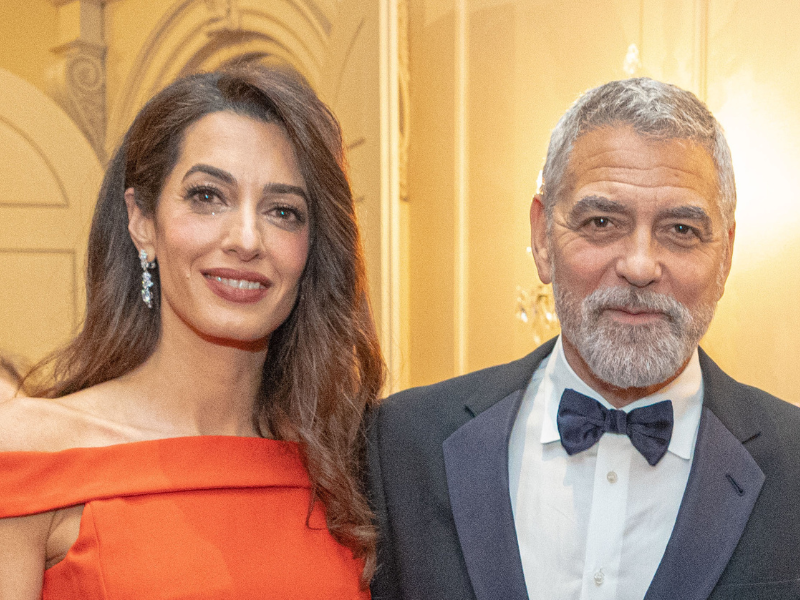
But no matter how successful Amal was, nothing, one suspects, could prepare her for the impact of meeting her future husband. At the time, George Clooney was not simply famous – he was one of the most recognisable men on the planet, as he still is. An Oscar-winning actor, a director, a producer, and a committed humanitarian, he had been a leading man in Hollywood for decades, named “Sexiest Man Alive” twice by People magazine, and was known from Los Angeles to Lagos, from Tokyo to Turin. His face was synonymous with blockbuster films, his name shorthand for charm and wit. For years, he had been the gold standard of the global bachelor – until Amal walked into his life.
Here’s how it happened. In July 2013, she was passing through Lake Como when a mutual friend casually called: “‘I’m stopping by,’” George later recalled, “‘and can I bring my friend?’” And he simply thought, “Of course.” What felt at first like an ordinary evening – two professional lives casually converging over wine and conversation – quickly turned into something unforgettable. “The wildest thing,” George would say, “my agent called me beforehand and said, ‘I met this woman who’s coming to your house, who you’re going to marry.’”
He painted the scene vividly: “The funniest thing was my mom and dad were visiting, so my parents were there, and we just talked—and we stayed up all night talking.” It wasn’t a tabloid whirlwind so much as a quiet inevitability. Those who know them say it was clear from the start that this was not going to be a passing flirtation.
That night marked the beginning of a relationship that would thrust Amal into a scale of fame unlike anything she had known. Friends say she met the spotlight with characteristic strategy and grace. Invitations now came not just from legal circles and UN institutions, but to galas and premieres, where whispers followed her into every room. Yet where some might have been consumed by the glare, she turned it outward – using it to illuminate her work. Her messaging became sharper, the causes more visible. And while celebrity brought scrutiny – with a sort of wearisome predictability to her wardrobe, her speeches, her pauses – it also undeniably magnified her voice.
Colleagues would later reflect that the marriage gave her an extraordinary opportunity to bring legal arguments and human rights narratives into living rooms that would never notice a law journal. But she never let glamour dilute substance: “She never allowed the glamour to overshadow her work,” an associate observes. “Instead, she made the glamour serve it.”
Perhaps Amal is the sort of person for whom a privileged life only increases the urgency of fighting for those whose lives lie at the opposite end of the spectrum.
The Dark Reality
At the centre of her career is the importance of press freedom. The statistics she shared at the Global Conference for Media Freedom paint a stark picture of the current global landscape for press freedom. “In the last 18 months, over 100 journalists and media workers have been killed. India and Brazil, two of the world’s largest democracies, have some of the highest murder rates. And the vast majority of these murders have gone unpunished.”
Her words carry particular weight because they come from direct experience. “I am a witness in my legal practice to the challenges faced by journalists. I have represented journalists targeted by their governments for reporting corruption and human rights abuses from Azerbaijan to the Maldives, to Cairo.”
The urgency in her voice becomes evident as she describes the broader implications: “Yet today, journalists are under attack like never before. They are dying not only while covering wars – but because they are being targeted for exposing crimes committed in war and for speaking the truth about abuses of power in peacetime.”
One case that exemplifies both the challenges facing journalists and Clooney’s approach to international advocacy is her work starting in 2018 representing Reuters journalists Wa Lone and Kyaw Soe Oo in Myanmar. She joined the case in 2018, after the two journalists had been arrested in December 2017 and charged under the Official Secrets Act. The case, as she described it at the Global Conference, revealed the extent to which authoritarian governments will go to silence critical reporting.
“Over the past year I have also spent hundreds of hours working on the defence of Reuters journalists Wa Lone and Kyaw Soe Oo, heroic young reporters imprisoned in Myanmar for allegedly violating the Official Secrets Act after they wrote an article about the execution of 10 Rohingya men by security forces.”
The circumstances of their arrest, as Clooney detailed, read like something from a spy thriller, except the consequences were devastatingly real: “The government’s treatment of the journalists was so outrageous it is hard to believe: the phone rings one evening at the Reuters office; a police officer asks the journalists to meet at a café; when they walk into the café the officer hands them rolled-up documents; when they walk out they are arrested for espionage.”
What followed revealed the true nature of the government’s intentions: “When the journalists were in custody the police did not even pretend to be interested in supposedly secret documents they were carrying; they asked only about the sources for their Rohingya report, offering to drop the charges if Reuters dropped the story,” Clooney continues.
The case’s resolution highlighted both the persistence required in human rights work and the ultimate vindication that can come from sustained advocacy: “It took over a year to secure a pardon for the journalists. But on the 6th of May, they walked out of the prison gates to be reunited with their wives and baby daughters, one of whom had been born while her father was in prison. And six weeks ago they went to New York to collect a Pulitzer Prize for that Rohingya report.”
It’s important to note that in this instance, Clooney was part of an international team of lawyers working on the defence, collaborating with Myanmar counsel and Reuters’ in-house legal team. While she did not work alone, she played a visible, strategic role – coordinating the legal arguments for their appeal, liaising with diplomatic channels, and using her profile to keep the case in the global spotlight.
Those close to the case describe her as combining the precision of a seasoned barrister with the instincts of a campaigner; she could pore over legal minutiae one moment and, in the next, deliver a compelling public statement that cut through the noise of international politics. Legal directories have described her as “a brilliant legal mind” and “in a league of her own at the Bar,” with advocacy that is “crystal clear in focus and highly persuasive.” One review summed her up as “a leader on every case she is involved in, and a master strategist and compassionate advocate for the most vulnerable.” It is true of course that the legal directories always such things, but even so – nobody has ever doubted her capacity and skill.
For young lawyers, cases of this kind show the many possible entry points into human rights advocacy. Some start in corporate law before pivoting to pro bono or NGO work; others go directly into international organisations or press-freedom groups. Clooney herself has said that opportunities exist not just for barristers and solicitors, but for those skilled in research, documentation, diplomacy, and media strategy – all of which can be decisive in winning justice in politically charged cases. The lesson from Myanmar is that success can require both the patience to work within the system and the creativity to pressure it from the outside.
The Case of Maria Ressa
Clooney’s more recent work representing Filipino journalist Maria Ressa – a case she joined in 2019 – demonstrates her continued commitment to defending press freedom in increasingly challenging circumstances.
Ressa’s case exemplifies how award-winning journalism can make practitioners targets for government persecution: “More recently I have been appointed as counsel for another award-winning journalist, Maria Ressa.” So what were the facts of that case? “Ms Ressa was CNN’s bureau chief in Jakarta and Manila before she teamed up with three other women to set up an independent news site. Their site, Rappler.com, quickly became one of the leading online news portals in the Philippines, known for its hard-hitting stories about human rights abuses under the administration of President Rodrigo Duterte.”
The government’s response to Ressa’s journalism reveals the lengths to which authoritarian leaders will go to silence criticism: “Last year, Ms Ressa was one of four journalists named Time Magazine’s Person of the Year for taking ‘great risks in pursuit of greater truth’. The government’s response has been to arrest her and initiate a series of civil and criminal cases that expose her to a maximum sentence of 63 years in prison.”
This case illustrates what Clooney identified as a cruel irony of contemporary human rights work: “The Maria Ressa case in the Philippines, like the Reuters case in Myanmar, exposes a cruel irony that I see time and time again in my work: journalists who expose abuses face arrest, while those who commit the abuses do so with impunity.”
As with the Reuters case, the legal battle stretched on for years, spanning multiple charges designed to keep Ressa and Rappler under constant pressure. Amal Clooney’s role was both strategic and public – assembling an international legal team, working with press-freedom organisations, and keeping the case in the headlines through high-profile advocacy at the UN and in media interviews.
In January 2023, the first major breakthrough came: the Philippine Court of Appeals acquitted Ressa and Rappler of tax evasion charges, eliminating the possibility of a lengthy prison sentence in that case. Later that year, in September 2023, another court dismissed the final remaining tax case, marking a decisive legal victory. While some politically motivated cases – most notably a cyber-libel conviction – remain under appeal, the collapse of the tax cases was widely seen as a vindication of Ressa’s defence and a rebuke to the government’s campaign against her.
Ressa herself credited her legal team and the global coalition supporting her for helping to secure those wins, saying the rulings sent “a message not just to the Philippines but to the world that journalists will not be silenced.” It is also fair to say that Amal’s marriage to George Clooney and the name recognition it brings have played a role in building the kind of visible, international coalition that can sway outcomes in cases like this.
Her profile meant the Ressa case could leap from legal filings into front-page headlines, drawing attention from world leaders, diplomats, and celebrities who might otherwise never engage with press-freedom issues. Colleagues note that she has been careful to use that spotlight deliberately – ensuring that when the cameras turn toward her, they illuminate her clients’ stories first. In this way, the “Clooney” name has become not a distraction from her work, but a force multiplier for it.
The Clooney Foundation for Justice
Amal’s work in Myanmar and the Philippines showed what could be achieved when a single case is fought with persistence and global attention. But for Clooney, those high-profile cases were also reminders of the limits of a case-by-case approach. For every journalist whose name reached the headlines, there were countless others tried and silenced without ever making the news.
It was in part to address that imbalance that she and her husband George established the Clooney Foundation for Justice in 2016. From the outset, it was positioned not as a vanity project but as a serious, strategic organisation aimed at tackling systemic human rights abuses. The foundation’s approach combines legal intervention, strategic litigation, and public advocacy, with an emphasis on sustainable, structural change rather than one-off victories.
One of its most ambitious undertakings is TrialWatch, a programme that sends trained monitors – often local lawyers or NGO partners – to courtrooms around the world to document proceedings that may violate international fair-trial standards. These monitors file detailed reports which are then reviewed by expert legal panels. The findings are used both to challenge unjust convictions and to build a database identifying patterns of abuse.
Some cases are small in scale but emblematic of wider failings. In Zambia, TrialWatch monitored the prosecution of opposition leader Hakainde Hichilema on charges of treason after a traffic incident involving the presidential motorcade. Observers found serious breaches of due process, and international attention helped ensure the charges were dropped. In Cameroon, TrialWatch documented the trial of journalist Samuel Wazizi, who was arrested for reporting on separatist unrest. Wazizi died in military custody, and the monitoring reports became part of the evidence used by press-freedom groups to demand accountability from the government. In Egypt, TrialWatch reported on mass terrorism trials where hundreds of defendants were convicted on identical charges in proceedings that fell far short of international standards.
The foundation also runs a Waging Justice for Women initiative, which supports strategic litigation to reform discriminatory laws – ranging from child marriage statutes to laws that make it harder to prosecute gender-based violence. In Malawi, for example, the foundation’s legal support has been part of successful challenges to laws enabling child marriage, leading to stronger statutory protections for girls.
Education is another pillar: the foundation funds scholarships, training workshops, and mentorship for young lawyers in regions where human rights expertise is scarce. In partnership with universities and local bar associations, these programmes aim to create a pipeline of advocates who can sustain reform long after international attention has moved on.
The impact has been tangible, but not without criticism. Some observers have noted that high-profile cases backed by the foundation tend to attract disproportionate resources compared to less-publicised abuses. Others question whether the Clooney name, while undeniably useful in drawing attention, risks overshadowing the work of local activists. Amal has responded by emphasising that the foundation’s model is built on partnerships with grassroots organisations, and that visibility is a tool, not a goal in itself.
In its short lifespan, the Clooney Foundation for Justice has built a track record that is unusually robust for a celebrity-founded organisation – combining star power with the kind of rigorous, technical human rights work more often associated with long-established NGOs. In this sense, the arc from Myanmar to Manila to the global monitoring of TrialWatch is not a change in mission but a widening of scope: from defending individuals to confronting the systems that threaten them.
Building a Career of Impact
For young professionals aspiring to build careers that combine excellence with impact, Amal Clooney’s journey offers a model of purpose-driven success. Her path demonstrates that making a difference on a global stage doesn’t come from charisma alone, but from a deep and deliberate investment in competence, culture, and courage.
Equally critical to Clooney’s impact is her global fluency. Her career has been international in every sense, requiring her to operate across legal systems, languages, and cultures. Fluent in English, French, and Arabic, and trained in both common law and civil law traditions, Clooney exemplifies the kind of multicultural and multilingual competence increasingly required in today’s interconnected world. Her ability to move fluidly between jurisdictions and cultures has not only expanded her reach but enhanced her credibility in diverse contexts.
Another hallmark of Clooney’s success is her strategic networking. Throughout her career, she has cultivated relationships with professionals who share her values – barristers, activists, journalists, academics, and political leaders – creating a broad and deep support system for her work. These alliances have not been accidental; they have been carefully built to enable collaboration on complex, global issues that no one can tackle alone.
Clooney has also shown a willingness to take calculated risks. Many of the cases that defined her career involved uncertain outcomes and significant professional jeopardy. But they were also morally urgent. Perhaps most notably, Clooney has demonstrated how to use platforms wisely. In an age where media visibility is often conflated with vanity, she has used her profile with uncommon discipline. She doesn’t chase the spotlight for its own sake. Instead, she leverages attention to spotlight others: the victims, the forgotten, the vulnerable. In doing so, she offers a masterclass in how professionals – even those outside the legal field – can harness visibility not for ego, but for impact:
Clooney explains: “With authoritarianism, isolationism and nationalism gaining ground, the relevance of international institutions and respect for international norms are seriously in question. I believe it is this crisis of the international rule of law that makes this initiative compelling. It is compelling not because the international system works; but because it is broken.”
So what does she advocate as the way forward for young people: “So we need to think outside the box. We need groups of like-minded states that will move forward on one issue, even if they are paralysed on others. That is why I am supporting this campaign, and I look forward to working with many of you here to see what we can achieve.”
Amal Clooney’s legacy is still being written, but its outlines are already clear: a career that has advanced international justice, strengthened legal frameworks for protecting human rights, and inspired a new generation of advocates to take up the work. In a world where justice often seems elusive and progress uncertain, she has demonstrated that committed individuals can make a difference – one case, one client, one victory for justice at a time.