



 BBC News
Borrowing was £17.4bn last month, the second highest October figure since monthly records began in 1993.
Christopher Jackson
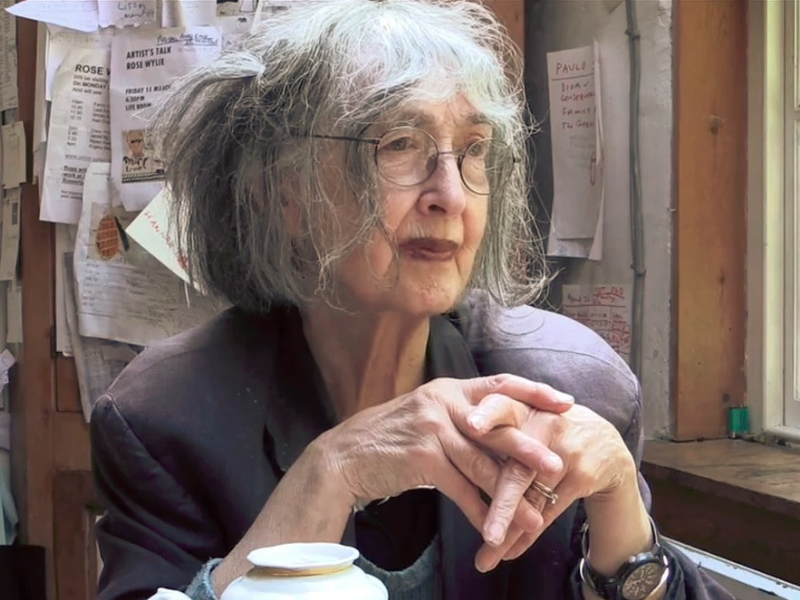
I once spent an afternoon with Rose Wylie at her cottage in Kent. This was some years ago, when she was already in her mid-eighties and had only recently become famous — a sequence of events which, in itself, tells you almost everything you need to know about her. The garden, I remember, was aggressively untamed. This was not neglect but philosophy. “I like wild daffodils,” she told me. “They grow and you can leave them alone; you don’t have to nurture them – they’re completely glorious.” It seemed, at the time, a precise description not just of her garden but of her art: something that had been left to grow in its own direction, stubbornly, gloriously, without reference to what the neighbours might prefer.
What I remember most vividly, though, is this: she stood for the entire interview. Not briefly, not for the first half hour while we warmed up, but for the whole two hours — standing among the canvases in her studio, under the rafters, on a floor covered in newspaper to catch the falling paint. I was, by the end, considerably more tired than she was. She was in her mid-eighties. I was not.
I thought of that afternoon recently, standing in the Royal Academy’s main galleries, where Wylie’s largest ever exhibition – The Picture Comes First – has taken over the whole space. She is 91. She is the first British female painter ever to have been given a solo exhibition in the RA’s main galleries. That fact is worth sitting with for a moment: the Royal Academy was founded in 1768. It has taken two hundred and fifty-eight years to get here. The delay tells us something about the institution, certainly. But it also tells us something about Wylie – about the particular, obstinate, entirely her own trajectory that her career has taken, and about why that trajectory matters to anyone thinking seriously about how a life can be lived and what a career can look like.
The exhibition brings together more than ninety paintings and works on paper, tracing a practice that spans four decades of sustained, peculiar, exhilarating work. Walking through it, you are struck first by the scale – the canvases run almost the full width of the walls, figures tilt and lean across enormous surfaces of unprimed canvas, words are written directly into the paint in Wylie’s signature block capitals. Then you are struck by the energy. The RA’s gilded cornices and marble busts provide a setting that should, by rights, seem incongruous with Wylie’s cartoonish anarchism. Instead, somehow, it works: the grandeur of the rooms becomes a kind of joke that the paintings are in on.
To understand why the Rose Wylie story matters to readers of Finito World, you need to know the life behind the art. It is, in outline, familiar enough: a talented woman trained, diverted, returned, and eventually recognised. But the specifics are extraordinary.
Wylie was born in 1934 in Hythe, Kent. She studied at the Folkestone and Dover School of Art in the early 1950s, learning anatomical drawing and figurative painting in the old-fashioned way. In 1957 she married the painter Roy Oxlade, and for the next several decades her own painting largely stopped. She raised three children. Her husband’s career continued; hers did not. This is not an unusual story for women of her generation, which is precisely what makes it worth examining — the sheer ordinateness of the sacrifice, the way it was made not dramatically but by a thousand small accretions of domestic necessity.
In the mid-1970s, in her early forties, she began returning to her practice. And in 1981 — when she was forty-six years old — she completed an MA at the Royal College of Art. Her dissertation, characteristically, was on the language and status of drawing. She was not a student making a late start. She was a serious artist who had already formed her sensibility, and who was now returning to it with the kind of focus that only the experience of having had it taken away can produce.
What happened next was a very long slow burn. Through the 1980s and 1990s, Wylie worked. The paintings accumulated. A first major series — Room Project, made between 2002 and 2003 — began to attract attention: large canvases in which cats, paper dolls, Olympic swimmers, and figures from her own life drifted across expansive surfaces. The scale was there, the looseness was there, the peculiar vividness was there. But the world was not yet paying attention in the way that the work deserved.
Recognition, when it came, was sudden and comprehensive. In 2010, she was the only non-American artist included in Women to Watch at the National Museum of Women in the Arts in Washington. In 2012, a retrospective at the Jerwood Gallery in Hastings. In 2013, a BP Spotlight show at Tate Britain. In 2014, election as a Senior Royal Academician. By the time I met her, she was selling work for six figures, P. Diddy owned a painting, and Germaine Greer was a public admirer. Roy Oxlade — her husband, the painter who had been better known for most of their marriage — died in 2014. Rose Wylie continued.
The show opens with a group of works drawn from Wylie’s childhood memories of the Blitz. In Park Dogs & Air Raid, oversized dogs stalk Kensington Gardens while Spitfires and Messerschmitts lock in combat overhead. The word “doodlebug” recurs across several canvases — the British nickname for the German V-1 missile, and a perfect example of Wylie’s instinct for the way language can defang terror by making it sound absurd. She grew up in Hythe, in Kent, and there is something very specific and very English about the way she processes history: not with solemnity, but with a kind of amused, slightly incredulous attention.
From the wartime rooms, the show moves through the full range of her preoccupations. A series of four canvases depicting Nicole Kidman on a red carpet — the actress’s backless dress rendered in Wylie’s deliberately flat, deliberately imprecise style — shares space with Peter Crouch, Thierry Henry, and the Duke and Duchess of Argyll. Her Film Notes series, tracking her obsession with cinema, features scenes from Kill Bill and Inglorious Basterds processed entirely through memory and reassembled according to their graphic force rather than their narrative logic. Lilith — the mythological figure she has labelled “the first feminist” — appears alongside a Gucci fashion show attendee. The juxtapositions are not random. They follow the logic of a very particular and very alert mind, one that sees connections and rhymes and collisions where most of us would see only category distinctions.
One of things she told me all those years ago was her particular dislike for Leonardo da Vinci, and every room tells us that the Renaissance possibly shouldn’t have happened – and maybe so far as Wylie is concerned, didn’t happen. It is as if by describing in any faithful way we start to do violence to the quiddity of our own perception and our own memory of that perception.
It’s an interesting insight – sometimes I wonder looking at Wylie if it’s definitely true. A treacherous thought occasionally enters my head, which reminds me of an indignant Larry David asking in an episode of Curb Your Enthusiasm of a modern artist: “If I can do it, is it art?” That’s the treacherous thought which pursues me through the hallowed halls of the RA: “I think I can do this”. Against that notion, jostling with it, is the knowledge that I didn’t; Wylie did.
The show closes with four large monochrome animal paintings, made by applying paint directly with her hands. A bird, a lemur, an elephant, a horse — the names written loosely beneath each figure, almost as if she doesn’t quite trust the image to identify itself. The surfaces are thick and physical, and the effect is one of blunt, unapologetic presence. The image comes first. Meaning follows later, if at all.
The curator Katharine Stout has described the goal as letting the work shine, and largely it does. The word most heard at the opening was “exuberance” — and while that is accurate, it risks underselling what Wylie actually achieves. The Financial Times put it better: it is her ability to create collisions between wildly different things that is most remarkable, and most likely to take up permanent residence in your mind. You leave the RA in a better mood than when you arrived. For a painter, this is not a small thing.
So what does the Wylie story essentially amount to? It is not simply that she is old and still working, though she is. It is not simply that she became famous late, though she did. It is that her lateness is inseparable from her particular quality as an artist — from the thing that makes her work what it is. Had Wylie not spent those decades raising children, not returned to her practice in her forties with the experience of a full life behind her, not developed her art quietly and stubbornly across two decades before the world decided to pay attention, she would not be the artist she is. The work is what it is because of the life, not in spite of it.
Consider what she brings to the canvas. Her cast of characters spans Elizabeth I and Nicole Kidman, Marilyn Monroe and Serena Williams, Snow White and Lilith. She has lived through the Blitz, through the postwar reconstruction of Britain, through the sexual revolution and second-wave feminism, through the collapse of the art market and its various subsequent reinventions. She watched her husband’s career flourish while her own was paused. She returned. She remembers everything, and everything is available to her paintings: “I can pick up images all the time,” she has said, “because of newspapers and photography and art books.” This is not the art of a young person discovering the world. It is the art of someone who has had the world for a very long time and is not remotely finished with it. It’s the same energy which insisted on standing all those years ago when I wanted to sit.
“You have to know where to start, where to go on, and where to stop,” she told me, that afternoon in Kent. “It’s very difficult to do something like this when 99 per cent of the world will say, ‘What’s she doing? It’s ghastly!’”
This is the kind of artistic courage that is very difficult to sustain without a certain depth of self-knowledge — without having lived enough to know what you believe and to be willing to act on it even when most of the world would prefer you didn’t. It is the courage, specifically, of someone who has waited long enough that the opinions of others have lost some of their power.
Rose Wylie: The Picture Comes First ran at the Royal Academy of Arts, Burlington House, Piccadilly, London W1J 0BD, until 19 April 2026.