



 BBC News
Borrowing was £17.4bn last month, the second highest October figure since monthly records began in 1993.
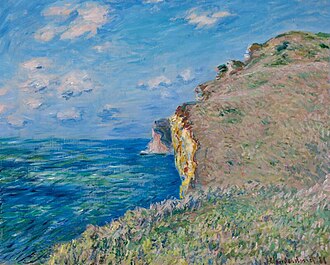
A hundred years after Claude Monet’s death, the water lilies still ask us to look – and, looking, to care, writes Robert Golding
I was perhaps nine when my mother and father took me through the National Gallery on a wet Saturday, steering me past the gold-leaf saints and the brown Dutch interiors towards the rooms where the light seemed to change. He stopped me in front of The Water-Lily Pond: a small arched bridge over a pool so thick with green, violet and silver that it seemed less painted than grown. I remember the sensation exactly, because it was the first time a picture altered my sense of what was possible. Colour, until then, had been a fixed and practical thing – the red of a bus, the grey of the river. Here was colour that drifted and dreamed, that seemed to belong to the inside of a thought. I had not known the world was permitted to look like that.
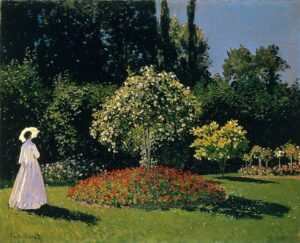
Over time I have come to feel that Monet is less a painter of things than of the moment before things are named – the instant when a willow is not yet a willow but a cascade of blue-green light. He died at Giverny on 5 December 1926, at the age of eighty-six, and the centenary is being kept across two continents. In Tokyo, the Artizon Museum opened the commemorations in February with Questioning Nature, hanging Monet beside the ukiyo-e prints he loved. In Normandy, the Musée des impressionnismes at Giverny returned the paintings of his first years in the village to the valley where they were made, and Le Havre gathered the work of his boyhood. This autumn in Paris, the Musée de l’Orangerie has opened Monet, Painting Time, while the Musée Marmottan Monet traces his long inheritance from the 1890s to David Hockney. On the anniversary itself, flowers will be laid at his grave.
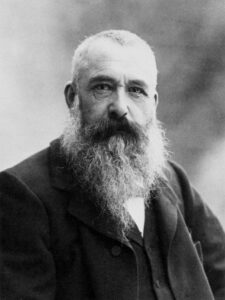
The life is easily told and hard to imagine. Born in Paris in 1840 and raised in Le Havre, the young Oscar-Claude sold caricatures of the town’s worthies until the painter Eugène Boudin coaxed him out of doors to paint the sky directly. In Paris he fell in with Renoir, Bazille and Sisley, and was poor for decades, writing begging letters to friends while producing some of the most radiant canvases of the century. War in 1870 sent him to London, where he looked hard at Turner and Constable and painted fog on the Thames. In 1874 he showed a hazy view of Le Havre harbour, Impression, Sunrise, and a mocking critic gave the movement its name. His first wife, Camille, died in 1879; he painted her on her deathbed and later confessed to his horror at finding himself noting the blues and yellows of her face even in grief. In 1883 he rented a pink house with green shutters at Giverny, and there, over forty-three years, he found his last and greatest subject. ‘My garden,’ he said, ‘is my most beautiful masterpiece.’
That garden was, in part, a Japanese print made real. Monet collected Hiroshige, Hokusai and Utamaro – more than two hundred sheets still line the walls of the house – and from them he learned to crop boldly, to tilt the ground towards the viewer, to let a single motif return through the seasons as Fuji returns in Hokusai’s views. He diverted a stream to dig his lily pond, planted bamboo and wisteria, and built a wooden footbridge painted green. Late in life he told a visitor that what he admired in the Japanese was an art that evokes presence through a shadow, the whole through a fragment. It is as good a description of his own late manner as any critic has managed.
What still astonishes is the speed. Monet painted against the clock of the sun. At Étretat, at Rouen, in the poppy fields, he worked with a row of canvases, moving from one to the next as the light shifted, sometimes for only minutes at a time. ‘Instantaneity’ was the word he used to the critic Gustave Geffroy in 1890, while labouring over the Haystacks: what he wanted was the envelope of light around a thing before it changed. The American painter Lilla Cabot Perry remembered his advice to forget what you were looking at and think only: here is a little square of blue, here an oblong of pink, here a streak of yellow. Cézanne’s famous remark – that Monet was only an eye, but, good God, what an eye – is usually read as a tribute to this swiftness of perception. Yet the speed was also a kind of illusion. Many of those fleeting impressions were worked and reworked in the studio for months. The swiftness is in the seeing; the labour is in keeping it alive.
I have never thought Cézanne’s phrase quite fair. ‘Only an eye’ suggests a painter without a heart, and no one who has stood before the Nymphéas could believe that. I sometimes wonder whether Cézanne, himself the prickliest of men, was gesturing at something else: the distance between the man and the work. For Monet was famously difficult. The household at Giverny lived by the barometer; when the light failed or rain spoiled a motif he would withdraw into black, silent moods, and the family learned to tread softly until the weather turned. His letters to Alice from the Normandy coast seethe at the clouds. In 1908 he postponed a long-awaited exhibition and destroyed canvases he judged unworthy, and over the years he scraped, slashed and burned many more. Even Clemenceau, his most loyal friend, wrote to him in exasperated anger in 1924 when Monet threatened to withdraw his gift to the nation. Yet out of this irascible, exacting, often wretched temperament came the most consoling pictures of the age. Perhaps that is the real shape of his career: a lifelong separation of the work from the life, so that everything troubled stayed on this side of the canvas and only the light passed through.
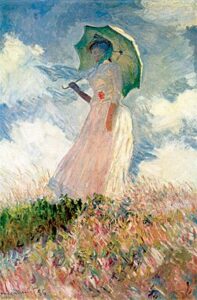
Across sixty years the work moved from description towards dissolution. The bright, legible boating scenes of Argenteuil gave way in the 1890s to the series – haystacks, poplars, the façade of Rouen Cathedral rendered thirty times like a cliff in changing weather – and then to the pond, which absorbed the last quarter-century of his life. Grief came thickly: his second wife, Alice, died in 1911, his son Jean in 1914. Cataracts clouded his sight until the reds turned muddy and the blues went dark; he submitted to surgery in 1923. Out of all this came the Grandes Décorations, panels two metres high whose surfaces are scumbled, scraped and flooded with colour. Kandinsky, encountering a Haystack in Moscow in 1896, had been unsettled to find he could not at first tell what it showed, and yet could not forget it. Sixty years later Clement Greenberg, in his essay on the later Monet, argued that the old man had arrived first at the open field of colour the New York painters were claiming as their own. ‘Colour,’ Monet confessed, ‘is my day-long obsession, joy and torment.’
Nowhere is that obsession more completely felt than in the two oval rooms of the Orangerie. Monet offered the panels to France the day after the Armistice of 1918, a gift for the peace arranged with his friend Georges Clemenceau; they were installed in 1927, months after his death. André Masson called the rooms the Sistine Chapel of Impressionism. To enter them is to step out of the noise of the Tuileries into a soft, diffused daylight and find that the walls have become water. There is no horizon. The banks are gone. You stand where the shore ought to be. Willow trunks rise at the edges like the pillars of a cloister, their fronds hanging over you, and in the reflected clouds you sense depths that are also heights. At moments you feel what lies just beyond the painted water – the next curve of the bank, the cooler air beneath the trees – and you seem to be almost at the lake, leaning out over it. Monet described precisely this ambition in 1909: he wanted ‘the illusion of an endless whole, of water without horizon or shore’, a refuge where nerves overstrained by work might rest, a place of peaceful meditation at the heart of a flowering aquarium.
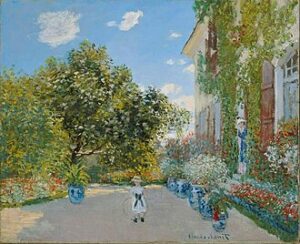
It is this that makes him, a century on, something like a prophet. Monet painted the Seine as it was being industrialised, railway smoke and all, before withdrawing into a paradise of his own making, tended by a team of gardeners. Yet that paradise was never complacent. It is all flux: weather, season, decay, regrowth. The curators at the Musée d’Orsay have framed this year’s commemorations around Monet’s idea of nature in an age of industry, and the question feels newly urgent. We live at a time when the natural world feels breakable, when the willow and the dragonfly and the clean pond are no longer givens. To stand inside the Nymphéas is to practise a different kind of attention – patient, unhurried, receptive – the attention that comes before love, and therefore before care. Monet does not lecture us about fragility. He lets us feel what it would be to lose it.
When Monet was buried at Giverny, Clemenceau is said to have pulled the black cloth from the coffin and replaced it with a flowered one: no black for Monet. I think of that often, and of my father, steering a small boy towards a painting of a pond. What he gave me that afternoon was not an opinion about art but a widening of the world – the discovery that colour could dream. A hundred years after the painter’s death, that is still the gift. The lilies open. The water holds the sky. And for a moment, in a gallery in London or Paris or Tokyo, we are almost at the lake.