


 BBC News
Borrowing was £17.4bn last month, the second highest October figure since monthly records began in 1993.
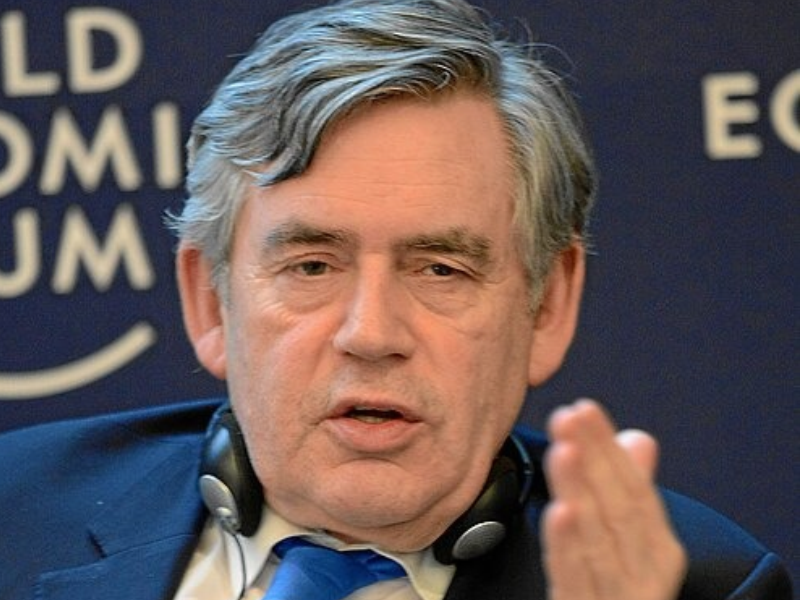
Gordon Brown
The world in which Britain must earn its living is changing fundamentally. We face an international environment that is more dangerous, more uncertain and more prone to the arbitrary exercise of power. Our response must begin with a clear understanding of those changes. It must also begin with confidence that we have something distinctive to contribute.
There are three seismic shifts taking place. Each affects our ability to grow as an economy. Each also affects our safety and security as a nation. We cannot frame an economic policy as though these changes were happening somewhere else, with little bearing on the choices we make at home.
The first is the move from a unipolar world, dominated by American hegemony, to a multipolar world. There are now multiple centres of decision making. There is no single world policeman, no one authority capable of controlling events. That brings greater instability and makes cooperation more difficult. Countries must work out how to protect themselves in circumstances in which power is more dispersed and decisions are less predictable.
The second shift is from a rules-based world towards a power-based world. There were always arguments about how consistently the old rules were observed. Some people would say that the liberal world order was neither sufficiently liberal, nor truly worldwide, nor particularly orderly. But there was at least support for principles that mattered: human rights, the rule of law, humanitarian aid, multilateral cooperation and environmental stewardship.
Those principles are now under pressure. The arbitrary use of power is becoming more prominent, and weakness is something that authoritarian leaders seek to exploit. I have met Vladimir Putin on a number of occasions. My experience is that he understands strength and will take advantage of weakness. We have to recognise the implications of that for the way countries deal with one another.
The third shift is from a world committed to free trade towards a more protectionist world. Global supply chains depend on countries remaining open and engaged in trade. They are complex arrangements involving many economies. When tariffs proliferate and decisions become unpredictable, the assumptions on which those arrangements were built are called into question. Businesses and governments have to respond to that uncertainty.
We will not simply return to the old world. But we can prevent a protectionist world from becoming worse, and we can work to improve it. We can insist that rules matter. Countries prepared to cooperate can agree a programme of action based on shared principles, even when the largest powers are unwilling to join them.
That is the case for what I call principles of cooperation. It does not require us to wait until every country agrees. It requires those willing to work together to do so. Without that unity, countries risk being played off against one another, responding separately to pressures they would be better placed to meet collectively.
We need to make that cooperation more concrete. Countries that regard the behaviour of Russia or China as unacceptable must consider what they can do together. The alternative is to leave each country to face pressure on its own. A shared programme of action offers a way to defend principles while also protecting the conditions for prosperity.
There are three practical questions for Britain in this environment. The first is how we protect ourselves against the weaponisation of assets controlled by other countries. What happens if a vital strait or another choke point in the world economy is closed? How do we respond if access to the processing of rare earths is cut off? What protection is available when financial power is used against a country?
These are questions about the shelter countries need in a less dependable world. They also point towards the importance of cooperation among middle powers. Countries facing similar vulnerabilities have reason to think together about how to protect themselves, rather than assuming that their individual resources will always be sufficient.
The second question is how we build coalitions of the willing. I can see, for example, the possibility of an agreement linking the European Union with the trading partnership across the Pacific. Britain and Canada are already part of that Pacific arrangement. A very substantial trade agreement could be formed without requiring either America or China to take part. There are possibilities for action if we are willing to pursue them.
The third question is what we are particularly good at. Every country has to understand its distinctive strengths. For Britain, innovation is central. We have great potential in science, technology and the industries that grow from them. Our task is to turn that potential into internationally competitive companies, exports and jobs.
But an international economic strategy also has to take account of the public reaction to the changes people have experienced. Globalisation has too often been seen as a free-for-all rather than something fair for all. People have felt that the economy was open without being inclusive, and that their own living standards were failing to meet their expectations.
In the work for my book, we examined public opinion through a survey of 100,000 people in 34 countries. A common pattern emerged. People were reacting against the economic and civic environment in which they found themselves. The outward signs included distrust of governments, authority, the media and other people. There was nostalgia for a life that had gone, and anxiety about immigration and social cohesion.
Yet when we asked what directly worried people about their own lives, two deeper concerns emerged: economic decline and civic decline. The first concerned the gap between expectations and experience. The second concerned the feeling that nobody stood up for them or spoke on their behalf. People did not feel that there was a civic organisation to which they could turn.
Churches and faith groups, trade unions, business organisations and cultural associations have all provided forms of belonging and representation. But many people no longer feel that these organisations are present in their lives. Economic disappointment and civic disconnection have to be understood together if we are to understand the reaction against the environment people inhabit.
That is why a response based only on telling people that the world has changed will be inadequate. We have to do something about their economic prospects, just as we have to take seriously their sense that they have nobody to turn to. The experience of decline cannot be answered by asking people to lower their expectations indefinitely.
For Britain, improving growth is therefore a task with consequences beyond the economy alone. We need companies capable of competing internationally, and we need the jobs that can flow from clusters of innovation. We also need a national effort that people can recognise and support. There must be something in which they can participate, something bigger than themselves.
Our response to this dangerous world must combine protection, cooperation and a clear sense of our own strengths. Britain cannot control every international decision. It can choose the partners with whom it works, strengthen the basis of its prosperity and make better use of its capacity to innovate. We should tell the world that we are an innovation nation, and show through what we do that we mean it.
Gordon Brown was speaking at the Design Museum at an event hosted by E2E.