


 BBC News
Borrowing was £17.4bn last month, the second highest October figure since monthly records began in 1993.
Sarah Tucker
Like most modern professionals, I spend far too much of my life staring at illuminated rectangles while convincing myself this constitutes living.
My phone vibrates before I have fully opened my eyes in the morning. My laptop remains permanently warm with overuse. Entire days disappear into tabs, messages, alerts and digital obligations which somehow all announce themselves with the urgency of a minor constitutional crisis. I occasionally go to the cinema because there is still something reassuring about sitting quietly in the dark with strangers while collectively pretending not to cry during advertisements for insurance companies.
I do not own a television, although this sounds more intellectually rigorous than it really is. The truth is simply that televisions collect dust, and I already possess enough household objects quietly exposing my inadequacies.
Recently, to become a more balanced and perhaps faintly artisanal person, I booked myself into a ceramics class. I imagined calm concentration, elegant bowls and the vague possibility of spiritual growth. Instead, I accidentally walked into a figurative sculpture class featuring a completely naked man standing heroically on a platform under fluorescent lighting.
For several deeply confusing seconds I assumed this was simply what creative culture in west London had evolved into.
Reader, I stayed.
Since then, I have produced sculptures so anatomically questionable they would concern a medical professional. Yet despite the alarming proportions and structural liberties, something unexpected emerged from the process. The sculptures occasionally captured emotion more accurately than realism ever could.
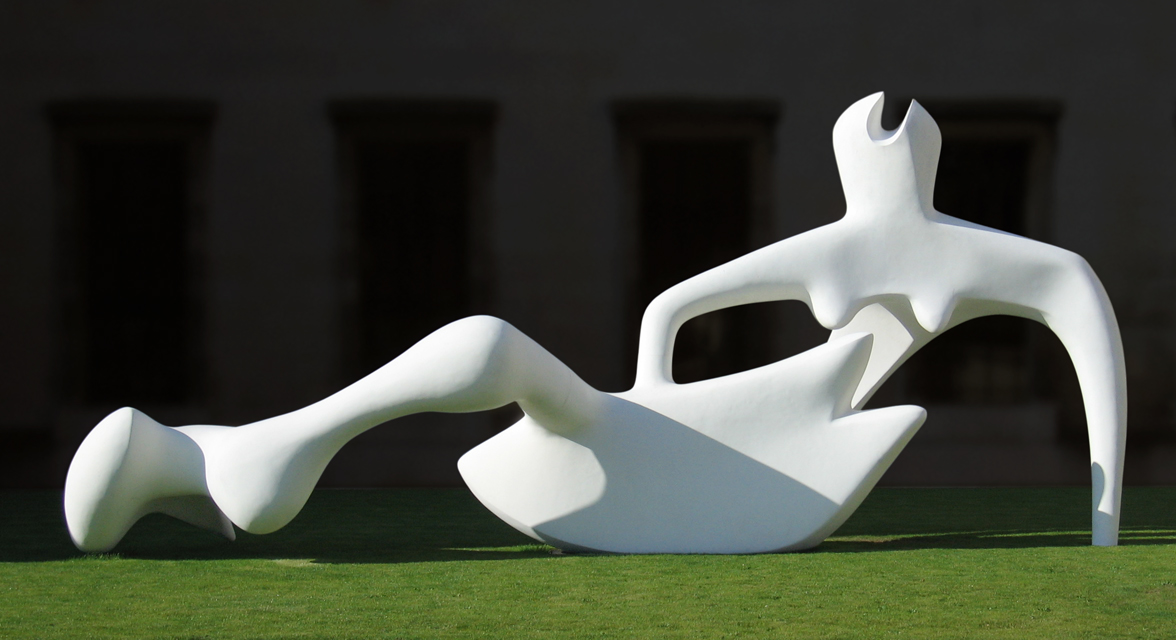
That thought stayed with me while walking through Henry Moore: Monumental Nature at Kew Gardens, which may genuinely be the most intelligent exhibition Kew has staged in years.
The exhibition, which runs until 31 January 2027, includes 30 monumental sculptures placed throughout the gardens as well as more than 90 works housed inside the Shirley Sherwood Gallery of Botanical Art. (kew.org)
Henry Moore, born in 1898 and dying in 1986, spent much of his artistic life exploring the relationship between human forms, natural structures and landscape. While many people still think of sculpture as something static and decorative, Moore understood that sculpture changes according to movement, weather, light and perspective. His work is never fully understood from one position because it was never intended to be.
At Kew this becomes extraordinarily clear.
What makes the exhibition so successful is not simply the scale of the bronzes, although some appear large enough to require diplomatic negotiations before installation. It is the way the sculptures have been curated among the trees, lakes and pathways. Kew is not functioning as a polite backdrop to the art. Nature itself becomes part of the experience of looking.
You round a corner and suddenly a sculpture emerges between branches. Another appears reflected in water so that its shape seems to dissolve and reform simultaneously. Some works frame the landscape behind them, forcing you to look through the sculpture rather than merely at it.
That subtle shift changes something psychologically.
Most of modern life encourages us to look quickly and conclude immediately. Social media rewards certainty. Digital culture encourages rapid opinions. We glance, categorise and move on. Moore’s sculptures resist this entirely because they demand patience and movement. You have to circle them repeatedly before they make sense.
And even then, they continue changing.
A reclining figure can appear maternal from one angle and geological from another. Openings within the bronze suddenly become more important than the solid mass surrounding them. What first appears abstract gradually becomes recognisably human. You realise that understanding is dependent upon perspective and that perspective itself depends upon movement.
This is perhaps the most valuable thing the exhibition offers.
Not information, but a recalibration in how we look.
The Shirley Sherwood exhibition reveals Moore’s fascination with natural forms including roots, bones, shells, rocks and trees. What fascinated me most was learning that during his travels in Italy he became homesick for English trees with their thick trunks and dense canopies rather than the elegant verticality of Mediterranean landscapes.
There is something deeply reassuring about one of the twentieth century’s greatest sculptors essentially longing for chunky Yorkshire trees.
Moore adored trees because they contained both strength and vulnerability. Their forms were shaped by weather, damage, growth and survival. The same principles appear throughout his sculpture. Bodies become landscapes. Landscapes become bodies.
Walking through Kew, you begin noticing the strange visual similarities everywhere. Tree roots resemble veins and nervous systems. Branches mirror limbs. Trunks twist like torsos. It becomes difficult to determine whether Moore was inspired by nature or whether nature simply solved structural and aesthetic problems long before humans attempted sculpture.
This way of seeing has implications far beyond art.
The most interesting people I know, especially founders and entrepreneurs, rarely succeed because they obsess over one narrow viewpoint. They succeed because they can move around an idea mentally in the same way you move physically around a Moore sculpture.
They understand that problems alter according to perspective.
A challenge viewed financially may in fact be cultural. A technological issue may actually be psychological. A business can appear successful from one angle and deeply fragile from another.
Moore’s sculptures become unexpectedly useful reminders that reality is rarely fixed and that certainty is often simply the result of insufficient movement.
One of the recurring themes throughout the exhibition is Moore’s fascination with motherhood, shelter and protection. His Mother and Child works are less sentimental than structural. Bodies curve around one another protectively. Openings become refuges rather than absences.
While I was there, two geese marched across the grass accompanied by more than twenty goslings with the kind of militant maternal vigilance usually associated with elite security operations.
Against that backdrop Moore’s work stopped feeling symbolic and began feeling observational.
The exhibition also restores something else which modern life quietly erodes, namely proportion.
Standing beneath Moore’s monumental bronzes while surrounded by ancient trees has a curiously humbling effect upon anyone who secretly believes their inbox constitutes the centre of civilisation. I include myself firmly in this category.
There is nothing quite like a twelve-foot sculpture beside a centuries old cedar to make your own anxieties appear faintly melodramatic.
The experience is also strangely calming, although not in the aggressively monetised wellness sense currently fashionable among people who own weighted blankets and speak passionately about magnesium.
Kew slows you down because the exhibition cannot be consumed efficiently. You walk. You pause. The weather changes the work. Shadows move across bronze. Wind alters the atmosphere entirely.
Even time itself begins to feel less compressed.
Naturally, Kew has placed signs throughout the exhibition politely requesting visitors not to climb on the sculptures. Equally naturally, certain members of the public continue attempting to sit on internationally significant artwork as though auditioning unsuccessfully for a particularly intellectual rodeo.
Do not do this.
Moore’s sculptures are best appreciated from a distance because distance itself is part of the point. Perspective matters. The relationship between observer and object matters. What you see depends entirely upon where you stand.
That idea stayed with me long after I left Kew.
Perhaps wisdom itself is simply the ability to keep moving around an idea until you understand it more fully.
If so, Henry Moore may have understood far more about modern life than many contemporary thinkers currently flooding LinkedIn with motivational diagrams.
Kew Gardens has created something remarkable with this exhibition. It does not merely display sculpture beautifully. It quietly teaches you to observe differently.
And in an age where most of us spend our lives staring flatly at screens, that may be one of the most valuable experiences available in London.
Exhibition runs from 9th May – 27th January 2027. For more information kew.org.