




 BBC News
Borrowing was £17.4bn last month, the second highest October figure since monthly records began in 1993.
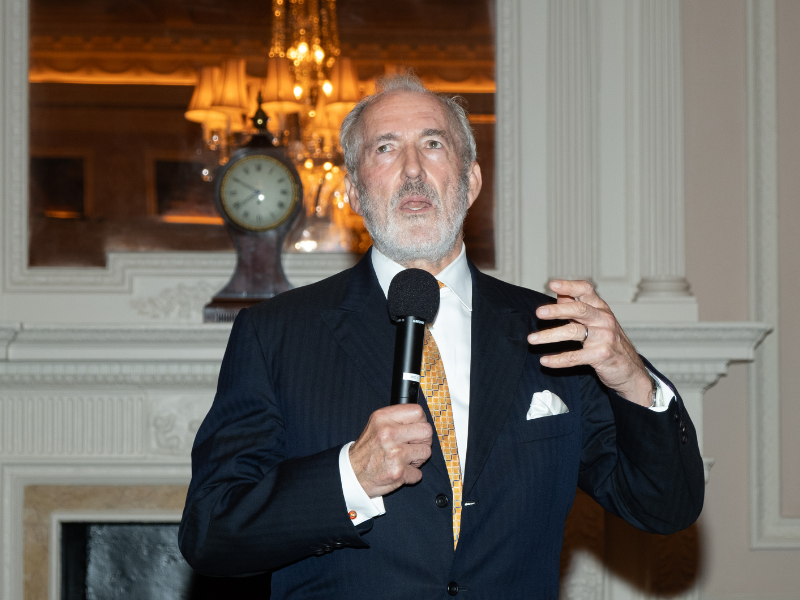
Jeremy King, the restaurateur behind The Wolseley, The Arlington and the revived Simpson’s in the Strand, gave the closing remarks at Finito Education’s report launch at Simpson’s. This is what he said.
I have come to you tonight from an awards ceremony round the corner, and it was a very particular award, because it was a trade award for the happiest places to work. Standing there waiting for it to happen, I thought: that is something we can really learn from. Work can be happy. We can find enjoyment in it. And a great many of the thoughts I want to share this evening come back to that idea, which is simply about getting people to do what they want to do.
Some years ago I did one of the Speakers for Schools talks at a big school in Whitechapel, with perhaps three hundred in the sixth form. I was just about to go on when the head teacher came over. “I don’t know what you are going to talk about,” he said, “but please don’t talk about working in restaurants.” I asked him why. He explained that around seventy per cent of the pupils were from Bangladeshi or Pakistani families, and that their parents, particularly their fathers, had grown up in restaurants. They hated restaurants. The last thing they wanted was for their children to follow them. I took that as a good challenge. But what excited me was that these young people were not resigned to anything. They wanted to be something else, and their parents were encouraging them. That, I find, is what matters.
There is a great excitement for me in standing here at Simpson’s, which is nearly two hundred years old, and its history has taught me something about the same subject. When we took the place over I was terribly upset by the story of the ladies’ dining room. If you look at the clock above the bar downstairs, it is stopped at two minutes past one, and I was told that this marked the moment the first woman crossed the threshold. I found it disorienting, a kind of apartheid. Then I talked to the archivist, and she gave me a different way of looking at it. “No, no,” she said, “don’t feel uncomfortable about it. The women did not want to be down there with the men.” The men in the basement were loud, sweaty, drunk and smoking cigars, and the women preferred their decorum upstairs. All these thoughts, for me, come back to the same thing: letting people do what they want.
Only recently The Times ran a piece declaring that hospitality was in the worst state anyone could remember. I am one of the oldest people still working in the West End, so people come to me and say, “Isn’t it terrible? Covid, Brexit, the tax rises. Is this the worst time you have ever known? You can’t get any staff.” And I say no, it is not. If you want to know the worst time, it was between 1975 and 1995, when we listened to bombs going off and had grilles on our windows against the IRA. I remember, in 1982, having to decide whether to believe a bomb threat that came through on the telephone or treat it as a hoax. I decided to keep operating, and as eight o’clock came, the hour the bomb was supposed to go off, I found myself moving in slow motion, waiting for it to happen. That was a terrible time. This is not.
And Brexit? Brexit is bad for the country, certainly. But in terms of staff, I told them what I had seen the night before at The Arlington. I watched six people working the room. Three were white public school boys and three were young black women from the inner city. They worked in such harmony, so well together. The women, of course, were better than the men. It really excited me as to what is possible.
So drawing all these thoughts together, what I am saying is that we have to start teaching people attitude, because the way to get people into jobs is to teach them belief in themselves. Danny Meyer, the great New York restaurateur, once said that he could teach anybody the skills of the trade, but he could not teach them the attitude. And I think that is what is missing from young people in terms of employability at the moment: the idea that they might pull their shoulders back and believe in themselves.
I am not offering solutions. But there is a story I can tell you about how this works. A friend of mine in the restaurant trade came to me and said, “Jeremy, give my son a job, any job, washing up.” I asked why. “Because he is at home all the time. He goes to bed at three in the morning, he gets up at three in the afternoon, he does nothing for himself.” His mother, he told me, was in despair. “Just give him a job.” I said absolutely not, and he was shocked. “But I will,” I said, “teach him a trade. Send him to me if he is prepared to do the work, and I will teach him to be a waiter.” Because once he had a trade, he would start to believe in himself, and it really is as simple as that. He did the training. As time went on he travelled the world, he worked for us, and suddenly his parents were telling me he was a different person. He got up in the morning. He did his own laundry. He believed in himself. His mother, I should add, was happiest of all, because she could tell her friends that he was training to be a barrister.
A lot of people thought I was stupid to open this restaurant, twenty-one and a half thousand square feet at a massive cost. But I think we should be positive rather than bemoan things, and the British, I feel, have a tendency to moan. There is a big difference between moaning and complaining. In New York they complain. In England we moan. We need to start complaining, and to rise up and say, “This is not good enough. We need to get better.” And the way to do it is not through the three Rs. It is to teach young people belief in themselves, and to teach them to smile.
A friend of mine was once told that we should bring back national service to give young people some backbone. Absolute nonsense, he said. Get every child to work for six months in a restaurant, where they will learn about the relationships between people, about teamwork, about reconciling the till, about any number of logistical things that will change them for good. I think that is right, and I think it is the equivalent of hope. Not necessarily in restaurants, and not necessarily through apprenticeships, but through giving young people belief. That is my contribution, and it is very nice to see you all.