



 BBC News
Borrowing was £17.4bn last month, the second highest October figure since monthly records began in 1993.
Meredith Taylor
Antonin Baudry’s two-part historical epic, beginning with De Gaulle: Resistance and followed by De Gaulle: Liberte, offers an unexpectedly contemporary meditation on power, legitimacy and the value of experience.
There are few more unfashionable qualities in contemporary life than stubbornness. We prefer agility, disruption and reinvention. Organisations talk about adaptability; politicians speak of renewal; employers increasingly prize the appearance of perpetual forward motion. The successful individual is expected to evolve continuously, preferably before anyone has had the chance to decide that he or she has become obsolete. French president Charles de Gaulle (1890-1970) offered a rather different model.

Antonin Baudry’s ambitious two-part film about the wartime general — La Bataille de Gaulle: Resistance, released on 28 August, followed by La Bataille de Gaulle: Liberte — arrives at a moment when the politics of leadership, legitimacy and national identity once again feel unusually unsettled. What makes the two films compelling is not simply that they revisit one of the defining episodes of French history. It is that they ask a deceptively modern question: what happens when the person who refuses to accept that something is finished turns out to be right? The answer, in de Gaulle’s case, is the making of a political myth. But Baudry is too intelligent a filmmaker to begin with the myth.
The French co-writer/ director begins his story in the summer of 1940, when the French military has been defeated, the country is collapsing and the armistice with Nazi Germany has effectively destroyed the political order of the Third Republic. Marshal Pétain’s Vichy regime emerges. France is divided and demoralised. Resistance is neither organised nor inevitable.
De Gaulle, meanwhile, is hardly the national colossus that history books would later make him. He is a general without an army, a politician without a constituency and, initially, a Frenchman speaking from London to a country with little reason to believe him. His celebrated appeal is not retrospectively triumphant. In Baudry’s telling, it is an act of extraordinary political risk. That uncertainty is the first film’s great strength. We know the ending. The characters do not.

De Gaulle: Resistance therefore avoids the comforting structure of the conventional historical biopic, in which greatness appears inevitable from the opening frame. Instead, Baudry reconstructs a period when the future could have taken almost any direction. France might have remained subordinate to Vichy. De Gaulle might have become a footnote. The Resistance might have remained fragmented. Britain and the United States might have decided that the French general was simply too difficult to be useful. History, in other words, is shown before it becomes history: That is where Simon Abkarian’s performance becomes so effective. His de Gaulle is austere, difficult and frequently isolated. He does not have the easy charisma of a conventional screen hero. His authority seems to come from somewhere more formidable and less immediately attractive: the absolute conviction that he is defending something larger than himself. Abkarian understands that this conviction has two sides. De Gaulle’s refusal to compromise is both his political weakness and his greatest asset. The man who is difficult to persuade is also difficult to defeat.
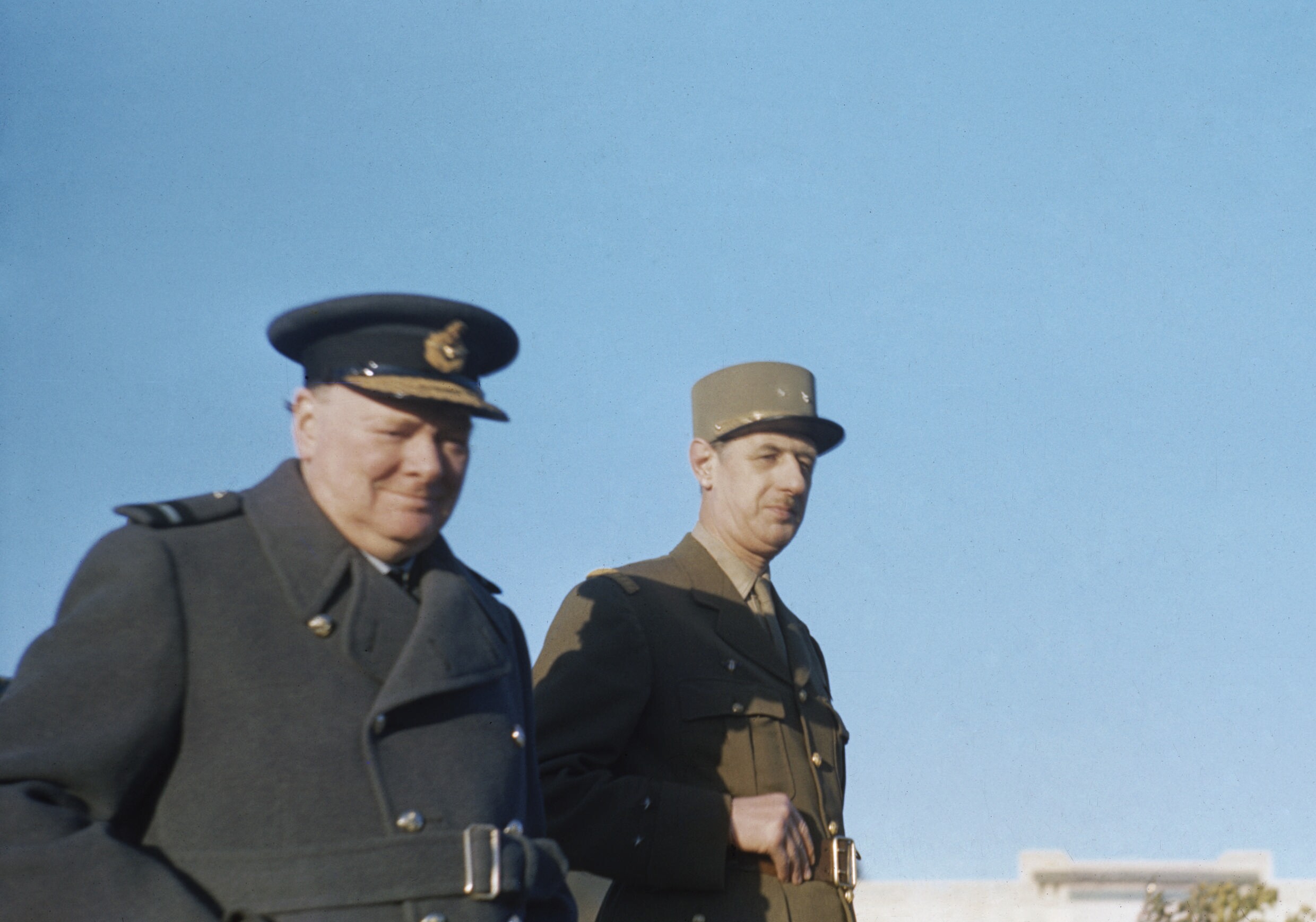
Opposite him, Simon Russell Beale gives Winston Churchill an appealingly ambiguous intelligence. His Churchill is neither the convenient British ally nor the genial wartime hero of popular memory. He is a realist. He admires de Gaulle, but Britain has interests of its own. Their relationship becomes a fascinating study in the difference between friendship and necessity.
The political conversations between the two men are among the films’ pleasures because they demonstrate that power is rarely exercised by simply giving orders. It is negotiated, withheld, traded and occasionally bluffed. And this is where Baudry’s films begin to feel less like a history lesson and more like a commentary on contemporary political life.
The second film, Liberte, shifts the emphasis from survival to legitimacy. Covering the period leading to the Liberation of Paris, it follows de Gaulle’s increasingly difficult campaign to persuade the Allies that France must emerge from the war not as a liberated dependency but as a sovereign nation. His problem has changed. He is no longer trying merely to keep the idea of France alive. He is trying to establish who has the right to speak for France. The distinction is crucial. Military power can liberate territory. It cannot, by itself, determine political legitimacy.

De Gaulle understands this with an almost obsessive clarity. His battles with Roosevelt, Churchill and General Henri Giraud are therefore not peripheral diplomatic episodes but the substance of the story. His weapon is not an army. It is the ability to insist, repeatedly and often infuriatingly, that France possesses a political identity that cannot simply be handed back by foreign powers.
Baudry draws on Julian Jackson’s biography De Gaulle: Une certaine idée de la France, and the influence is apparent in the film’s refusal to turn de Gaulle into a saint. The general is not always right. He is certainly not always pleasant. His certainty can shade into obstinacy. Yet perhaps that is precisely the point.
There are moments in history when compromise is prudence. There are others when compromise becomes surrender disguised as pragmatism. The difficult question is knowing which moment one is living through. For contemporary audiences, that dilemma has a surprisingly personal resonance. Consider the experienced professional who has spent 30 or 40 years acquiring knowledge, relationships and judgment, only to discover that the market has become fascinated by novelty. Or the executive whose expertise has suddenly been declared old-fashioned. Or the entrepreneur who finds that a lifetime of accumulated understanding counts for less than the latest fashionable vocabulary.
The parallel with de Gaulle should not be pushed too far. A rejected job application is obviously not the fall of France. But the underlying psychology is recognisable: institutions can be remarkably bad at distinguishing between something that is obsolete and something that has simply become inconvenient.
De Gaulle’s great achievement was not merely endurance. It was the ability to preserve a proposition until circumstances made it valuable. That is a subtler form of perseverance than the motivational posters suggest. It requires judgment. It requires the capacity to absorb rejection without allowing rejection to become self-definition. And it requires enough confidence to recognise that being temporarily disregarded is not the same thing as being irrelevant. Baudry reinforces this idea by refusing to tell the story exclusively from the perspective of the powerful.
In the first film, Florian Lesieur’s Fernand provides the human scale. While de Gaulle and Churchill operate within the grand machinery of international politics, Fernand experiences the occupation as a young man confronted with the intoxicating and terrifying possibility of resistance.

In the second film, the Resistance itself comes further into focus. Anonymous organisers, couriers and fighters become part of the story. Their contribution matters because political legitimacy cannot simply be manufactured by a single charismatic individual. It requires people willing to make the idea real. This three-level structure — statesman, political institution, ordinary citizen — is one of the film’s most successful devices.
A speech in London has consequences in occupied France. A diplomatic calculation in Washington or Whitehall affects a teenager in a French town. A decision taken by famous men is paid for by people whose names history will never record.
Baudry’s camera understands the connection.
Pierre Cottereau’s cinematography gives London a rain-soaked, muted melancholy, making exile appear as much psychological as geographical. De Gaulle may have a relatively comfortable house in Hampstead, but comfort is not the same as belonging. In occupied France, the visual language becomes more immediate and physical.
The second film’s use of original wartime newsreels is even more striking. Archival footage is integrated into the drama rather than presented as an interruption. Real faces appear alongside reconstructed ones, and the distinction between history as recorded and history as imagined begins to blur. The effect is to restore something that hindsight habitually removes: uncertainty. The people in those newsreels did not know what was going to happen. Neither did de Gaulle.
Neither did Churchill.
That may be the most valuable reminder these films offer at a time when political commentary is often delivered with the confidence of hindsight. We routinely treat historical outcomes as though they were inevitable. They almost never are.
The French title J’écris ton nom adds another layer. It recalls Paul Éluard’s Resistance poem Liberté, in which the repeated invocation of freedom becomes an act of defiance in itself. Baudry uses the reference to suggest that liberty is not simply bestowed at the end of a war. It must first be imagined, then articulated, defended and finally institutionalised. The political argument is therefore also a cultural one.
Nations survive through stories about themselves. So do institutions. So do individuals. A company that believes its most experienced people have nothing more to contribute will eventually lose knowledge it cannot easily replace. A society that treats its history as settled may discover that its assumptions were more fragile than it thought. An individual who accepts somebody else’s judgment that his or her most useful years are over may make that judgment self-fulfilling.
De Gaulle’s example is not an argument for refusing change. It is an argument for understanding the difference between change and surrender. The distinction matters increasingly in professional life. For older workers and executives, the language of perseverance can sometimes sound patronising: another injunction to “stay positive” while institutions quietly lower the drawbridge. But Baudry’s films suggest something more demanding. Perseverance is not passive optimism. It is the disciplined preservation of one’s judgment and sense of purpose while searching for the moment and the environment in which they can once again matter.
There is also something distinctly French about the political imagination involved here: the conviction that an idea of a nation can survive the temporary collapse of the state that represents it. But the principle travels well. Power does not always belong to the person who appears strongest at a particular moment. Sometimes it belongs to the person who is still standing when the circumstances change. That is why de Gaulle’s story remains more than a patriotic anecdote.
It is a story about the politics of being underestimated. And perhaps that explains why these two films feel unexpectedly well timed. At a moment when political systems are questioning old certainties, businesses are reconsidering the value of experience, and individuals are being encouraged to reinvent themselves at increasingly improbable speed, Baudry proposes a more old-fashioned form of resistance.
Stay the course — but know why; be difficult when the principle matters; do not mistake rejection for irrelevance.
And, above all, do not assume that because the prevailing consensus has decided that the story is over, it necessarily is.
De Gaulle: Resistance and De Gaulle: Liberte are therefore more than a two-part portrait of one of France’s most consequential figures. They are a meditation on the strange interval between failure and vindication — the period in which perseverance looks least rational and may be most necessary. History may eventually reward the stubborn. But Baudry’s deeper point is that the stubborn rarely know, while they are persevering, whether history will reward them at all.