




 BBC News
Borrowing was £17.4bn last month, the second highest October figure since monthly records began in 1993.
Finito World
When Elon Musk proposes putting data centres in orbit, it is tempting to file it under spectacle. SpaceX merging with xAI in a trillion-dollar consolidation sounds less like industrial policy and more like a trailer for the future. Orbital server farms humming above our heads, powered by solar arrays, delivering artificial intelligence to the planet below. It is either visionary or delirious. Possibly both.
But to dismiss it as hype is to dodge the larger question. Not whether data centres belong in space, but whether AI itself is a boom or a bubble. The answer to the orbital question depends entirely on the answer to that one.
Strip away the theatre and the economics are more prosaic. Despite the noise, we are still early in AI adoption. Surveys show widespread experimentation but selective deployment. A third of CEOs report revenue gains; a quarter report cost reductions. That is not mania; it is cautious integration. Businesses are testing, not surrendering.
We have seen this pattern before. Few predicted that the automobile would generate more registered cars than drivers, let alone spawn roadside America and fast food. Few foresaw that the personal computer would outnumber humans or that e-commerce would hollow out high streets and create trillion-dollar logistics ecosystems. Revolutionary technologies rarely look revolutionary in their adolescence. They look awkward, expensive, and intermittently useful.
The deeper parallel is not hardware but accessibility. The personal computer took computing out of institutional basements and placed it on desks. Artificial intelligence does something more radical: it makes language the interface. It collapses the distance between question and computation. It allows non-experts to interrogate complexity directly. That shift is as profound as the move from mainframes to PCs, perhaps more so.
Forecasting AI demand is therefore not about guessing how many chips we will need. It is about asking how much useful information humanity wants. And history offers a simple answer: more. Always more.
Unlike cars or aircraft, whose utility is bounded by physical constraints—road-hours, air-hours—information has no natural ceiling. The appetite for data is effectively infinite, and the supply of it is limited only by imagination. What shall we measure? How granular shall we get? What patterns might be extracted? Each new instrument, each sensor, each digital exhaust trail adds to a compounding archive.
In 1962, the Council on Library Resources asked a prescient computer scientist, J.C. Licklider, to imagine a “neolibrary” networked by computers. He estimated that all the world’s printed books amounted to roughly a petabyte of data. He predicted a fivefold increase by the year 2000. Instead, global data expanded one hundred thousand-fold by then—and another thousand-fold since. The error was not in direction but in scale. Exponential systems mock linear intuition.
AI rides two accelerants at once. The software itself improves at a pace that outstrips earlier computing eras, and its deployment piggybacks on an already colossal cloud infrastructure. More than 5,000 data centres operate in the United States alone. The cloud is arguably the largest infrastructure build-out in human history, measurable in dollars, steel, silicon and fibre miles.
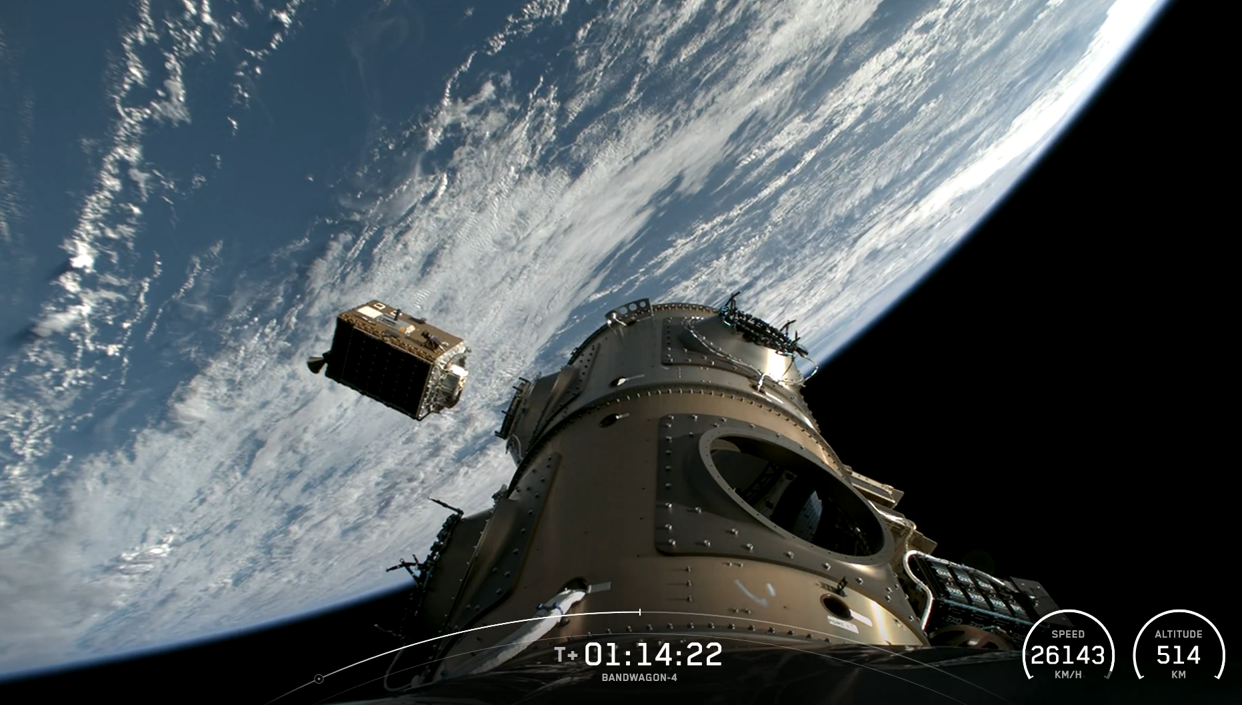
Against that backdrop, orbital data centres are less fantastical than they first appear. SpaceX’s Starlink constellation already resembles a distributed computer in the sky: thousands of satellites, hundreds of thousands of processors, powered by solar arrays generating around 100 megawatts collectively. It is not conceptually absurd to imagine layering AI workloads onto such a network.
The economic objection is obvious. Launching a gigawatt-scale data centre into orbit would cost tens of billions more than building one on earth. Even with falling launch costs and “free” solar energy, space remains an expensive postcode. Yet in a world where big tech capital expenditure runs into the hundreds of billions annually, cost alone may not be decisive. The question is demand. Is global AI usage destined to be so vast, so latency-sensitive, so geopolitically complex, that orbital nodes make sense?
There is a strategic subtext here. If the epicentre of AI capability resides in American firms, then delivering those services globally requires either building infrastructure in politically and geographically fraught territories or beaming it from above. Low-earth orbit, in this framing, is not science fiction but geopolitical arbitrage.
Still, it is worth tempering the narrative. Not every technological flourish reshapes civilisation. Helicopters created new markets and niches without supplanting fixed-wing aircraft. Likewise, orbital data centres may prove additive rather than transformative—an elegant solution for particular problems, not the new default.
The more important issue is not whether we process data in Nevada or in orbit. It is whether AI itself proves durable enough to justify the infrastructure race now under way. The evidence suggests that we are not witnessing a speculative bubble detached from utility, but the early stages of a structural shift in how information is produced, refined and consumed.
The hype is real. So is the capability.
If AI is indeed the next general-purpose technology—on par with electricity or computing—then the scramble for capacity, wherever it resides, will look obvious in hindsight. If it is not, then orbital data centres will be remembered as monuments to overconfidence.
My suspicion is that history will rhyme. We will underestimate scale, misjudge timelines, argue about costs—and build anyway. Whether in concrete bunkers in Virginia or in constellations above the atmosphere, the infrastructure will follow the appetite.
And if appetite for information is infinite, as it has always been, then the boom may prove less about hype and more about gravity—economic gravity pulling capital toward the refinement of data, wherever that refinement most efficiently occurs.
Space may not be the final frontier of AI. But it is unlikely to be the final exaggeration either.