


 BBC News
Borrowing was £17.4bn last month, the second highest October figure since monthly records began in 1993.
Polly Cecil
The bar has spilt onto the street, abandoning any pretence of having walls. Glasses of cold tinto de verano stand on upturned wine barrels, sweating rings into wood already stained a hundred times over. Waiters weave through the crowd with trays held high, laden with croquetas and cañas. Voices tumble over one another like a choir with no conductor. A group begins to sing cumpleaños feliz, and within seconds the whole bar has taken it up, napkins waving overhead like flags, words hurled up to the sky. It’s eleven o’clock on a Monday night.
Further down the street, a flamenco dancer turns on the cobbles, her heels striking the stone in sharp bursts. Her dress is polka-dotted, red on black, its ruffles stacked in tight tiers that snap and unfurl with every spin. People pause to watch, then drift away, and others take their place: an elderly couple walking their dog, a pair of teenagers sharing a cigarette, a little girl, hands on hips, frowning in concentration as she stamps a beat behind. If the dancer notices any of them, she doesn’t show it. In Seville, you don’t have to seek out the spectacle. You stumble across it.
SONY DSC
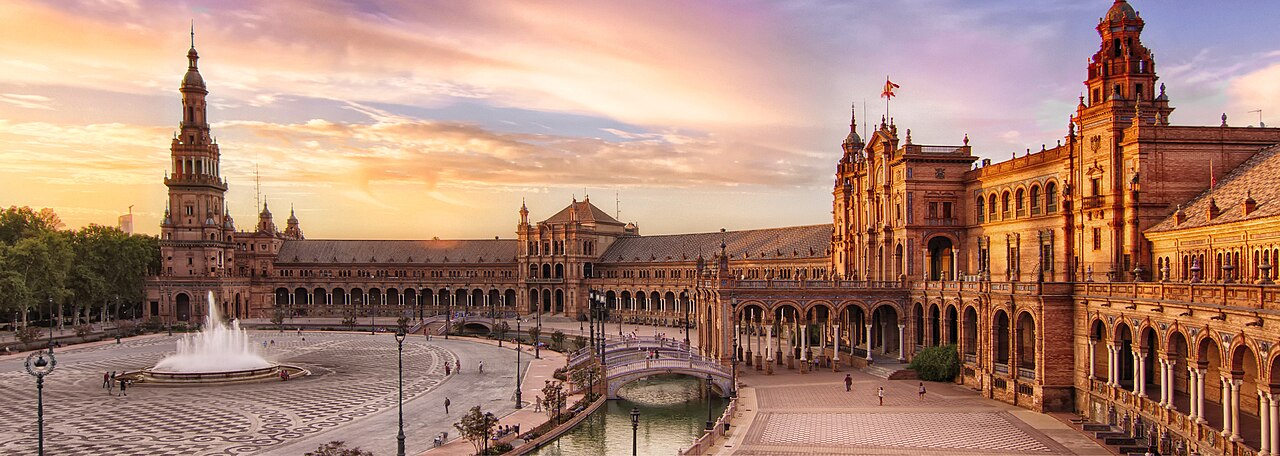
At the edge of the Parque de María Luisa, the Plaza de España curves like a pair of open arms: a vast half-moon of terracotta brick, lined with ceramic tiles in cobalt and ochre, built for the 1929 Ibero-American Exposition. Horse-drawn carriages clatter past, and rowing boats nose along the canal at its foot. The fountain at its centre is rarely without an audience. For a few weeks each summer, the square is given over to the Icónica festival, and a stage rises where tourists usually pose for photographs. This afternoon there is no stage, only a man in a pressed linen suit near the fountain who has started singing “Viva España”, with nothing behind him but his own lungs. On a tiled bench, an old man lowers his newspaper. A carriage driver lets his horse stand. Above them, the orange trees hang heavy with fruit. It’s Seville doing what it always does: refusing to let the ordinary and the ceremonial live in separate boxes.
Indoors, the same refusal holds. At the Basílica de la Macarena, conversation falls away at the door. Gold leaf and marble frame the camarín, where the Virgen de la Esperanza stands behind glass. Devotees queue to climb up beside her. Others linger at the altar, lighting candles, praying, weeping. It is less serene than overwhelming, and, after a while in all that gold and candlelight, a little terrifying.
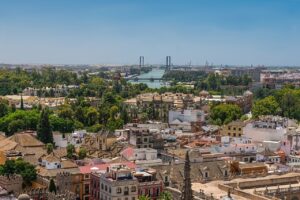
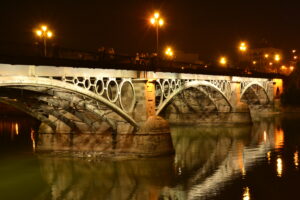
Across the river, Triana has an Esperanza of her own. Todos los Santos usually finds cemeteries brimming with flowers rather than crowds. But today, hundreds have gathered on the bridge to welcome the Esperanza de Triana back to her barrio after months away. She passes over the river in gold, banked with candles, lifted just above the heads along the parapet. The bridge glows white beneath her. There is no music to sing along to and no napkins in the air. After so many loud nights, the quiet feels intimate. For a moment, the whole crowd seems to be holding its breath.
By December, the city is strung with lights, and families flock to the Belén stalls beneath the Cathedral, hunting for moving-water contraptions, tiny shepherds and cattle figurines to add to their nativity scenes at home. It all builds towards La Cabalgata de los Reyes Magos on the 5th of January, when the Three Kings arrive with gifts for the city’s children. The crowd runs nineteen rows deep, toddlers hoisted onto shoulders. A stick strikes a drum; a fanfare answers, swelling as the parade rounds the corner. Float after float glides into view, one modelled on Superman, another on Peter Pan. Then come the camels, swaying through a hard rain of boiled sweets that bounce off the street. Over a hundred thousand kilos of them fall across the city that night, snatched up by a swarm of sticky-fingered children. Long after the Kings have gone home, the streets carry on as a carnival of their own.
Modern life tends to shut beauty behind glass, admired but never touched, and leave the rest of the day to be merely functional. In Seville, the two are harder to separate. The extraordinary and the ordinary share the same streets, until it becomes difficult to tell where one ends and the other begins.
Back at the bar, it’s one o’clock on a Tuesday morning. The tables are still outside. The glasses are still cold. Somewhere down the street, someone has started to sing.