


 BBC News
Borrowing was £17.4bn last month, the second highest October figure since monthly records began in 1993.
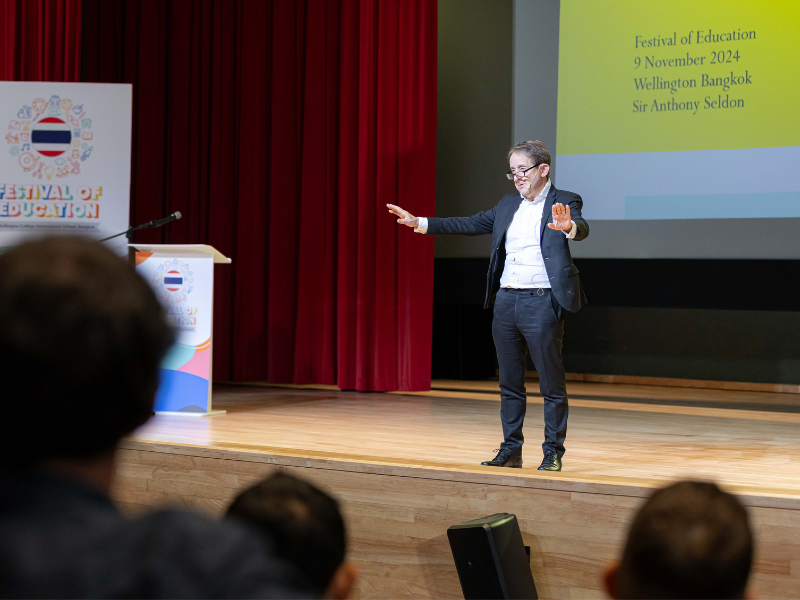
AI is accelerating – but education is lagging. Sir Anthony Seldon in conversation with Edward de Bono biographer Sarah Tucker, explains why imagination is now a strategic advantage.
There is a piece of ground in Ilford, Essex, that quietly exposes one of the great strategic failures of modern society.
Today, it is home to Sir Isaac Newton Academy, a school preparing young people for a future shaped by artificial intelligence. One of its teachers is Sir Anthony Seldon’s son, working at the educational frontline of the 2020s. The same ground once held Gearies Boys’ School, where my father, Norman Tucker, served as deputy head. Different era. Different tools. Same underlying problem: how do you prepare young people for a world that will not wait for them to catch up?
That question has animated Sir Anthony Seldon’s professional life for decades. A historian of politics and education, former Head of Wellington College, former Vice-Chancellor of the University of Buckingham, and one of Britain’s most influential public thinkers on schooling and leadership, he has observed institutional change closely enough to know that failure rarely comes from ignorance. It comes from hesitation, and from mistaking control for progress.
At the centre of his thinking is a deceptively demanding premise.
“Education is fundamentally about human flourishing, not just knowledge transmission,” says Sir Anthony.
For Finito World’s audience, founders, investors, and builders, that framing should feel immediately familiar. Start-ups rarely fail because founders lack information; they fail because judgment collapses under pressure, because incentives distort behaviour, because resilience, ethics, imagination or collaboration prove insufficient when conditions change. Education systems, Sir Anthony argues, have spent decades optimising precisely the wrong things.
Artificial intelligence has now exposed that imbalance.
“Look, exams are not the end. They’re a means to an end,” he says. Accountability matters. Targets matter. Anyone who has tried to run an organisation without them knows what drift looks like.
But systems have a habit of worshipping what they can easily count.
“Too often exams have become not the means to an end, but the end itself,” he adds.
AI collapses that illusion overnight. When a machine can produce flawless coursework in seconds, assessment ceases to function as proxy. Education is forced, finally, to answer the question it has deferred for years: what are we actually trying to produce?
Sir Anthony’s answer is consistent and unapologetically unfashionable.
“We need to develop the head, the hand and the heart, not just the head,” he says.
This is not nostalgia. It is strategy.
For entrepreneurs, this distinction matters deeply. Machines are accelerating cognitive output. What they cannot replicate, at least not yet, are secure identities, moral judgment, embodied confidence, empathy under pressure, and the ability to work meaningfully with others when outcomes are uncertain.
And yet, for years, education policy moved in the opposite direction. Successive UK governments have spoken eloquently about the importance of teachers while managing them like overheads rather than investing in them like talent. Curricula were narrowed in the name of efficiency. Anything that resisted tidy measurement was quietly squeezed out.
Drama was one of the first casualties.
Not because it lacked value, but because it was inconvenient.
Sir Anthony is blunt about what was lost.
“Drama builds confidence, trains young people to inhabit perspectives other than their own, what Edward de Bono called OPV, Other People’s Views, and gives students a sense of identity and place,” he says.
These are not ornamental skills. They are foundational. They are also, not coincidentally, core founder capabilities.
Research I conducted at Cambridge University supports this intuition: teachers are more likely to be cited as role models than either parents or peers. Not influencers. Not content. People.
Which is precisely what concerns Sir Anthony most about uncritical technological immersion.
“We can see from the work of Jonathan Haidt and many others that immense damage can be done to the formation of secure identities through over-reliance on machines,” he says.
He is careful, as a historian, not to over-claim.
“We don’t yet have reliable data. Causality is very hard to establish,” he notes.
Even so, his intuition is clear.
“If you take people away from natural, healthy, caring relationships and substitute that with technology, this will not help secure personality formation,” he says.
“We are moving into deeply dangerous territory if we don’t get this right.”
This is why he argues that schools must actively protect non-digital space: reading and reflection, physical exercise, time in nature, responsibility, friction, real human consequence. Not as a rejection of AI, but as a condition for using it wisely.
In 2023, Sir Anthony co-founded AI and Education with Alex Russell, a multi-academy trust leader, to help schools collaborate rather than compete as they navigate this transition. The initiative is deliberately practical, focused on teachers rather than policy statements.
Because Sir Anthony is clear about where leadership is unlikely to come from.
“The ideas will not be generated by central or local government,” he says.
“They’re too busy fighting themselves, trying to get headlines the next day.”
For entrepreneurs, this diagnosis will sound uncomfortably familiar. Innovation rarely comes from the centre. It emerges from people closest to reality, responding to constraint with imagination.
Which brings us back, inevitably, to that ground in Ilford.
My father never spoke the language of strategy decks or governance frameworks. But he understood something essential: education was about forming people who could stand upright in the world.
Sir Anthony is explicit.
“Change will come from the front line, the teachers,” he says.
This is where governments consistently miscalculate. They talk about education as infrastructure while treating its most important agents as costs to be controlled rather than assets to be developed. No venture capitalist would build a high-growth company while systematically de-skilling its talent. Education has done precisely that.
Looking twenty years ahead, Sir Anthony naturally slips into the historian’s register. By the early 2030s, society may pass through Artificial General Intelligence into superintelligence, possibly even into early forms of transhumanism.
Future historians, he suggests, will ask an unforgiving question.
“Did education rise to meet the age of AI, or retreat into caution when imagination was most needed?” he asks.
They may ask who was thinking not about scale and efficiency alone, but about humanity, especially the most disadvantaged. They may ask why teachers were praised rhetorically while being structurally constrained.
Sir Anthony remains, characteristically, a cautious optimist.
“I think humans will win,” he says.
But not because governments suddenly found vision. If humans do win, it will be because of what happened at ground level, on the same ground, with different tools, led by teachers who understood that in an AI-accelerated world, wisdom, not capability, is the ultimate competitive advantage.