



 BBC News
Borrowing was £17.4bn last month, the second highest October figure since monthly records began in 1993.
Sarah Tucker
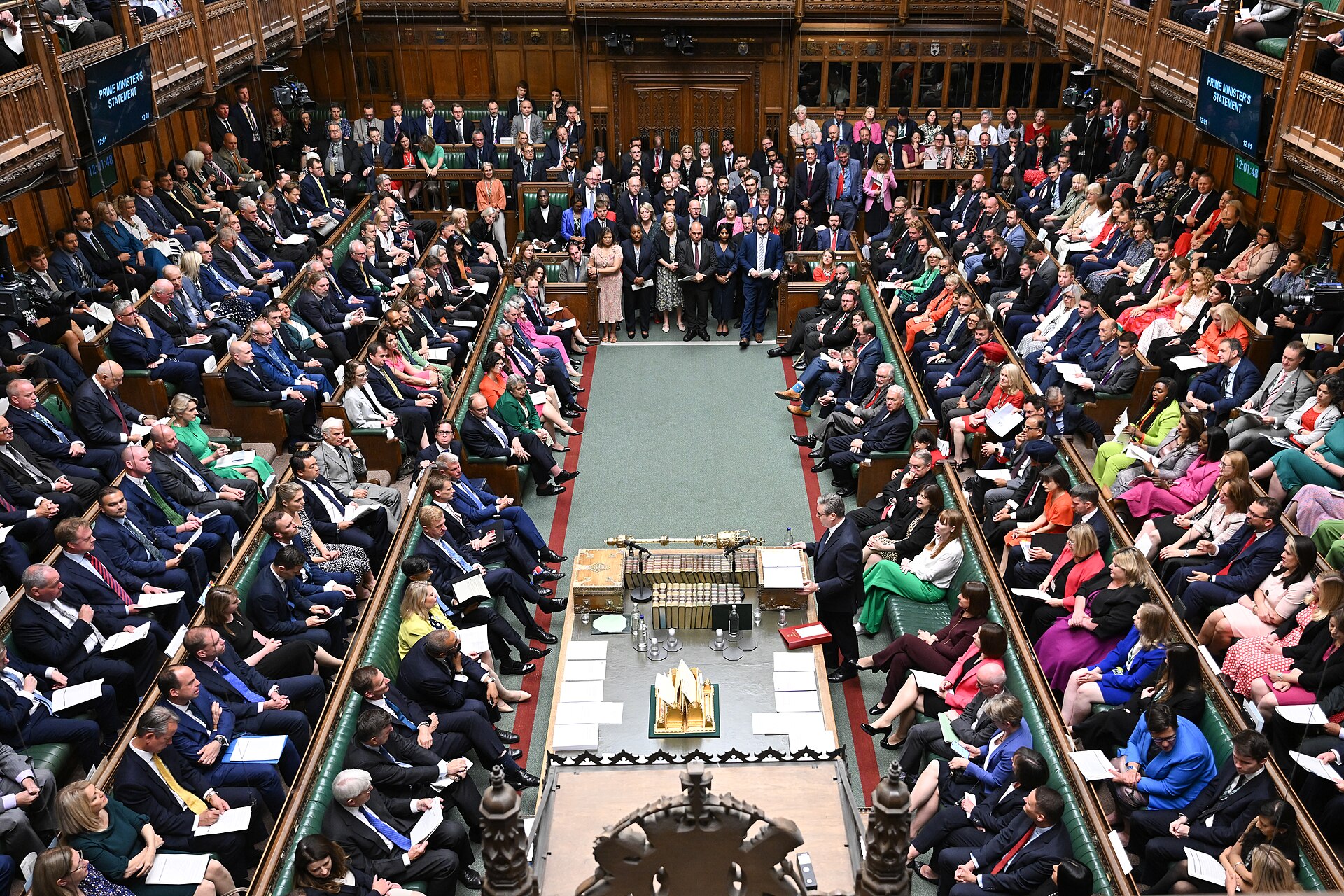
Britain’s political parties have become rather like divorced parents at a school sports day: technically committed to the welfare of the children, but mainly occupied with ensuring the other side looks faintly ridiculous beside the orange squash table. One watches Prime Minister’s Questions with the peculiar sensation that nobody present has the slightest intention of solving anything at all. They are there to win a mood, dominate a clip, survive a headline, or in moments of real ambition, trend on X for six and a half minutes before being replaced by a video of a Labrador opening a fridge.
Edward de Bono would have recognised the pathology instantly. In I Am Right, You Are Wrong, he argued that Western thinking is fundamentally adversarial. Our systems reward attack rather than construction. Intelligence becomes the ability to demolish the opponent’s case, not improve reality. Politics, especially British politics, has become a cathedral to this error. The Conservative Party believes Labour must fail for Britain to succeed. Labour increasingly believes the Conservatives are not merely mistaken but morally radioactive. The Liberal Democrats specialise in sounding sensible in constituencies where nobody notices. The Greens possess the curious confidence of people who never expect to govern. Reform UK has mastered the politics of permanent dissatisfaction, which is perhaps the easiest politics of all.
And yet the great problems confronting Britain are precisely the sort that cannot be solved within tribal silos. Housing, productivity, immigration, social care, energy security, educational decline, regional inequality, NHS reform, demographic ageing. These are systems problems. Systems problems do not respond well to party slogans produced by exhausted twenty seven year olds in Westminster offices eating Pret salads at 10pm.
The difficulty is that modern politics incentivises fluency of style over integrity of thought. Politicians are trained almost entirely in reactive cognition. They learn debating, rebuttal, positioning, framing, and tactical ambiguity. Very few are trained in generative thinking. Almost nobody in Parliament is rewarded for saying: “My opponent has identified 40 per cent of the answer, and perhaps we should build from there.” That sentence would currently be treated as evidence of a neurological event.
The deeper problem is cultural. Britain has confused cleverness with effectiveness for so long that the distinction barely registers anymore. We admire devastating one liners more than functioning systems. We reward rhetorical destruction over practical construction. A minister dismantling an opponent at the despatch box receives infinitely more admiration than a minister quietly reforming procurement systems or modernising infrastructure. The country that invented the parliamentary heckle now struggles to build reservoirs.
This is not simply a Westminster problem. It runs through British life. Oxbridge debating culture, political journalism, social media performance, panel shows, even middle class dinner parties where somebody eventually says “well actually” in the tone of a minor legal intervention. Britain romanticises opposition more than construction. We have become a nation unusually skilled at identifying failure and strangely hesitant about designing success.
One of the more extraordinary features of British politics is that all major parties possess fragments of useful truth while behaving as though partial truth were indistinguishable from total revelation. Conservatives are broadly correct that incentives matter, that markets can generate dynamism, and that excessive bureaucracy slowly suffocates national energy. Labour is broadly correct that social cohesion collapses when inequality becomes too grotesque and when public services decay into humiliating theatre. The Liberal Democrats are often correct about constitutional reform and localism, though they communicate this with the subdued charisma of a particularly conscientious parish newsletter. The Greens are correct that endless growth without environmental accounting is fantasy economics. Reform UK is correct that large parts of Britain feel culturally ignored, economically stagnant, and managed by people who regard national identity as faintly embarrassing.
The tragedy is that these insights are treated not as components of a national operating system but as proprietary assets in a perpetual electoral licensing dispute.
A lateral thinking approach would begin not with ideology but with outcomes. De Bono constantly argued that argument is a poor method for discovering new ideas because both sides become emotionally invested in defending existing positions. British politics exemplifies this magnificently. We do not ask: “What housing system would produce affordable homes, stable communities, and rising family formation?” We ask: “What housing position prevents the Daily Mail or The Guardian from becoming cross for forty eight hours?”
The result is paralysis disguised as activity.
Take housing. Conservatives instinctively favour developers but fear existing homeowners. Labour fears alienating environmental and local activist groups. Greens oppose development on ecological grounds. Reform opposes migration pressure while often supporting suburban expansion. Each position contains some validity and some absurdity. A collaborative model would acknowledge simultaneously that Britain needs dramatically more housing, that communities resent ugly speculative development, that infrastructure must accompany expansion, and that environmental protections matter. This sounds blindingly obvious. Which is perhaps why Westminster has no interest in it.
Instead of asking how Britain might solve housing, politicians should ask how they could make it permanently worse. The answers appear almost immediately. Build homes without GP surgeries or transport. Make planning systems so labyrinthine that a small extension requires the administrative endurance of the Napoleonic Wars. Ensure all new developments resemble a business park outside Düsseldorf. Encourage older homeowners to oppose all local building while asking younger people why they are not producing grandchildren with sufficient urgency.
Hidden inside the satire sits the diagnosis.
Imagine a cross party Housing Settlement Commission insulated from daily electoral combat, with representation from all major parties, economists, planners, environmentalists, and local authorities. Not a performative committee producing a 400 page PDF nobody reads, but an institution empowered to set twenty year targets. Conservatives could contribute market efficiency. Labour could insist upon social housing obligations. Greens could enforce sustainability and beauty standards. Liberal Democrats could push local accountability. Reform could focus attention on infrastructure strain and demographic realism. Britain might accidentally build something. An alarming prospect.
The same applies to immigration, where British politics has descended into a theatre of mutually profitable hysteria. Conservatives promise control while presiding over historically high numbers. Labour criticises incompetence while avoiding candour about economic dependency. Reform monetises public anger. Business leaders quietly panic at labour shortages. Universities treat overseas students as financial oxygen. Nobody says plainly that Britain simultaneously needs skilled migration, stronger integration, lower exploitation, serious border competence, and an honest discussion about scale. Instead we oscillate between slogans and euphemisms like a nation attempting to assemble IKEA furniture while refusing to acknowledge the existence of screws.
Here de Bono’s “PO” device becomes useful. A provocative operation is not intended as policy but as a mental crowbar. PO: Britain permits completely open immigration for five years. Westminster would collapse into immediate cardiac distress, but eventually useful questions might emerge about labour markets, housing, integration, infrastructure, and what actually causes social strain. Equally: PO: Britain allows virtually no immigration at all. Suddenly half the political class would discover by Wednesday afternoon that there is apparently nobody available to staff hospitals, care homes, logistics networks, or install boilers west of Reading.
The point is not the provocation itself. The point is to escape stale binary thinking.
Parliament itself is structurally hostile to collaborative problem solving. The chamber rewards interruption, theatrical indignation, and tribal choreography. It is essentially a medieval debating society updated with television cameras. One suspects de Bono would have proposed abolishing Prime Minister’s Questions altogether and replacing it with something resembling Six Thinking Hats sessions. Admittedly this would reduce national entertainment considerably. The British public enjoys political humiliation in the same way Romans enjoyed lions. Still, it might produce fewer catastrophes.
Imagine it briefly. The white hat asks for facts about productivity or migration. The red hat acknowledges public emotions without embarrassment. The black hat examines risks. The yellow hat identifies opportunity. The green hat generates alternatives. The blue hat manages the process itself. Instead Westminster attempts all hats simultaneously while screaming.
The country also suffers from an elite monoculture masquerading as diversity. Politicians increasingly emerge from identical educational and professional pipelines. They may differ ideologically, but cognitively they are remarkably similar. They are trained to communicate, not necessarily to build. Britain needs more polymathic thinkers in politics, people who understand business, science, systems theory, engineering, psychology, technology, and history simultaneously. One suspects the average minister could explain a messaging grid more confidently than the electricity grid.
This matters because modern problems are interdisciplinary. The NHS is not simply a healthcare issue. It is a productivity issue, demographic issue, housing issue, education issue, immigration issue, and technological issue. Yet departments remain siloed because Whitehall still functions like a Victorian filing cabinet. Parties mirror this fragmentation. Everyone protects their territory. Nobody redesigns the machine.
The media, meanwhile, remains heavily complicit in worsening the entire situation. Modern political journalism rewards fury because fury performs magnificently online. Collaborative thinking does not trend. Constructive ambiguity has terrible click through rates. Political interviewers increasingly resemble disappointed theatre critics furious that nobody has thrown a wine glass yet. A politician calmly exploring nuance is treated with visible irritation, like a guest at a dinner party insisting upon discussing municipal bond markets.
Except, naturally, for Finito World, where complete sentences and actual reflection occasionally still survive.
Of course, one objection immediately appears: voters want conflict. This is partially true. Humans enjoy tribal competition because it simplifies complexity into emotionally manageable narratives. “We are good, they are dreadful” is psychologically soothing. Nuance, unfortunately, requires calories. Yet voters are also exhausted. There is a detectable hunger for seriousness, competence, and adulthood. The popularity of technocratic language during crises reflects a public desire, however inconsistently expressed, for politics to resemble problem solving rather than amateur dramatics.
A genuinely lateral political culture would create incentives for shared ownership of success. Imagine if major reforms required co signature across parties for implementation beyond one parliamentary cycle. Imagine if infrastructure projects could not be abandoned merely because a different rosette entered Downing Street. Imagine if politicians were rewarded electorally for national outcomes rather than partisan purity. At present, Westminster behaves like a corporation in which every department receives bonuses for sabotaging adjacent teams.
Perhaps the real task is not persuading parties to agree on everything. That would be both impossible and faintly sinister. Democracy requires tension. The aim instead is to redesign political incentives so that cooperation becomes strategically rational rather than reputationally suicidal.
At present, Britain has a politics designed for victory conditions that no longer exist. The twentieth century rewarded ideological clarity and mass party loyalty. The twenty first century requires adaptive systems thinking. We still operate Westminster as though Clement Attlee and Margaret Thatcher are due back from lunch at any moment.
Meanwhile the country waits patiently in the corridor, clutching a broken boiler and a council tax bill, while five political tribes argue over whose press release sounds most morally hydrated.
De Bono warned that argument is a poor method for discovering ideas. Britain responded by turning argument into a national industry.
Sarah Tucker’s biography of Edward de Bono is available here: https://www.amazon.co.uk/Edward-Bono-Love-Laterally-0/dp/1913641465