


 BBC News
Borrowing was £17.4bn last month, the second highest October figure since monthly records began in 1993.
Christopher Jackson
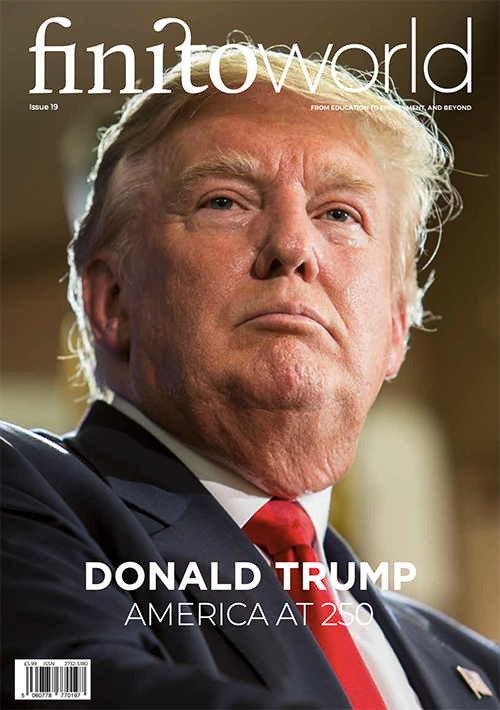
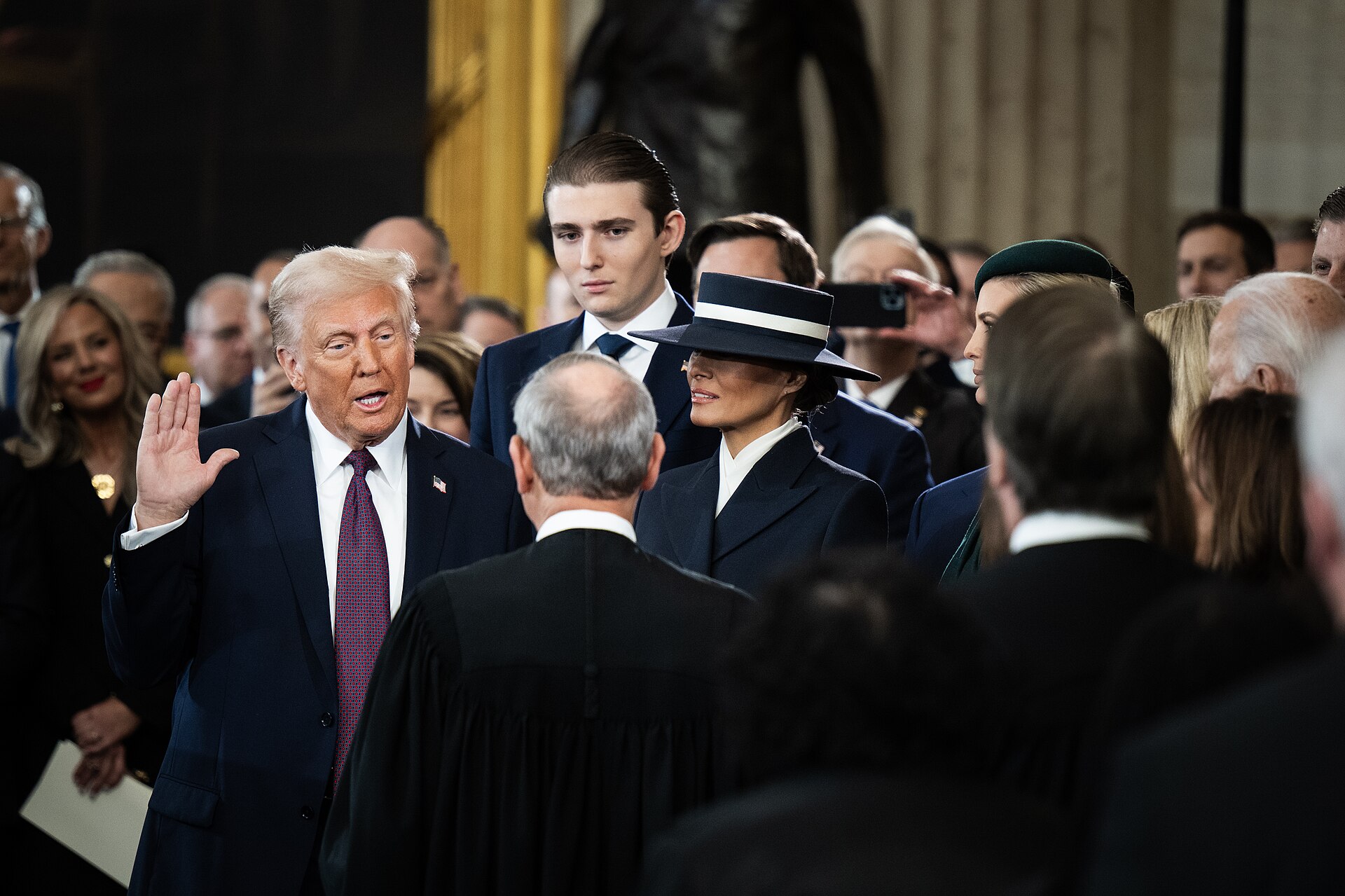
It’s often said the Oval Office is smaller than you think. The rectangular waiting room with its people rushing in and out has doors on three walls, and when two are ajar at once you can hear the famous voice of its occupant spilling into the corridor before you have even been shown in. It is a threshold of sorts, which very few people cross. Conrad Black, who has known Trump more than twenty five years and has written some two million words about him, was shown through it not long ago, and what struck him once he was inside was less the room than the atmosphere around it: “it was possible to see how the private office functioned, and it was clear the president’s staff is devoted to him personally.”
Well, of course, you have to be – if you’re in any way anti-Donald Trump you can’t seriously expect your boss not to notice. But the smallness of the setting is a metaphor for power and its limits. The White House, like Downing Street, is notable for its physical smallness against its symbolic immensity, and this in turn makes you think that most presidents fall short of really exercising the power of the office. As America turns 250, its current occupant, the 45th and 47th president, Donald Trump, whatever one may think of him – and for most people the verdict will be decidedly mixed – is one of the rare politicians who seems now, especially in this second term, to know exactly where the levers are. One cannot accuse him of inaction, as people plausibly did of some of his predecessors.
It is, in fact, a roster of achievement on his own terms whether one likes it or not, and the man himself never lets you forget it. “We have accomplished more in 43 days than most administrations accomplished in four years, or eight years, and we are just getting started,” Trump told Congress within weeks of returning to office in 2025. He was not exaggerating the pace, whatever one makes of the substance: 228 executive orders in his first full year back, a record for modern presidents; the first negative net migration in fifty years; and, by his own count, seven or eight peace deals brokered abroad, a tally independent observers regard as generous but not fantastical. “I’ve made seven peace deals where countries were, in many cases, thirty, thirty one years, a hundred and thirty five, a hundred and thirty seven years they’ve been fighting,” Trump explains, “and I brought peace. And I did it through, in not all cases but probably at least five of the seven that we’ve done so far, it was through trade.”
His first term, for its part, had already delivered unemployment at a fifty year low, the largest corporate tax reform in a generation, the Abraham Accords, three Supreme Court appointments, and the replacement of NAFTA with the USMCA. A year into his second, standing at the White House podium on the anniversary of his return, he put the two terms together in his own inimitable idiom: “We have a lot of accomplishments… we’ve done more than any administration has.” Fact checkers picked apart plenty of the specific figures that day, the gasoline price, the jobs numbers, the size of the investment pledges, but the underlying claim, that this is a presidency organised entirely around the accumulation of visible, countable wins, is not in dispute even among people who despise him.
Gilt Edge
What does he actually look like, up close, and what does he sit in front of. The Resolute Desk itself has not changed, but almost everything around it has. Gold cherubs, brought over from the Louis XIV ballroom at Mar-a-Lago, now peer down from above the doors. A portrait of Reagan hangs prominently to his left, and above the fireplace a new, much larger George Washington, painted with a sword, has replaced the modest version Biden left behind. Close to twenty portraits in total now crowd the walls, nearly all gold-framed: Jefferson, Franklin, Jackson, Lincoln, a bust of Churchill returned to its old spot, so that the whole room reads less like a working office than, in the description more than one visitor has reached for, a gilded gallery. A button on the desk still summons a Diet Coke at the press of a thumb, a first term flourish he brought back on the first day of his second.
By most reports, he is frailer in the flesh than the television lighting generally allows, the years showing in the walk, in the grip on handrails boarding Air Force One, and yet the energy in the room when he is talking is remarked upon by nearly everyone who sits across from him, a matter less of physical vigour than of a very particular quality of attention: reading you, deciding within a minute whether you are friend or foe, and enjoying, with what looks like real relish, the whole adventure of it, even though he insists, against all available evidence, that he is not really a politician at all.
The critic Clive James, interviewed by this writer for the New Statesman not long before his death, put the visual comedy of the man better than anyone I have read since. “I wouldn’t want my suspicions about the support mechanism of Donald Trump’s hairstyle,” James said, “to get in the way of my lingering memories of how Colonel Gaddafi looked in full dress uniform.” It is a joke, but not only a joke. James was saying, as only he could, that we must learn to perspectivise Donald Trump if we’re to understand him at all.
Some, though not many, have been inclined to do this. The comedian and talk show host Bill Maher discovered the personal side of Trump over a two and a half hour dinner arranged by their mutual friend Kid Rock. He brought a printed list of nearly sixty insults Trump had aimed at him down the years and asked him to sign it, which Trump did, laughing, without once asking Maher to put on a MAGA hat for the cameras. “A crazy person doesn’t live in the White House,” Maher told his own audience afterwards. “A person who plays a crazy person on TV a lot lives there, which I know is messed up. It’s just not as messed up as I thought it was.” He added that the strangest part of the night came hours later, switching on the news at home to find Trump already back in the other register, denouncing enemies exactly as Maher had spent twenty years writing jokes about. “Who’s that guy,” Maher thought to himself. “What happened to Glenda the good witch.”
The Feed
But really Trump’s power has always been, first and foremost, to do with omnipresence. “Without Twitter, there would be no Donald Trump presidency,” the CNN analyst Kirsten Powers once said, “and I think he knows that.” His former campaign manager Corey Lewandowski put the mechanism even more plainly: “Donald Trump’s Twitter account is the greatest bully pulpit that has ever existed. In 140 characters, he can change the direction of a Fortune 100 company, he can notify world leaders, and he can also notify government agencies that business as usual is over.” That was true in the first term, when a single early morning tweet could knock two hundred million dollars off General Motors before breakfast. It is an aspect of the scale and impossibility of him: the sheer volume of ‘truths’, and the engagement they cause will be essentially impossible for future historians to gauge. The Trump phenomenon is all about pace and magnitude conducted through the Internet. He is a man who has never needed the press office, the network anchor, or the newspaper of record to be heard the moment he wants to be – though he has command of those too. There is a sort of thoroughness when it comes to self-image; each day he comes out swinging on every front.
This instinctive sense of how to be ahead of the media is probably the single biggest ingredient in his success. When Sir Keir Starmer left office earlier this year, it seemed partly a lesson in what happens when you don’t seize the narrative as Trump does. It also showed what Trump is determined to avoid: essentially, he refuses to have the narrative defined by someone else, and so is also prepared to destroy the credibility of anyone likely to have another viewpoint to his own.
It is worth pausing, too, on how he actually takes in the world beyond his own feed, because the reporting is more interesting than either his admirers or his critics generally allow. He has never hidden his preferences. “I like bullets, or I like as little as possible,” he told Axios as his first term began, adding that he did not need two hundred page reports on something that could be handled on a page. Intelligence officers spent that first term building presentations heavy with maps and graphics to hold his attention, and National Security Council staff reportedly learned that briefing papers worked better if his own name appeared in as many paragraphs as possible.
If anything, the habit has hardened in the second term: Politico reported he had sat for only twelve in-person presentations of the President’s Daily Brief in his first several months back, fewer than either Obama or Biden, both of whom, unlike him, were known to read the written document itself. By autumn 2025 his own Director of National Intelligence was reportedly exploring whether the briefing could be reformatted to resemble a Fox News segment simply to keep him watching. And yet sit through any of his marathon press conferences and what strikes you is not an absence of numbers but a fluency with them, tariff figures, trade deficits, investment pledges cited to the decimal point, delivered without notes and at speed, some accurate and some, on inspection, simply invented. The fluency is real even where the figures are not, a saturation absorbed from cable news and aides and his own talking points, repeated with a confidence that owes more to repetition than to verification, and it may say less about this particular man than about what happens to anyone thoroughly steeped in the same job, across two non-consecutive terms, for the better part of a decade.
Five Names
After Obama heard of the defeat of Hilary Clinton by Trump in 2016, he summoned his aides to the Oval Office. “I’m trying to place him in American history,” he reportedly wondered aloud.
We’re in a better position to that now than Obama was then. Trump is categorically not an incrementalist. In fact, there is a school of thought among American political scientists, associated above all with the Yale professor Stephen Skowronek, that presidents come in a small number of recurring types, and that only a handful in any century qualify as what he calls “reconstructive,” a figure who does not simply occupy the office but clears the field of the old political common sense and replaces it with a new one, so thoroughly that everyone who follows, of either party, is obliged to govern on his terms. Skowronek’s list of genuine reconstructive presidents is short: Jefferson, Jackson, Lincoln, Franklin Roosevelt, Reagan.
Each name on that list earned its place by closing a genuine argument rather than merely winning an election. They weren’t so much stewards as surreptitious revolutionaries. Jefferson’s Republicans dismantled the Federalist assumption that a strong central government and a monied elite were the natural custodians of the young republic, and no president after him seriously tried to restore that older settlement. Jackson smashed the idea that the presidency was a restrained, quasi-aristocratic office answerable mainly to Congress and the propertied classes, and replaced it with a mass democratic mandate exercised personally, often ruthlessly, a template every populist since (including Trump) has drawn on whether he admits it or not.
Lincoln – one of the few people I’ve never heard Trump dare to criticise – did something starker still: he used the war power to end slavery and to settle, by force, whether the Union was a compact that states could unmake at will, foreclosing a question that had run since the founding and has never seriously reopened.
Franklin Delano Roosevelt answered the Depression by deciding the federal government bore permanent responsibility for the economic security of ordinary citizens, an assumption that outlived him by half a century, trimmed but never removed even by the president most determined to try. And Reagan reconstituted the office once more by convincing both parties that lower taxes, deregulation, and suspicion of government spending were now the default setting of American politics, a proposition Bill Clinton effectively ratified when he told Congress the era of big government was over.
What unites them is not ideology, since between them they span the whole distance from expansive to restrictive government, but the fact that each closed off an argument that had genuinely still been open before him, so completely that no successor has been able to simply reopen it.
Does Trump belong on this list? It would seem so. It is hard to imagine any of his successors failing to see the possibilities his second term has opened up. His direct, unfiltered style, saying exactly what he thinks, in real time, in his own voice, without waiting for a press office to launder it, has already shown a future president that the old filter was a convention rather than a law of physics; whoever follows him will find it very hard to go back to speaking only through spokesmen.
Meanwhile, his use of tariffs as a diplomatic instrument, not a last resort buried in a trade filing but a first-resort tool of statecraft, has been vindicated often enough. NATO’s shift to a five percent of GDP spending commitment is chief among the results, so that no successor is likely to leave the instrument in the drawer once they have watched it work. His open scepticism of NATO’s old assumptions, that allies could underspend indefinitely beneath the American umbrella, produced an actual renegotiation of the alliance’s terms rather than another decade of polite communiqués about burden-sharing. And his targeted, boots-off-the-ground approach to foreign policy, shown to most effect in the raid that captured Nicolás Maduro inside his own fortified compound in January 2026, has handed the office a working template no future president is likely to unlearn: that a hostile government can be removed and a region’s balance of power reshaped in a single night’s operation, without the decade of occupation that swallowed two previous administrations in Iraq and Afghanistan. Whichever party wins next, it is difficult to imagine any of them closing all four of those doors again.
Back to Queens
Everyone who arrives in the Oval Office carries an unexpected story into it, and Trump is no different. His narrative has an undeniable New York flavour that has led more than one historian to reach for Alexander Hamilton as the nearest founding-era comparison – another striving, status-anxious New Yorker who talked his way from the margins of the establishment into the centre of national finance by sheer application of nerve.
We see him so often on our screens and in our feeds, that it is tempting sometimes to forget to ask who he is and where he came from. He was born on the 14th of June 1946 at Jamaica Hospital in Queens, the fourth of five children, and the facts of the childhood are more ordinary than the adult they produced suggests. He attended the Kew-Forest School, a private day school a short drive from home, where a pattern of fighting, name-calling and arguing with teachers eventually became, in his niece Mary Trump’s account, too disruptive for even his father’s tolerance. It’s worth noting that Mary’s account is disputed by the president himself who dismissed her as a ‘seldom-seen niece’.
In 1959, at thirteen, Trump was sent to the New York Military Academy in Cornwall-on-Hudson, sixty miles up the river, a regimented boarding school built for exactly this purpose, straightening out boys whose families had the money to outsource the job.
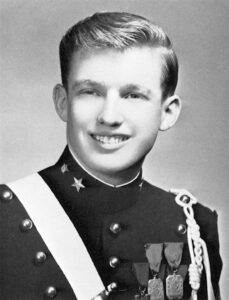
He arrived, in the memory of the training officer Theodore Dobias, unable to make his own bed or shine his own shoes, and left, five years later, having made himself into one of the school’s more effective operators, rising to cadet captain and leading the entire academy down Fifth Avenue in the 1963 Columbus Day parade. He has often mentioned it since. “I did very well under the military system,” he said decades later. “I became one of the top guys at the whole school.” In his own book, The Art of the Deal, he put it in terms that anticipate everything that follows: he learned, he wrote, “a lot about discipline, and about channelling my aggression into achievement.” From there he went to Fordham University for two years, then transferred to the Wharton School at the University of Pennsylvania, graduating in 1968 with a degree in economics, and walked directly into his father’s company, which he would rename the Trump Organization and, within a few years, remake in his own image.
That father is worth introducing properly, since the rest of the story does not make sense without him. Fred Trump Sr was not a Manhattan glamour developer but a builder of solid, profitable, unglamorous middle-class housing across Brooklyn and Queens, tens of thousands of apartments over four decades, a man who ran his family the way he ran his business, according to a strict internal ledger of winners and losers with almost no tolerance for anything that looked, to him, like softness. A lot in Trump may be to do with that Queens childhood organised around the building of things and the ranking of people by strength.
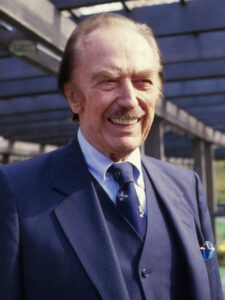
Fred Trump
Trump’s elder brother, Fred Trump Jr, known as Freddy, left the family firm to become a commercial airline pilot, a decision the family treated as something close to a demotion, comparing it, according to his daughter Mary, to that of a bus driver. Freddy’s drinking worsened, possibly under the weight of that disapproval, cost him his career and his marriage, and he died in 1981 at forty two, of a heart attack brought on by alcoholism, alone in a hospital. Trump has said, more than once and with what reads as real feeling, that his own lifelong abstinence from drink and tobacco owes everything to watching his brother’s decline. “Every day he lectured me,” Trump has recalled, quoting Freddy verbatim, “‘Look at the mess I’m in. If I ever catch you smoking, you’ll be sorry, drinking even a glass of booze because you’ll like it too much.’ Freddy did a good job.”
It is one of the few touching threads in the whole story, a real discipline forged in real grief, held for close to fifty years. His niece Mary, a clinical psychologist whose book on the family carries the not unbiased subtitle How My Family Created the World’s Most Dangerous Man, argues that Fred Sr’s cruelty toward Freddy taught the young Donald a colder lesson still, that any display of ordinary kindness was itself a kind of exposure, and that the only safe posture was his father’s own emotional remove. Kindness – not necessarily Trump’s strength, and we shall come back to it at the end. For now it is enough to say that something in him has run at two settings ever since: a puritan discipline about drink, and an appetite for achievement and the bling it can buy which is arguably the dominant leitmotif of his career.
Build, Build, Build
How did he do it? The young Donald’s first real move, once he took charge of the family firm in the early 1970s, was to cross the river: from Brooklyn and Queens rental housing into Manhattan itself, where the money, the newspapers and the skyline all were. He would later describe the philosophy behind that move in terms that have not really changed since. “I like thinking big,” he wrote in The Art of the Deal. “I always have. To me it’s very simple: if you’re going to be thinking anyway, you might as well think big. Most people think small, because most people are afraid of success, afraid of making decisions, afraid of winning.” This might be true to an extent – and yet it might be objected other people like to use their thinking time to do such comparatively unTrumpian things as to seek peace and quiet, to love unobtrusively, and in many cases, to avoid the spotlight if at all possible in favour of regular pauses for contemplation.
His first major deal, in 1978, was the rescue and rebuilding of the derelict Commodore Hotel next to Grand Central, the same building the novelist Sir Martin Amis would later use, correctly, as the defining case study of his method. After identifying his target, Trump struck, buying it a knockdown price and renaming it the Grand Hyatt. The deal was secured with a forty-year property tax abatement that Trump negotiated by threatening the city with the alternative of a permanently boarded-up eyesore.

Grand Hyatt Hotel, Manhattan, New York
He was on a roll. Trump Tower followed in 1983, the pink marble atrium on Fifth Avenue that turned his own name into a piece of architecture you could point at, and by the late 1980s the Trump Organization’s holdings ran to office towers, apartment buildings, golf courses, an airline shuttle and three Atlantic City casinos, an empire he described, without much modesty, in the language of art rather than commerce. “I don’t do it for the money,” he wrote. “I’ve got enough, much more than I’ll ever need. I do it to do it. Deals are my art form. Other people paint beautifully on canvas or write wonderful poetry. I like making deals, preferably big deals. That’s how I get my kicks.” The bravado was, on his own account, entirely deliberate strategy rather than simple boastfulness. “The final key to the way I promote is bravado,” he explained. “I play to people’s fantasies… A little hyperbole never hurts. I call it truthful hyperbole. It’s an innocent form of exaggeration, and a very effective form of promotion.” It is the same approach he would bring to the office of the presidency one day.
Then came Atlantic City, and things nearly came apart altogether: three separate corporate bankruptcies tied to his casino empire, in 1991, 1992 and again in 2004, and a fourth restructuring in 2009, each one a personal financial catastrophe that the corporate structure, and his own lenders’ reluctance to write off a name that still sold tickets, allowed him to survive largely intact. He has always preferred to describe the underlying appetite for risk rather than the wreckage it periodically left behind. “Most people are afraid to fail, so they don’t try,” he wrote. “Even if you fail, that’s how you learn. There has never been, and will never be, an Olympic skater who didn’t fall on the ice.”
You’re Fired
By the early 2000s that appetite had produced a man who was, on paper, worth a fraction of his own legend, and it was television, not real estate, that fixed the legend permanently in place. The producer Mark Burnett, an Englishman who had been a paratrooper in the Falklands before reinventing himself in Los Angeles as the creator of Survivor, pitched NBC a business version of the same format in 2003: contestants competing for a real job working for a real billionaire. NBC’s head of entertainment, Jeff Zucker, needed little persuading. “Being from New York, I understood what a publicity magnet Donald Trump was,” Zucker said years later. “I knew, if nothing else, it would generate a tremendous amount of publicity.” The show’s most famous line was, by the account of its own producers, a piece of on-set economy rather than scripted genius: contestants were originally to be told they should either “hit the street” or “hit the suite,” and Trump, unimpressed by the wordplay, proposed simply saying “you’re fired” instead.
The Apprentice ran for eleven years and turned that two-word sentence into one of the most recognised catchphrases in American television, delivered, invariably, with the same cocked-finger gesture, and it did something for Trump’s business reputation that decades of actual dealmaking had never quite achieved: it made a man who had been bankrupt in effect four times over into the most famous symbol of successful enterprise in the country, a man millions of Americans had watched, week after week, sit in judgement over other people’s careers. It is not a coincidence that the sentence he made famous on a reality set is the same one his administration would go on to apply, literally, to inspectors general, United States attorneys and FBI directors, within weeks of his first taking office.
Amis, writing decades before any of this, called Trump “a spotless, empty vessel,” a man who stood for nothing beyond money and the accumulation of attention, possessed of “no conscience and no curiosity,” qualities Amis thought far more sustaining than any amount of cleverness. “That question, how do you sleep at night, is meaningless to him,” Amis said. “He sleeps fine. He sleeps like a baby.”
On the other hand, Amis, as any reader of Koba the Dread soon discerns was not really a political animal and there is contained in his essay the seeds of an underestimation that would become widespread. There runs through Amis’ verdict a sense that Trump doesn’t quite understand life as he should which should remind us that Hilary Clinton was a huge favourite in the 2016 election precisely because nobody quite saw Trump coming because nobody knew what Trump had gleaned: that globalisation wasn’t working for many people in the crucial swing states in the mid-West.
There is a story in his second term which I think encapsulates this underestimation. Asked whether he could get rid of the then Chair of the Federal Reserve Jay Powell with whom he was in perennial disagreement over interest rate policy, Trump paused and thought and replied: “If I asked him to resign, I don’t think he would. If I told him to, that’s a different story.” It’s this ability to scent weakness, and to probe the boundary of what’s doable which plainly makes him a formidable wielder of power.
It’s precisely this which certain leaders, often derided as too nice – one thinks of Starmer again – appear to lack: the ability to ask oneself what one can get people to do, and to know how to maximise timing for political effect. This isn’t enough for greatness if what you’re seeking to achieve is wrong or selfish as it often is with Trump, but it is still a lesson in power and what to do with it, whether we like it or not.
The Tutor
It’s not hard to know, looking at Trump’s biography, how he acquired this skill. Roy Cohn is the man who turned that temperament into a method, and he deserves more than a walk-on part in the story. Cohn was born in the Bronx in 1927, the only child of a Democratic judge and a wealthy, ferociously connected mother, educated at Fieldston and then Columbia, from which he took both an undergraduate and a law degree while still a teenager. He made his name at twenty three on the prosecution team that sent Julius and Ethel Rosenberg to the electric chair for atomic espionage, reportedly the one who pushed hardest for Ethel’s execution. Then, barely into his mid twenties, Cohn became chief counsel to Senator Joseph McCarthy for the Army-McCarthy hearings, the televised 1954 spectacle that destroyed McCarthy’s career and nearly took Cohn’s with it.
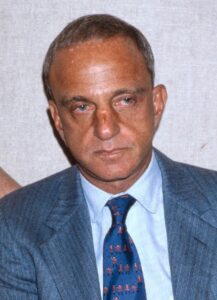
Roy Cohn
Cohn survived by retreating into private practice in New York, where he spent the next two decades as a fixer for clients that included all five of the city’s organised crime families alongside real estate developers, media figures and a cardinal, operating on the same three rules he would later hand down as doctrine: attack, attack, attack; admit nothing, deny everything; and always, whatever actually happened, claim total victory. Trump’s own later formulation of the same instinct, offered as business advice rather than autobiography, could almost be a translation of Cohn’s rules into commercial language: “The worst thing you can possibly do in a deal is seem desperate to make it,” he wrote. “That makes the other guy smell blood, and then you’re dead. The best thing you can do is deal from strength, and leverage is the biggest strength you can have.”
Once you know about Cohn, you start to feel that despite being dead he is practically functioning as president beyond the grave. He met Trump in 1973, at a private club in Manhattan, when Trump was twenty six and the family firm was facing a federal lawsuit accusing it of racial discrimination against Black tenants. Cohn’s advice, delivered on the spot, was not to settle but to countersue the government for a hundred million dollars, a case Trump eventually lost in substance while declaring victory in public exactly as instructed, and Cohn remained his lawyer, dealmaker and mentor for the next thirteen years.
It all ended badly. Cohn was disbarred by a New York court in 1986 for a catalogue of ethical violations and died of AIDS-related illness within weeks of the ruling, having spent his final months publicly insisting to Mike Wallace and Barbara Walters that he had liver cancer and was not gay, even as friends say Trump himself grew visibly distant from a dying man he had once called irreplaceable. He proved, in the end, exactly that: three decades later, as president, frustrated that his own attorney general would not fight for him the way Cohn once had, Trump was overheard asking, to nobody in particular, “Where’s my Roy Cohn?”
Amis understood what Cohn bequeathed the future President. Trump’s defining asset, he wrote, was that his antennae were exceptionally sensitive to weakness, “a crocodilian nose for inert and preferably moribund prey,” the same nose that had already found the Commodore Hotel. Amis’s closing question, posed years before Trump ever ran for office, was whether that nose could eventually be turned on democracy itself. In 2016 Trump answered it, diagnosing Jeb Bush, Marco Rubio and Ted Cruz as symptoms of an establishment gone soft and compressing the diagnosis into Low Energy Jeb, Little Marco, Lyin’ Ted, and, for the general election, Crooked Hillary, arguably the most durable nickname of the social media era. He had sensed, correctly, that the whole Republican establishment was itself a Commodore Hotel, a grand old asset in real trouble, waiting for someone unsentimental enough to buy it at a discount.
Into the Wilderness
His first term carried a flaw many of his own allies now identify as the single biggest difference between the two administrations: he did not surround himself with people loyal to him personally rather than to the institutions or donors they arrived from. The resulting churn – names that seem passé now, Tillerson, Mattis, Bolton, Scaramucci – consumed energy that might have gone into governing. Trump 1.0 seems now an oddly undisciplined affair full of infighting and incompetence, culminating in the misery of Covid-19, defeat to Biden and the madness of the 6th January 2021 Capitol Riots.

Then came the wilderness years, and it is here that the case for his resilience, whatever one makes of him otherwise, is at its most striking. After January 6th, Senator Lindsey Graham, no natural enemy, told reporters through evident anguish, “Trump and I, we’ve had a hell of a journey. I hate it to end this way… count me out, enough is enough.” Most contemporary observers assumed exactly that. He spent the next four years absorbing multiple indictments, civil judgments running into hundreds of millions of dollars, and then, after becoming the nominee, an assassination attempt in Butler, Pennsylvania that came within an inch of ending his life on stage.
The photo of him emerging bloodied and defiant that day changed him – and everything else. From that moment on, he always seemed the stronger candidate against a flat-footed and ill-prepared Kamala Harris. Trump would go onto win the popular vote for the first time in his career. Graham had by now performed a volte-face, and thanked him the following spring, putting the reversal as plainly as anyone could: “On a professional level, I am proud to have been there at the beginning when President Trump, through sheer force of will, achieved the greatest political comeback in American history.” He wasn’t done with Trump, after all.
Should presidents have to take a mandatory four years off to recharge their batteries and consider lessons from having held the office? It wouldn’t necessarily be a bad idea. The clearest evidence of what Trump did with his exile is the team he built the second time round, and whatever else is said of it, its central figures are demonstrably better at their jobs than their counterparts in Trump 1.0. Susie Wiles, his chief of staff, is by every account the load bearing wall of the administration, credited even by critics of the President with running the tightest, least leak-prone West Wing operation in a generation, blunt enough in interviews with the journalist Chris Whipple to call Elon Musk “an avowed ketamine” user and “an odd, odd duck, as I think geniuses are,” and to concede that the President himself “has an alcoholic’s personality” in his bottomless need for stimulation, without ever once, in JD Vance’s own words, being disloyal to him personally.
Meanwhile, Scott Bessent at Treasury is the most intellectually serious occupant of that office in a generation, a genuine macroeconomic heavyweight whose 3-3-3 plan (increasing growth, lowering taxes, and increasing energy production) has been taken seriously by investors and rivals alike regardless of its eventual verdict. Marco Rubio, once Little Marco, now serves as Secretary of State, and, in an arrangement that would have been unthinkable in almost any previous administration, National Security Adviser at the same time, a consolidation of two roles historically kept separate precisely so that no single voice could dominate the President’s view of the world. Rubio himself, a former rival with two decades of foreign policy experience in the Senate, has by most diplomatic accounts handled the double load with more competence than the arrangement’s critics predicted.
And what of Trump’s most likely successor? JD Vance has grown, across eighteen months, from an untested running mate into a genuinely consequential Vice President, the administration’s sharpest voice on where to draw lines with both Ukraine and Silicon Valley. Musk’s own Department of Government Efficiency, for all the chaos of its exit, did what previous efficiency drives in Washington had mostly only promised, it found real, auditable waste and cut some of it, even if the headline savings figures were considerably smaller than DOGE’s own claims, and his tenure still ended within months in a bitter public breach that required both Wiles and Vance to intervene personally, a rupture managed rather than left to fester, which is itself the whole difference between the two terms in miniature. It is, taken together, a cabinet built on a mix of real competence and a single shared test, the one Maher and every other visitor to that room eventually face: are you with him? What that discipline actually produced becomes visible only once you watch the presidency in action, room by room, ally by ally.
Zelensky, in the Room
Trump’s vision of foreign policy is impulsive and theatrical, but beneath the apparent chaos reasonably coherent if we accept that he is essentially looking for transactional relationships which will further American dominance. But at the same time, he believes in the reciprocal good of deals he’s prepared to make: in that sense it’s a businessman’s foreign policy. Everybody’s buying off each other, everyone’s receiving something.
Of course, this approach sounds reasonable but it doesn’t include something which can often prove defining in reality: namely, Trump’s extremely unpredictable temper. This fact, probably the chief among him alongside the supreme self-confidence that Susie Wiles noted and which is probably a sine qua non for presidents anyhow, is sometimes overlooked now that it has been our daily reality for over a decade. For instance, it was in the Oval Office, on the 28th of February 2025, that the second term’s foreign policy showed its teeth for the first time, in public, on camera, in a way no Oval Office meeting had quite done in the modern era.
Trump took office making it clear that he regarded the Russia-Ukraine conflict as almost embarrassingly soluble. At time of writing, it certainly hasn’t worked out that way. Its intractability seems to stem in part from the specific quagmire of the Ukrainian battlefield. But it also has something to do with his own bizarre liking for Vladimir Putin. A charitable explanation of this, as offered by Conrad Black, is that Trump wisely thinks that Russia ultimately belongs in the Europe-America camp (to the extent that under Trump 2.0 that is still a camp) as it did during the Second World War – and not alongside China. Another view is that Trump, an authoritarian instinctively, tends to warm to other authoritarians with an added warmth reserved for those who don’t have to face elections of any serious kind whatsoever.
My own sense is that a certain vanity is likely in play, but not always the kind we think. Trump often likes to seek movement on problems by doing something no one else can do, partly so that he can be seen to be doing it, and partly so that he can test a stagnant situation and rearrange it. This sort of instinct was on display when he began imagining Gaza as a piece of pleasant real estate, and also when he began to fantasise openly about the acquisition of Greenland. The Trumpian approach seems to amount to doing the unusual thing so that you can learn more about allies and enemies alike by seeing how they react to it. This has had noticeable wins – with NATO spending, in the Middle East (though the record isn’t straightforward), and in Venezuela. The trouble is that bizarre behaviour is sometimes redundant and his approach can simply exhaust everyone – and in the case of Iran, may even have had backfired to the point where he has exhausted himself.
Anyhow, Volodymyr Zelensky had come to sign a minerals deal. Within minutes it had become something else. “You’re gambling with the lives of millions of people,” Trump told him, his voice rising. “You’re gambling with World War Three.” It was something he would never have said to Putin, who actually started the war.
Zelensky, trying to explain that Ukraine had been fighting Russian aggression since 2014 under three American presidents before this one, got nowhere. JD Vance, sitting to one side for most of the meeting, leaned in to accuse the Ukrainian president of ingratitude – “have you said thank you?” – and of touring frontline suffering as propaganda. Trump, warming to the theme, told Zelensky flatly that he was “not in a very good position,” that he did not, in the phrase that would outlive the meeting itself, “have the cards.” Zelensky was, in effect, asked to leave. The press conference was cancelled, the minerals deal unsigned, and Trump posted afterwards that his guest could return “when he is ready for Peace,” capitalising the word as though peace were now a personal possession of his to grant or withhold.
It was, whatever else it was, the most extraordinary thing to happen inside that room in decades, a head of state harangued on camera by his host, and it told you something true about the presidency Trump had built the second time round: nothing, not diplomatic convention, not the presence of television cameras, not centuries of Oval Office custom, would be allowed to get between him and the version of events he wanted the country to see. Zelensky did, eventually, return, chastened and more careful with his gratitude, and the relationship settled into something workable rather than warm, closer to the transactional register Trump prefers with everyone, allies included, than to the moral solidarity Western leaders had extended Ukraine in the war’s earlier years. Whether that colder, more mercantile approach to an ally under invasion produces a durable peace or simply a durable resentment is, at the time of writing, still an open question, and probably the single most consequential one this presidency has yet to answer.
Being with Bibi
If Zelensky got the rebuke, Benjamin Netanyahu got something closer to a marriage, one with all the tenderness and all the exasperation that word implies. Trump has called him “a very, very special person” and has described the American relationship with Israel in the warmest terms available to him. This is broadly reciprocated in Israel – as was shown by the welcome Trump received in Knesset in early 2026.
Even so, according to the journalists Maggie Haberman and Jonathan Swan, whose book Regime Change draws on internal accounts of the administration’s first year, the warmth has coexisted with real fury. With someone like Trump, one suspects there are no cloudless relationships – at least none which don’t contain absolute submission to his will. During last September’s push for a Gaza ceasefire, Trump reportedly told Netanyahu, in front of his own Jewish aides, that everybody, including the Jews on the call, was sick of him. Earlier in the term he had called him a con man in private. And yet by September the two men stood together at the White House announcing what Trump called, with his usual appetite for understatement, one of the great days ever in civilization, the outline of a deal to end the Gaza war. The relationship runs on the same operating principle as everything else in this presidency: total, theatrical loyalty when things are going his way, and total, theatrical fury the moment they are not, with remarkably little space in between for the quieter register most leaders reserve for their closest allies.
But it would be a mistake to read the volatility as the whole story, because underneath the theatre sits a theory of diplomacy that is more coherent than Trump is usually given credit for. The Abraham Accords, his first-term legacy achievement, were never built on historic grievance being resolved or ancient enmities being reconciled. They were built on the much cruder and, it turns out, much more durable proposition that a Gulf monarchy which can trade freely, fly direct, and build alongside Israel rather than against it will eventually find that arrangement more attractive than the old grievance was. Whatever one makes of the man, the wager underneath the Accords is close to a universal truth about how people actually behave once the abstractions are stripped away: nearly everyone, in Riyadh or Rabat or rural Ohio, wants roughly the same thing Trump himself visibly wants, money, security, and a good life for their children, and a leader who can plausibly promise more of that is harder to refuse than one arguing from history or justice alone. It is, in its way, the least romantic and most effective diplomatic instrument available to him, considerably more effective than any speech about shared values – witness for instance Obama’s 2009 Cairo speech – has proved to be.
It is in that light that his most startling remark on the subject deserves to be taken seriously rather than dismissed as a stunt. In the course of pushing to end the war with Iran in May 2026, Trump told a group of Muslim leaders that he expected all of them, in time, to join the Accords, and floated, almost in passing, the idea that Iran itself should one day do the same. Said of any other country in the region this would have sounded routine. Said of the Islamic Republic, a state whose founding posture toward Israel is annihilation rather than accommodation, it sounded close to unsayable. And yet it is difficult, once the thought is out, to unthink it. A great deal of the misery of the last half century in that region has been justified in the name of ideology, faith, and history. Almost none of it has been justified in the name of prosperity. If Trump’s crude wager is even partly right, that people will generally choose the good life over the old grievance if someone credible enough offers it to them, then the outlandish idea of Tehran at an Abraham Accords signing table is not a fantasy so much as the logical endpoint of the whole project, the one door left genuinely closed.
Crown and Country
Of all the foreign leaders and heads of state Trump has met across two terms, none has produced quite the same register in him as the British monarchy, and the reason for it is, on the record, not really a mystery. His mother, Mary Anne MacLeod, was born in 1912 in a fishing village called Tong on the Isle of Lewis, in Scotland’s Outer Hebrides, the youngest of ten children of a Gaelic-speaking sub-postmaster, and left at eighteen with almost nothing for a domestic’s job in New York. She kept, by every account, a lifelong and faintly wide-eyed reverence for the Crown she had grown up a subject of, and it plainly passed to her son. Landing in Aberdeen for a golf course opening in 2023, Trump told reporters, “It’s great to be home, this was the home of my mother,” and the White House itself, briefing his second state visit in 2025, put the connection on the record without embarrassment: the relationship, a deputy press secretary said, was “bolstered by President Trump’s family ties to Scotland.”
That inheritance meets, in the King, the one kind of authority Trump has never had to compete with or discredit to enjoy. Here is pageantry without the indignity of an electorate, hierarchy without the need to argue for it, a status secured by simple accident of birth rather than by combat, focus group or the endless corrosive work of being right in public. He was given, in September 2025, the honour no American president had received before him, a second state visit, and he did not undersell it. “It’s the first time this has ever happened where somebody was honoured twice,” he told reporters. “So, it’s a great honour,” he added with his usual repetitive logic.
Building on this theme, at the Windsor Castle banquet he called it “one of the highest honours of my life,” and of the King himself, whom he had known, in his own words, “long before he was king,” he said simply, “it’s an honour to have this king.” It is very hard, reading the transcripts of that visit, to locate the man who calls reporters piggy or turns a rival’s death into a talking point about himself. Whatever else the monarchy has that Trump wants, it appears to be the one context reliably capable of making him behave.
Because it is worth being honest about how differently he treats everyone else who has extended him warmth without power to back it up. Sir Keir Starmer’s turn in the Oval Office came three days before Zelensky’s, and it could hardly have gone more differently from that encounter, at least at first. Starmer cannily arrived bearing an actual letter from King Charles inviting Trump to that second state visit, and delivered it with a ceremonial warmth that, by all accounts, genuinely moved his host. “We’re very long-time partners and allies and friends,” Trump said of him later that year, “and we become friends in a short period of time. He’s slightly more liberal than I am, to put it mildly.” The two men went on to land a trade deal on cars and aerospace that six years of prior negotiation had failed to produce, Trump crediting Starmer directly for succeeding “where other people… haven’t been able to.”
As with almost all of Trump’s relationships, it didn’t last. By summer, as the coalition around the Iran war frayed and Britain grew more openly critical of the toll in Gaza, Starmer was telling his own MPs he was “fed up” with an ally he could not always predict and rarely controlled, and the steel tariffs he had been promised would fall to zero never quite did. The state visit itself, when it came, was full of royal pageantry and mutual compliment at Windsor, and changed nothing about the underlying terms of a relationship that remained exactly as asymmetric as before the King’s letter was delivered.
It is tempting to read something larger into which authority this particular man is willing to defer to and which he is not. The most profane and least deferential figure in American public life, a man who has called a sitting NATO ally’s leader ungrateful to his face, has never once, on any available record, been anything but reverent in a room with the King of England. More than that, it’s impossible to imagine him being so. Nowadays, and especially since the first assassination attempt at Butler, Trump invokes God’s favour regularly, insisting he was spared for a purpose. Whatever the true extent of his belief, it shares an odd kinship with the deference he shows Charles: both responses reach for something above the transactional register that otherwise governs every one of his relationships, ally and adversary alike. It may be that a man who has spent a lifetime being the most powerful figure in every room he enters simply requires, every so often, a room with someone plausibly above him in it, and that of all the candidates available on Earth, only a crown and, on his own account, God himself have so far qualified.
What Cannot Be Undone
What’s plain by this point is that Trump didn’t seek a return to power simply to occupy the office. He sought a more disciplined operation, staffed by people who knew what they were doing. Speaking on a Council on Foreign Relations panel this year, the historian Hal Brands recalled that when The Atlantic told Trump it meant to profile him as the most consequential modern president, he took the description as a compliment, untroubled by the fact that consequential says nothing about whether history judges the consequences good or bad. “I thought it was really revealing,” Brands said, “seeing consequential as the goal regardless of whether the outcome is defined or thought to be, in the end, by history positive or negative.”
It’s a reminder that with Trump, as with all presidents, people sometimes hear what they want to hear. I doubt very much Trump thought Brands was openly suggesting his agenda was wrong, and that he was voicing an indifference to the outcomes of his policies. But the story is worth relating because it shows what ground his opponents are prepared to cede him, even if they’re inclined to misrepresent him while ceding it. In Trump’s case, nobody says he’s ineffective at getting things done, so it’s a reasonable inference that he has achieved more than is usual of his agenda in the presidency.
This is Skowronek’s reconstructive president: one who measures success against the durability of the disruption, not the approval of the moment, binding “every one of his successors, even those from the opposite party,” in Skowronek’s words, to “political expectations that he set.”
Despite some talk of Lyndon Johnson and Ronald Reagan, and a few pieties about Clinton and Obama, the last president really to change the game like this was probably FDR. Roosevelt’s reconstruction rested on durable institutions and a domestic settlement, Social Security, the regulatory state, that no later president seriously tried to dismantle, because it worked. On the face of it, Trump’s runs the opposite way: contracting those commitments, concentrating executive power at the centre in the person of a strongman: him. What sometimes gets missed is that this reversal – if it’s really happening, which we’ll come onto in a moment – has a real argument behind it, which sensible people espouse. It goes roughly like this. Total government spending, federal, state and local, stood at 21 percent of GDP just after the Second World War. By 2025 it was an estimated 40.6 percent, nearly double, according to budget office data. Federal spending alone hit 22.8 percent of GDP in fiscal year 2025. Federal tax receipts, meanwhile, haven’t moved: they’ve averaged close to 18 percent of GDP every year since 1946, in a band between 14 and 21 percent, whoever held the White House, whatever the marginal rate. Economists call this stubbornness Hauser’s law. Spending doubled. Revenue didn’t. The gap has been financed by debt rather than honesty, because honesty would have meant telling voters what the settlement actually cost. Trump’s case for concentrating power back in the one office the country actually elects is that the administrative state has drifted out of reach, both of the voters who live under its rules and of the revenue meant to pay for it.
So far, so good. But then there’s what gets said versus reality. This is where it gets more complicated. Trump’s first term added $7.8 trillion to the national debt, and the pandemic explains only part of that: the Committee for a Responsible Federal Budget traces $1.9 trillion of ten-year borrowing to the 2017 tax cuts alone, agreed before Covid existed. His second term is repeating the sum, not correcting it. The One Big Beautiful Bill Act, signed on the Fourth of July 2025, is projected by the CBO to add $3.4 to $4.1 trillion to the deficit over the next decade, pushing debt held by the public toward 124 percent of GDP by 2034. This is why Elon Musk fell out with the administration calling it a “disgusting abomination” and said flatly that “Congress is making America bankrupt.” House Republicans elected on the same small-state argument voted for it anyway. One of them, a Freedom Caucus founder, admitted the numbers gave him “heartburn” and voted yes regardless. The diagnosis, that a state spending nearly double what it once did on a tax base that hasn’t grown, is heading somewhere unsustainable, may be correct. The cure, on the only numbers that matter, isn’t working. The bill built to prove the state could finally be cut instead became one of the largest single additions to the debt in the country’s history, on arithmetic his own party doesn’t dispute.
The Ledger
Yet as you put together the broader picture, it is plain that Trump is indeed remaking America and the world in some crucial respects. On immigration, ICE street arrests rose more than elevenfold in 2025, and Goldman Sachs estimates net immigration has collapsed by roughly eighty percent, though economists using the Deportation Data Project’s own figures have so far found no corresponding wage gains for American-born workers in the areas most heavily targeted. On tariffs, the underlying critique, that three decades of globalisation left manufacturing communities exposed, carries real weight, but the Yale Budget Lab estimates the 2025 programme leaves the economy permanently around 0.6 percent smaller, and manufacturing employment fell by 68,000 jobs in 2025 even as the tariffs were meant to protect it. On NATO the record looks close to unambiguous vindication: every member bar Spain has committed to five percent of GDP by 2035, and Secretary General Mark Rutte has credited sustained American pressure, across both terms, for a shift a decade of quieter diplomacy never achieved.
In January 2026, American special forces captured the Venezuelan dictator Nicolas Maduro in a night raid on his Caracas compound. “We are reasserting American power,” Trump said within hours, adding that the United States would “run the country until such time as we can do a safe, proper, and judicious transition.” Tim Kaine’s answer is worth quoting in full: “Maduro is terrible, but Trump put American service members at risk with this unauthorised attack.” For Trump the second half of the sentence is justified by the second.
And the same would be true when it comes to the ongoing question of Iran. In this instance, strikes badly degraded Iran’s nuclear infrastructure, the Iranian leadership was wiped out, and yet the administration seems to have badly miscalculated the economic effects of an otherwise disciplined set of actions. By July, the ceasefire collapsed after attacks on shipping in the Strait of Hormuz, sending Brent crude back toward eighty dollars a barrel. Trump called the resulting pain “a small price to pay,” a formulation that will be judged, like the rest of this record, by results rather than rhetoric. Lord Hague is among those who think Trump’s MOU with Iran was far too lenient, though he himself has called it a ‘test’ distinct from any finalised deal. If so, it is a test which Iran has surely failed, and at time of going to press there seems to be no end in sight to yet another conflict in that unhappy part of the world.
The Verdict
The question of the Straits of Hormuz and the price of oil might prompt us to ask what kind of economy is Trump actually building, and what does it mean for anyone trying to build a career inside it, or alongside it?
The honest answer is a more closed one than the world has operated under for thirty years, and its effects are already visible well beyond American borders. In September 2025 the administration imposed a new $100,000 fee on H-1B visa applications, the main channel through which American companies have long imported skilled foreign engineers, chiefly in technology and healthcare, the sectors Trump’s own proclamation accused of using the programme to undercut American wages. The fee makes it, in the words of one immigration lawyer, a “luxury work permit,” survivable for Amazon, Microsoft, Meta, Apple and Google, and close to prohibitive for the seed-stage AI startups that cannot absorb it. Nvidia’s chief executive Jensen Huang has said plainly that his own family’s move to America, the move that eventually built one of the most valuable companies on earth, “would not have been possible” under the current rules.
The predictable consequence is that other countries have started making the opposite bet at exactly the moment Washington closed the door: China launched a new visa category in October 2025 aimed at young STEM researchers without an employer sponsor, and Canada, the UK and several European governments have quietly widened their own skilled-worker routes to catch whatever talent bounces off the new American wall. For a Finito World reader building a career in engineering, data science or medicine anywhere outside the United States, that is not an abstraction. It is a genuine, current widening of where the best jobs, and the best colleagues, might plausibly be found.
The domestic picture is similarly two-sided. The same instincts behind the H-1B fee and the immigration crackdown are aimed explicitly at reserving entry-level and mid-skill jobs for American-born workers, and Commerce Secretary Howard Lutnick has said as much without euphemism: “Train Americans. Stop bringing in people to take our jobs.” Whether that reservation actually produces the wage gains promised remains, as this piece has already shown, a genuinely open question, but its second-order effect on employability is already measurable: companies unable to sponsor the talent they want are accelerating investment in domestic upskilling, in automation, and in what recruiters now call nearshoring, hiring or subcontracting talent in Canada and Latin America instead. None of that is necessarily bad news for those workers. It is simply a different map of opportunity than the one that existed in 2016, redrawn by tariff schedules and visa fees rather than by universities or by merit alone.
Zoom out to the global level and the picture sharpens further. The IMF’s most recent World Economic Outlook, published over the summer, projects global growth slowing to around 3 percent for 2026, with global trade growth falling sharply to 3.5 percent from 5 percent the year before, a deceleration the Fund attributes substantially to the fragmentation of trade relationships that Trump’s tariff programme has driven. Energy exporters and countries plugged directly into the technology and AI investment boom are broadly better positioned; commodity importers without that exposure are seeing their growth forecasts quietly marked down. For employability specifically, the practical translation is this: a young professional’s career prospects now depend more than they did a decade ago on which side of that divide their country and sector happen to sit, a divide substantially shaped, whether intentionally or as a side effect, by decisions made in the same small room this piece began in.
None of that, though, should be mistaken for the whole verdict, because ignoring what can genuinely be learned from a man this consequential is its own kind of failure, exactly as serious as ignoring his worst side. To do the first is to miss what he represents to enormous swathes of his own country, and what turns out to be possible when someone is willing to be creative, even reckless, with the actual machinery of power rather than merely custodial of it. But what would have made the whole story something more than consequential, what would have made it great in a sense even his critics could not argue with, is if the same man had managed to be kind as well as effective, and this is precisely where the case for Trump falls apart. Hours after the killing of Rob Reiner, he chose to post that Reiner’s death was “due to the anger he caused… known as TRUMP DERANGEMENT SYNDROME.” Months later, in front of cameras, he told a female reporter to be “quiet, piggy.” These are not slips. They are a pattern, and the pattern is the point: a man with the tools to be magnanimous choosing, again and again, not to be.
It is worth asking, of a fortune and an office this large, what either one is actually for, if not, eventually, to be kind with. Nobody watching Trump, or for that matter Elon Musk, over the past two years would come away with much confidence that either man is greatly troubled by the welfare of people who cannot do anything for him. Toughness is not the missing ingredient. Presidents are tough by definition, and none in modern memory has been tougher than this one. What is missing is the thing toughness was always supposed to be in service of. Trump invokes God’s favour often and without embarrassment, most memorably after Butler, where he has said more than once that he believes he was spared for a purpose. It is worth remembering, in that light, that the tradition he is claiming as his witness has a long and exacting memory for exactly this kind of language, and has never yet let a powerful man choose which of his own words get quoted back to him.
Whatever else this piece has established about the scale of what Trump has done to the American presidency, and it has been a great deal, the anniversary in the previous pages is as good a place as any to end on a smaller and more sobering point. However vast the power of that office, however completely one man has managed to bend it to his own account of himself, its limits remain exact and unmoved: all that he cannot change, all that he cannot maintain, all that was never his to begin with. Even from behind the Resolute Desk, even holding the loudest microphone on Earth, that turns out to be nearly everything.
DONALD J TRUMP EDUCATION TIMELINE
1946 — Born Donald J. Trump in Queens, New York, the fourth of five children of Fred Trump, a property developer, and Mary Anne MacLeod Trump.
1959–1964 — Sent to the New York Military Academy, Cornwall-on-Hudson, at thirteen after a disruptive spell at the Kew-Forest School. Rises to cadet captain.
1964–1968 — Two years at Fordham University, then transfers to the Wharton School at the University of Pennsylvania, graduating in 1968 with a degree in economics.
1968–1970s — Joins his father’s firm on graduation. Takes charge in the early 1970s, renames it the Trump Organization, and moves the business from Brooklyn and Queens rental housing into Manhattan, culminating in the Grand Hyatt (1978) and Trump Tower (1983).
2004–2015 — Hosts NBC’s The Apprentice for eleven years, a role that recasts a man who had been through multiple corporate bankruptcies as the country’s foremost popular symbol of business success.
2015–2016 — Announces his candidacy, defeats a crowded Republican field including Jeb Bush and Marco Rubio, and wins the presidency.
2020–2024 — Defeated for re-election, faces multiple criminal indictments and an assassination attempt in Butler, Pennsylvania, and is widely written off before returning to win the popular vote for the first time in his career.
2025–present — Second term. Cabinet built around Susie Wiles, Scott Bessent, Marco Rubio and JD Vance; the Venezuela raid and Midnight Hammer strikes on Iran; NATO’s shift to 5% of GDP; tariffs deployed as a primary tool of statecraft.