



 BBC News
Borrowing was £17.4bn last month, the second highest October figure since monthly records began in 1993.
Christopher Jackson
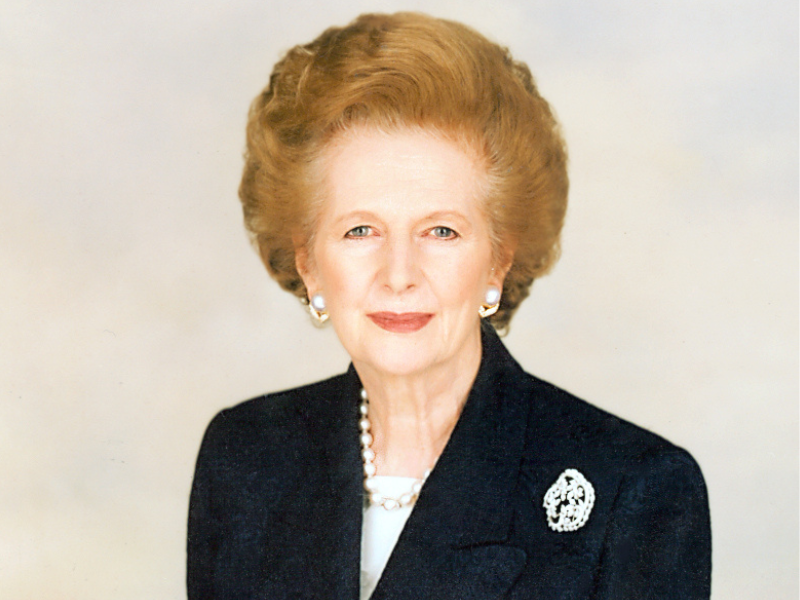
My grandfather died just before Christmas 2013 and so I often find myself thinking of him at this time of year. A gentle soul, who would probably wish to erase this reference to himself if he could, nobody ever thought of him as iron-like, and yet he springs to mind as I consider the ghost of Margaret Thatcher, who would have been a hundred on October 13th 2025.
The reason is this: my grandfather had an interesting legal career and became president of the Westminster Law Society. One evening in the 1980s, the society was hosting Margaret Thatcher, who came along the reception line of waiting lawyers, as prime ministers do on these occasions. She was about to vote on an important bill – my grandfather couldn’t remember which – but it was a sticky issue and she wasn’t quite sure how to vote. What struck him was that she asked him, there in the line, what she should do. It seemed humble, but also as not at all what he would have expected of her, given her media image.
On another occasion, he was at Chequers and, as the evening drew to a close, the assembled company was told to head off upstairs to bed as the Prime Minister needed to work. He remembered forgetting his glasses and coming back downstairs to find her curled up asleep on the sofa – not quite the three-hours-a-night PM we’re told about today, but a more human one.
More human than we sometimes imagine perhaps – but undoubtedly still one of the very few who one feels was really up to the job of PM. Sir Anthony Seldon famously called the prime ministership The Impossible Office – but it never seemed quite so impossible to Margaret Thatcher – or at least not until the very end. Even then, the dismay she plainly felt at her departure seemed to have something to do with not wanting to leave the one job which she felt matched her capacities.
But my grandfather’s memories, sketchy though they were, show that Thatcher was often different to know than her image suggested. The same could be said of many political figures – Dominic Cummings, for instance, comes across as far more thoughtful and strategic in person than his scowling public persona might suggest. But Thatcher’s towering legacy casts both an inspiring and troubling shadow over Britain’s conservative movement today. The woman who transformed Britain in the 1980s left a blueprint that shaped Conservative thinking for decades, yet that blueprint now lies in tatters, torn apart by Brexit, economic mismanagement, and the rise of populist challengers who claim her mantle while, in some cases, arguably abandoning her principles.
Two female prime ministers and seven male prime ministers have come since her tearful exit from Downing Street. What a strange procession they can sometimes seem. One sometimes wonders what she would have thought of Prime Minister May and Prime Minister Truss.
The Thatcher Template
Why was her premiership so important? Some of it can be told in statistics. Even there, before we even get to her symbolism and style, Thatcher’s impact on British political and economic life cannot be overstated. Let’s start with the economic statistics. Her governments created 2.8 million jobs between 1983-1990, fundamentally reshaping the UK’s economic landscape from heavy industry to services. She spearheaded the privatisation of state-owned industries, from British Telecom to British Gas, transforming the UK into a predominantly private-sector economy.
By the time she left office in 1990, around 50 major state-owned industries had been privatised, collectively worth billions of pounds. This move not only revolutionised the economy but also established a new class of shareholders and consumers, further cementing the nation’s financial future.
Thatcher championed entrepreneurship with an almost evangelical fervour, declaring that “there is no such thing as society” while simultaneously creating conditions where individual ambition could flourish. Her policies transformed Britain into Europe’s financial capital, attracting global talent and creating lucrative career paths in banking, finance, and professional services. This development alone was democratising. It was Sir Martin Amis who, in his memoir Experience (2000), observes that it was the nail in the coffin for the old boys’ network: “Whatever else she did, Margaret Thatcher helped weaken all that. Mrs. Thatcher, with her Cecils, with her Normans, with her Keiths.”
She also pursued aggressive tax cuts, reducing the top rate of income tax from 83% to 60%, and then to 40%, which encouraged both foreign investment and domestic entrepreneurship. In addition, her controversial but transformative policies on housing – allowing council tenants to buy their homes under the “Right to Buy” scheme – empowered millions of people to become homeowners, a key shift in Britain’s social fabric.
Her foreign policy, while often overshadowed by domestic issues, also left a lasting impact. Thatcher’s resolute stance during the Falklands War in 1982 helped restore Britain’s global reputation and reaffirmed her reputation for political courage and determination. Her relationship with Ronald Reagan strengthened the West’s resolve during the Cold War, and her role in promoting the European single market reshaped the contours of European integration. It was said that she would go into the Reagan White House and tell him what she thought – and then tell him what he thought. Nobody has done that since, or at the moment seems likely to again. It was perhaps the inverse of Starmer’s fawning relationship with President Trump.
Those who worked with her recall not just her legendary work ethic – despite my grandfather’s anecdote, she genuinely was capable of surviving on remarkably little sleep as any reader of Charles Moore’s great trilogy of biographies on her will know – but also her unexpected moments of vulnerability and kindness to staff. She could be funny, self-deprecating, and surprisingly willing to listen to advice from unexpected quarters. These human touches made her formidable political persona all the more effective.
For all the human qualities that made Thatcher an iconic figure, her impact on the Conservative Party and the wider political landscape was not just personal – it was profoundly institutional. Successive leaders of the Conservative Party, whether in power or in opposition, have had to grapple with her legacy, navigating its complexities and contradictions while trying to carve out their own political identities. Some admired her, others sought to distance themselves, yet all have been shaped by the framework she created. Tony Blair, for instance, recognised her economic reforms and, while ideologically opposed to much of what she represented, acknowledged her role in transforming Britain. Gordon Brown, despite their many disagreements, invited her to 10 Downing Street when she was still alive, demonstrating a respect for her place in British history. The Iron Chancellor eventually had to tip his hat to the Iron Lady.
David Cameron, though often characterised as a moderniser, sought to channel Thatcher’s ethos in his “Big Society” project, blending free-market ideas with an appeal to social responsibility. Theresa May, too, found herself within Thatcher’s shadow, wrestling with questions of national identity and the country’s place in the world post-Brexit: it can sometimes seem as though Thatcher’s own complicated relationship with Europe rippled out somehow to become the Party’s predicament.
Boris Johnson’s administration invoked Thatcher’s spirit in the rhetoric of “levelling up,” even as his policies often diverged from hers. In fact, the common complaint from the Brexiteers that the UK no longer makes things, can be seen as a sort of direct rebuke to Thatcher’s legacy – even if it was made in a Thatcherite tone of voice. Liz Truss, in her brief tenure, took a more direct approach to Thatcherism, promising to reignite the economic dynamism she championed, only to face a turbulent end to her premiership.
These figures, in their own ways, continued to grapple with Thatcher’s influence. Yet, as the Conservative Party moved further away from her core tenets, the stark challenge for her successors became clear: how to reconcile her vision with the changing political, economic, and social landscape of modern Britain.
The Sunak Paradox
Rishi Sunak’s thumping defeat in July 2024’s election – ending 14 years of Conservative-led rule – represents more than a typical change of government. It marked the failure of technocratic competence to address deeper structural problems. Despite his Goldman Sachs credentials and hedge fund experience, Sunak could never solve the party’s central contradiction: how to be simultaneously pro-business and pro-Brexit, globally competitive yet domestically protected.
His approach was hampered by an essentially transactional nature that worked well in financial services but proved inadequate for the retail politics required to maintain an electoral coalition. He made some simple slips. I remember at the time how upset his backbenchers were about him being photographed next to Lord Cameron: Sunak looked both literally and figuratively smaller than his more confident predecessor. One told me: “About 70 per cent of the job is foreign affairs and Rishi left that largely to Cameron. He then proceeded to micromanage the other 30 per cent going down as far as junior ministerial level on matters he should have left alone.”
But this was to some extent style, and nobody really doubted that Sunak was up to what Richard Nixon called ‘the work’. The problem was that under Sunak, the Conservatives failed to articulate how modern Britain could create the kind of secure, well-paid jobs that had sustained their electoral appeal since Thatcher. He also balked at the idea of tax cuts, as did his Chancellor, the otherwise competent Sir Jeremy Hunt. Once at a Finito breakfast, I floated the idea of abolishing stamp duty or council tax as a way to change the narrative, and he dismissed this as bribery of the electorate. I remember thinking how many of the electorate wouldn’t mind being bribed if it meant they could afford their household bills.
In acting like this, Sunak and Hunt were, though they would likely resist the label, anti-Thatcherite while also professing to espouse her legacy. Sunak’s super-deduction on capital allowances—a key pro-business measure—was mysteriously allowed to expire in March 2023. This reluctance to embrace traditional Conservative economics left the party without its most potent electoral weapon and abandoned the field to more radical alternatives. It was a gift to Nigel Farage who has never really looked back.
Fractured Movement
Kemi Badenoch’s historic election as the first Black woman to lead a major British political party in November 2024 therefore came with an impossible inheritance. As Business Secretary she had presided over very few memorable developments. Even today, despite a year as leader, she is mainly known for one anti-woke speech in the House of Commons. This might have its upsides, but her problem is that Farage can – and does – make those too – and he knows better than she does how to speak to the solar plexus.
Badenoch was tasked with leading a right-wing movement while reuniting a divided and weakened party that had been emphatically removed from power. As “a self-proclaimed enemy of wokeness” who “has suggested that maternity pay in the U.K. is “excessive,’” she represents a harder edge than her predecessors. Yet her background as a software engineer offers potential appeal to the knowledge economy workers the Conservatives desperately need to win back.
The thing is it’s not really working. Labour is highly unpopular since it has done what it always does and snookered itself into tax rises which people can’t afford, but the Conservatives haven’t been forgiven yet for the Truss debacle and the perception of malaise under Sunak – and in any case Farage has easily outflanked her. Rumours persist also about her personal style, especially with her immediate team. Andrew Pierce, at a recent Finito breakfast, said she had managed to be rude to a major political donor and The Sunday Times – and he was talking about that previous week. I wonder if this is a misunderstanding about Thatcher: the recent Steve Coogan drama Brian and Maggie shows how skilled Thatcher was at precisely the relationships which Badenoch seems to deem beneath her.
Still, she has her good points. When she was a minister under Sunak, Badenoch displayed the kind of optimism that Conservative politics demands, arguing that “we’re doing better than Germany, which hasn’t left the EU.” She insisted that “we need to not just prove them wrong but to communicate what we’re doing,” recognizing that the party’s fundamental challenge was one of messaging and narrative. But with Reform UK now breathing down the Conservatives’ necks, such messaging may prove insufficient.
Farage’s Ascendancy
However, surely the most striking development in British politics has been the meteoric rise of Reform UK under Nigel Farage. In the 2024 general election, Reform UK secured more than 4 million votes—14.3 percent of the total votes cast—winning five seats in the process. More remarkably, recent polling suggests that if a general election were held tomorrow, 25 percent of British voters would choose Reform UK, potentially making them the largest party. Reform UK have even claimed to have overtaken the Conservatives to become the UK’s second-largest party, behind Labour, in terms of size. Today when people talk of Nigel Farage as the next PM, nobody’s joking – and this is the case even though he doesn’t have an economic policy.
Does he need one? As with Trump in 2016 in the US, it may be that he needs only the implications of his tone to succeed. Farage’s success represents a fundamental challenge to the traditional Conservative electoral strategy. While Thatcher’s Conservatives attracted aspirational workers with promises of home ownership, social mobility, and the expansion of free-market principles, Reform appeals to a different constituency: those who feel left behind by globalization. Farage’s policies blend his longstanding political stances – such as advocating for strong borders and curbing immigration –with ideas reminiscent of US President Donald Trump’s administration. Farage tells us: “The most important thing we need to focus on is restoring the values that made Britain great—values of hard work, family, and prosperity.”
This shift presents a particularly acute problem for Conservative messaging. The traditional Conservative base – comprising small business owners, skilled tradespeople, and middle management – now increasingly views immigration not as an economic necessity but as direct competition for jobs and housing. Farage’s pledge to “dramatically reduce immigration while investing in British workers” resonates deeply with voters who feel sidelined by the government’s complex and inconsistent approach to labour market policies. “Government itself doesn’t promote growth,” Farage explains. “What government does best is clear away the barriers to allow individuals to get on with it, make money, and succeed.” His vision calls for a dramatic overhaul of government regulations, advocating for deregulation to spur entrepreneurship and remove bureaucratic obstacles.
Farage’s populist rhetoric taps into the frustrations felt by many Britons who believe their nation’s prosperity has been compromised by globalism. “We’ve let foreign companies take over our industries, we’ve allowed unchecked immigration to drive down wages, and we’ve allowed our communities to disintegrate,” Farage explains. “It’s time to take back control, not just over our borders, but over our future.”
Farage’s rise poses a direct challenge to the Conservative Party, especially as the country faces issues that echo Thatcher’s own era of economic discontent. Much like in the 1980s, Britain now finds itself at a crossroads, with questions about national identity, economic strategy, and the role of government in supporting entrepreneurship at the forefront of political discourse.
This challenge is especially evident with Sir Keir Starmer, who finds himself unable to address the deep divides within his own party and between the party and the electorate. Despite his virtues, Sir Keir Starmer’s leadership has failed to resolve the contradictions at the heart of Britain. “The truth is, we’re being led by people who believe in nothing,” Farage continues. “We need a fresh start, a leadership that understands the real problems people face, not one that gets lost in the minutiae of policy.”
Farage’s growing influence underscores a shift in the political landscape, one that requires a different approach to addressing Britain’s economic and cultural challenges – one that taps into the populist energy that Thatcher harnessed so effectively during her time in office, but with a sharper focus on identity, borders, and the protection of national interests. For many, Farage’s rise represents the final stage in a wider Conservative reckoning, as the party confronts its Thatcherite legacy while navigating an increasingly fractious and uncertain political environment.
The Blair Shadow
The Conservative Party’s current crisis has deeper roots than Brexit or recent leadership failures. Tony Blair’s New Labour project didn’t just defeat the Conservatives electorally in 1997 – it stole their ideological clothes. By embracing business-friendly policies, financial services expansion, and aspirational messaging, Blair made the Conservatives redundant for a generation of voters.
Starmer hasn’t necessarily repeated this: his tax rises are enough to show that. But it did mean in 2024 that by seeming to be close to Blair – and therefore at one remove, Thatcher – he was able to convince swathes of the country that he wasn’t a frightening notion as PM. In a way this meant that he wouldn’t do precisely what he has done: exponentially raise taxes. This, too, plays directly into Farage’s hands.
One suspect too that if Boris Johnson were still around it would play into his. Johnson tells us: “Today you have got an absolutely appalling situation – a classic situation engendered entirely by this Labour government – in which the bond markets are starting to demand ever higher yields on British gilts because they can see no clear economic[plan from the Labour government.”
Michael Gove, reflecting on this challenge during his time in government, explains that: “sometimes the preoccupation of the detail of a policy and the willingness to trade this or that statistic in order to prove that things are working means that people’s eyes glaze over because politics is ultimately a crusade.” The party had become, in his words, “administrators and not evangelists.” You could say the same of Labour today.
Is it possible then that Blair’s appropriation of Thatcherism left the Conservatives somehow without substance? That they didn’t know what they stood for anymore – other than being in power.
This turns out to be a difficult question to answer. Gove and President Obama, who uses a similar argument to explain the decline of the Democrats in the US, seem to argue in effect that politics is so boring that you lose popularity by being good at it. The argument runs that the detail leaves people cold, and that it’s essentially a thankless business where nobody realises the scale of what you’ve secretly achieved.
But it’s only partially true – and when the argument is being made by people who have been in government for a long while it can feel even less convincing. That’s partly why it’s critiqued from both sides. In the US, the Bernie Sanders lobby will say Obama wasn’t left-wing enough; in the UK, Farage will say Gove wasn’t right wing enough. Francis Fukuyama would say we’re at the end of history. Obama and Gove would sort of agree insofar as they’d say the problems are difficult and likely to continue to be so, and that ideology won’t get you far.
But there are two main examples running in the opposite direction. One is Trump. The other is Thatcher. Both seem to be examples of energetic political action where things really seem to happen whether one agrees with them or not. Going back into history we’d have to add FDR, Alexander Hamilton, Robert Peel and William Pitt as examples of leaders who really did change things.
This was what made Blair’s borrowing of Thatcher so significant: it meant that a consensus was arrived at between the two main parties, and that seemed to work for a while. But when the consensus wasn’t felt anymore, it began to atrophy until it became sclerotic and then it spread into the whole of society. There was no real energy behind Thatcherism, but the memory of her example meant her ghost was continually invoked as if her prime ministership still held all the answers.
In reality, the world had moved on, as it always does. This theft was so complete that even during the Cameron years, the Conservatives struggled to differentiate themselves meaningfully from Blairite centrism. The employment implications were profound. Blair’s Labour attracted the university-educated professionals who had been natural Conservative voters, while also maintaining working-class support through public sector expansion. But something bigger was on the way – and that was Europe.
Fault Line
Brexit represents both Thatcher’s greatest vindication and her legacy’s greatest contradiction. Her Euroscepticism provided intellectual cover for leaving the EU, but her commitment to free markets and global trade made the protectionist reality of Brexit almost impossible to reconcile with Conservative principles.
James Cleverly, when serving as Foreign Secretary, embodied this contradiction perfectly. He championed Britain’s “openness” as the first pillar of economic policy, boasting of the UK’s “particular strength in financial services” while simultaneously defending a Brexit that had made international trade more difficult. His travels to 53 countries in 12 months represented a frantic attempt to rebuild relationships that European Union membership had previously made automatic.
There was always something likeable about Cleverly and there is always the sense that he would have made a better leader in some ways than Badenoch. But the reality is he would likely have lost with the membership against either Badenoch or Jenrick had he made it to the final two. Though Thatcher could be kind in person, as I mentioned earlier, there is that Thatcherite note which simply must be sounded today and which Cleverly may have been too nice to convey. This is another aspect of the Thatcher legacy: everybody lives in a sort of simplified shadow.
I remember when writing the Europe sections of my biography on Theresa May being shocked to read in Charles Moore’s biography that Thatcher had signed the Single European Act without even reading it properly. It struck me as uncharacteristic then, and still does. In a way we are all living in the aftermath of that omission on her part.
The employment consequences of this contradiction have been severe. British businesses face increased regulatory burden, skilled worker shortages, and reduced access to European markets. Meanwhile, the promised “Brexit dividend” of increased sovereignty has delivered little tangible benefit to workers whose jobs depend on international trade.
This is why Britain’s conservative movement faces a fundamental employment paradox. The economy needs high-skilled immigration to fill critical roles in healthcare, technology, and finance. Yet their voting base increasingly opposes immigration of any kind. Similarly, the knowledge economy that drives growth in London and the South East operates on principles – diversity, globalization, cultural liberalism – that contradict much of conservative messaging.
At a 2024 Finito event just before the general election, the then transport minister Guy Opperman, reflecting on his time in government, recognized this challenge acutely. As Opperman noted, “we have got a million job vacancies in this country and we have also got millions of people on benefits.” The skills gap remains acute. Britain needs millions of workers trained in green technologies, digital skills, and advanced manufacturing. Yet the Conservative approach to education – focused on traditional subjects and market-based reforms – struggled to deliver the technical education required for modern employment.
Boris Johnson, looking back on his time in office, sees this challenge in characteristically grand terms. His “levelling up” agenda was explicitly designed to “unleash the potential of every human being in Britain,” recognising that “the concentration of wealth, power, talent, productivity is overwhelming still in the London and the south east.” But the practical delivery of this vision foundered on the same contradictions that bedevil British conservatism today.
Michael Gove’s perspective on these challenges offers perhaps the clearest articulation of what modern conservatism should become. Speaking about his colleague Lee Rowley, Gove emphasized that effective conservative politics requires “a bias in favour of liberty” combined with being “extremely careful with every penny of public money” and always asking “how can we make the market work better.” This wasn’t just about economics – it was about “giving people more control over their lives.”
Gove recognized that after 13 years in government, the party needed to move beyond administrative competence to something more inspiring. Politicians, he tells us, must “have an idea of the country that they want to lead and the need to have a vision of how individuals can flourish in it.”
This vision extended to practical policy areas like housing, where Gove championed the importance of place and beauty in development. Drawing on examples like Poundbury – “houses in Poundbury fetch more on the open market than houses in Dorchester itself” – he argued for development that created “something which is attractive as a destination and aspirational.”
It is that word ‘aspirational’ which really brings Thatcher’s ghost into the room. It is hard to imagine in the mouth of Macmillan, Churchill, or Baldwin or any of the other great Conservative prime ministers. The fact that the word ‘aspirational’ comes in in such a rote and expected way, while meeting no naysayers in the room, is a subtle measure of her achievement. For better or worse, she is utterly a part of the way everyone sees things.
Reform’s Jobs Policies
As 2025 has gone, it would be avoidant to pretend nothing has changed. Reform UK – once a political footnote, now a growing presence – is no longer simply a repository for Brexit nostalgia or protest votes. With five MPs and a regional mayor under its belt, the party is becoming a more durable part of the conversation. And as it stakes out its identity, a central question emerges: what does Reform UK actually offer the country in terms of work, jobs, and employability?
At first glance, the answer appears simple. Reform’s policies centre on the idea that work should be encouraged, rewarded, and protected. That means tax cuts – big ones. The party proposes raising the income tax threshold to £20,000, which would lift many low earners out of tax altogether, and reducing corporation tax to 15 per cent, a stark drop from the current 25 per cent. In this, Reform pitches itself as the friend of both the small business owner and the self-employed contractor, particularly with its call to scrap IR35 rules that have long frustrated freelance workers.
There is a philosophical clarity here, however blunt its expression: a belief that the state should do less, tax less, and step back so that enterprise can step forward. For Richard Tice and Nigel Farage prosperity is something unleashed with the sort of dramatic strokes of the pen we saw in Donald Trump’s first 100 days. As Farage recently put it: “Britain is groaning under the weight of over-regulation and punitive taxation. Let’s give people their freedom back.”
It might not seem so effective if the Conservatives didn’t currently seem so hesitant and directionless. Since replacing Rishi Sunak, Kemi Badenoch has struggled to define a clear platform or steady the ship.
Where Badenoch’s Conservatives have dithered, Reform has made its pitch boldly. On welfare, the party proposes a four-month limit on unemployment benefits. Miss two job offers, and support is withdrawn. This is a sharper, more disciplinarian system than that currently in place, reflecting a clear moral judgement: that work is not just economically necessary but socially virtuous. Critics, however, worry that it risks punishing people who fall between the cracks – those with caring responsibilities, patchy mental health, or who live in regions where decent jobs are simply hard to find.
The Institute for Fiscal Studies has cast doubt on whether these policies are financially viable. According to their analysis, the cost of Reform’s tax cuts would be so significant that public spending elsewhere would need to be slashed – by as much as £50 billion, the IFS estimates. In practice, that would likely mean cuts to services on which many workers rely: transport, childcare, training schemes, and the very Jobcentres that would be enforcing these stricter rules.
And yet, in one area, Reform may be onto something that deserves closer attention: vocational training. The party has voiced strong support for apprenticeships, promising tax incentives for companies who take them on. It has also emphasised the importance of re-skilling workers aged 16 to 34, particularly in trades and technical roles. In a country where the university route has dominated and too many young people leave education unprepared for the job market, this feels like a constructive intervention. This might be said to evoke Thatcher’s own interest in the polytechnics and her backing of the Technical and Vocational Education Initiative (TVEI).
Here again, the contrast with the Conservatives is instructive. While previous governments have introduced schemes like T-Levels and pledged more funding for further education, progress has been slow and often underfunded. Under Badenoch, the Conservatives can sometimes seem as though they have stalled altogether. Reform’s framing is clearer: the country needs skills – not just degrees – and work should be rooted in training that has purpose.
The Trouble with Nigel
Still, clarity of intent does not equal clarity of delivery: there remain serious doubts as to whether Farage could function as a Prime Minister. His appetite for policy detail is not great to put it mildly, and scaling from five MPs to the hundreds needed for government is a huge challenge, especially in the UK system: we do not, or so we thought, do Emmanuel Macron in this country.
The most trenchant critique I’ve heard of Reform UK comes from Dominic Cummings who tells me: “On the one hand, Nigel says the right things. He’s long been consistent on borders and energy. On the other hand, Reform is not a serious political party. It’s a limited company in which Farage is the sole shareholder. There’s no structure. No candidates. No strategy. It’s not a party, it’s a protest vehicle. Can it help topple the establishment? Probably. Can it run a government? No.”
Even those who like Nigel Farage will tell you privately that he has no interest whatsoever in policy detail. One insider reports Farage as saying: “How many times do I have to tell you? I’m not a details man!” when pressed on his jobs agenda.
For a party without a full costed plan, without the machinery of Whitehall behind it, and without the moderating structures of a large political operation, questions remain about how Reform would implement any of this. And beyond policy lies the deeper cultural question: do people want the state to do less, or do they want it to do better?
Reform is betting on the former. Its rise reflects a broader impatience with managed decline and cautious governance. Voters sense that work isn’t working – for them, their children, or their communities. Pay has stagnated, insecurity has grown, and for too many, effort no longer leads to reward. In that climate, a party promising simple solutions – lower taxes, less red tape, more jobs – has its appeal.
Of course simplification always carries risk. Real economies are not ideological constructs; they are messy, interdependent systems. You can cut taxes and still shrink the workforce if you also cut childcare. You can tighten welfare, but people need realistic paths into work. And you can praise apprenticeships, but without proper funding and employer engagement, few will follow.
In the end, Reform UK has done something important: it has placed work at the centre of political debate. It may not yet have the answers – though at the moment all it needs is Farage’s presence to make in-roads. But it has asked a question that resonates more deeply than many would like to admit—what has happened to the promise of work, and who, if anyone, is prepared to rebuild it?
Three Possible Paths
So what will happen? British conservatism is currently at a crossroads, with three potential futures emerging. The first path involves a Conservative-Reform merger, either formal or informal, which could unite the right under a populist, nationalist platform. The one to watch here is Robert Jenrick.
This would mark a departure from much of Thatcher’s economic liberalism, embracing instead protectionist policies aimed at appealing to working-class voters. The focus on employment would centre around reviving manufacturing, enforcing stricter immigration controls, and improving public sector efficiency. It might have a Thatcherite tone of voice but it would represent a sharp shift, similar to Trump’s dramatic reinvention of the Republican Party in the US.
The second potential future is a Liberal Conservative restoration. In this scenario, the Conservatives double down on Thatcherite economics, fully embracing globalization, high-skilled immigration, and market-based solutions. While this approach would likely lead to electoral defeat in the short term, the goal would be to build a coalition of educated urban professionals and business owners. Employment messaging would emphasise entrepreneurship, innovation, and global competitiveness. At the moment, the main obstacle to this is Farage’s success, and the sense that the country needs something radically different to what it has had for the last 30 years.
The third path, perhaps the most likely, is one of managed decline. In this scenario, the Conservatives find themselves stuck between these alternatives, losing votes to Reform while failing to win back liberal professionals from Labour and the Liberal Democrats. This path would lead to the party’s long-term irrelevance, with the Conservatives shrinking into a rump that represents rural England, while Reform rises to become the main opposition. All the momentum seems to be heading in that direction. The only thing at the moment likely to arrest that course is the emergence of a highly charismatic leader following Badenoch in the Conservative Party. Scanning the limited pool of talent among the small number of remaining Conservative MPs this seems more unlikely than ever.
Thatcher’s Ghost
As Margaret Thatcher would have reached her centenary this October, the human touches that those who knew her remember—her willingness to seek advice from unexpected quarters, her moments of vulnerability, her humour—remind us that effective leadership requires both vision and humanity. Her political heirs today possess neither in sufficient measure.
The party she led to three election victories has become a byword for economic incompetence and political chaos. The free-market principles she championed are blamed for inequality and social fragmentation. The aspirational society she envisioned has given way to one where many feel locked out of prosperity.
Perhaps most telling is Gove’s observation that the party now suffers from the perception that its leaders are merely “administrators and not evangelists,” lacking the crusading spirit that politics demands. The employment implications of this crisis extend far beyond politics. Britain needs a functioning conservative movement that can articulate how market economics, individual opportunity, and collective prosperity can coexist in the modern world.
Whether Badenoch can succeed where Sunak failed, or whether the future belongs to Farage’s populist alternative, will determine not just the fate of British conservatism but the career prospects of millions of workers whose livelihoods depend on getting this choice right. The Iron Lady’s centenary thus becomes not just a moment for historical reflection but an urgent reminder of what British conservatism has lost – and what it must recover if it hopes to remain relevant in the decades ahead.
The woman who once asked a stranger in a receiving line for advice on how to vote might have recognized that genuine leadership requires both confidence and humility, vision and pragmatism. Today’s conservative leaders would do well to remember both sides of her complex legacy.