



 BBC News
Borrowing was £17.4bn last month, the second highest October figure since monthly records began in 1993.
Christopher Jackson on what Beagle 2 teaches us about perseverance, premature conclusions, and the quiet dignity of being right after everyone has moved on
There is a particular kind of pain that attaches itself to the words Mission Failed. It is swift, totalising, and — as it turns out, in at least one famous case — entirely wrong. On Christmas Day 2003, Beagle 2, Britain’s first interplanetary lander, touched down on the surface of Mars and was never heard from again. For eleven years, this silence was the verdict. A plaque was not unveiled. A celebration was not held. Instead, there were inquiries, post-mortems, and the particular British ritual of the Public Accounts Committee, to which the mission’s project manager, Professor Mark Sims of the University of Leicester, was summoned to explain, before the assembled representatives of the nation, what had gone wrong with the money.
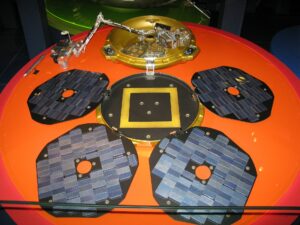
Yesterday, at the National Space Centre in Leicester, a very different kind of ceremony took place. The plaque — official, handsome, sponsored by the UK Space Agency — was finally unveiled. It reads: Beagle 2: the first British and European spacecraft to land successfully on another planet. 25th December 2003. This is not the wording of a consolation prize. This is the wording of a vindication.
Eleven Years of Silence
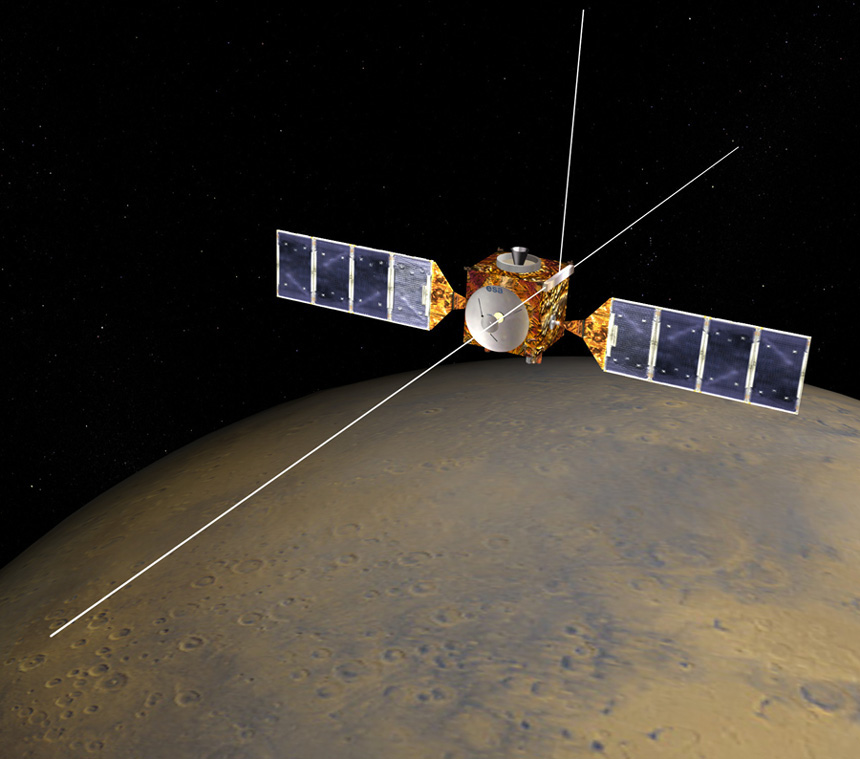
The story, for those who have forgotten or never knew, is this. Beagle 2 was named after the ship that carried Darwin, and conceived in the late 1990s as a hitchhiker on the European Space Agency’s Mars Express orbiter. The mission was put together with an audacity that borders, in retrospect, on the philosophical. Anu Ojha, Space Chief Technology Officer for the UK Space Agency and MC for the day’s proceedings, was precise about the scale of the ambition and the implausibility of the timeline: from the idea of having the lander to launching the mission in the summer of 2003 was, as he put it, “only a few years — almost unheard of.”
The mission involved around 70 companies, among them McLaren, who built the carbon fibre structure. Matt Cosby, now Chief Technology Officer of Goonhilly Earth Station in Cornwall, was a young engineer who had wandered into space science from a physics degree at Leicester — he had chosen the course, he admitted cheerfully at the panel discussion, because he knew three years of pure physics without something interesting would be unendurable. He was handed a 30-page specification and told to implement the communications system. When he asked about the deadline, the answer was unambiguous. As Cosby put it at the Q&A: “You’ve got to go and test it with NASA. What, when do you want this by? You’ve got six months.”
They missed the slot for testing at Kennedy Space Center when clearance didn’t come through in time, and Mars Odyssey launched without them. They improvised. They went to JPL in California with the engineering model. They tested at Jodrell Bank with a transmitter so powerful that Ted Gong, the engineer responsible, had to move it further and further from the dish, into a nearby botanical greenhouse, and finally bury it a metre underground just to get enough signal attenuation to run the test. There is something almost parabolic about this image: a British space engineer kneeling in a flowerbed, hiding a transmitter in the earth, so that the enormity of what they had built would not overwhelm the instruments designed to receive it.
Mark Sims, who was project manager and then mission manager through to launch, put the time pressure with characteristic directness at the panel discussion: “Mars Express was the only opportunity to go. If Beagle wasn’t there, Mars Express would go without us. It was very much a high-paced programme — in some respects, ridiculously paced.”
Christmas Day, 4:19am
Sims is a measured, precise man — forty-odd years as a space instrumentation engineer at the University of Leicester, every job going, from writing EGSE code to flight operations, the kind of person who doesn’t suffer fools. He does not traffic in self-pity. But when Ojha asked him, gently, to describe Christmas Day 2003, something shifted. He had given everyone an early Christmas, he explained. They had gone back to their families. They had tried to celebrate. Then they had come back to the control room.
The first expected signal window was around 4:19 in the morning. It did not come. Jodrell Bank was tasked with listening for a radio beacon. Still nothing. And then, as Sims described it at the panel: “The disappointment you could feel. A few hundred people around the UK had worked on this project for five, six years, some of them, and we didn’t get a signal. And I had the difficult job of walking out and saying to the audience: we didn’t get a signal. We don’t know what the status of Beagle 2 is.” The team drove through the early hours to Jodrell Bank, because they were so personally invested they wanted to be at the dish itself. It made no difference. After three or four months, they mentally accepted it.
What they did next is rather extraordinary. Instead of waiting for an official inquiry, they conducted their own post-mortem — we wanted to know what went wrong, Sims said, rather than other people telling us what may have gone wrong. The document is still on the web, if you dig. It is a monument to professional honesty and to the particular courage required to examine your own failure before the official verdict has been handed down. As it turned out, their conclusions were wrong. But the instinct was entirely right.
Cosby recalled those hours in the control room with the slightly haunted good humour of someone who has fully made his peace with a very strange memory. The control room was open to visitors through a glass wall — the radical public transparency that Chris Lee, former Chief Scientist of the UK Space Agency, had helped to build into the mission from the start. The engineers working through the night could be watched by anyone who came in off the street. As Cosby remembered it: “We were in there frantically, very little sleep — I think we were using some choice language. After about two hours I said: is this stamp-proof? And they went: yes. Thank goodness for that.” But it was not only the pressure of being watched. It was also the sustenance of it. “Everyone was rooting for us,” Cosby said. “There was all the radio programmes, all the TV — and that kept us going.”
The Redemption Orbiter
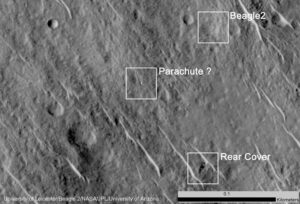
Eleven years passed. Mars Reconnaissance Orbiter, a NASA spacecraft, had been in orbit since 2006 — three years after Beagle 2 landed. Its HiRISE camera was extraordinary, but Beagle 2 is a small object on a large planet, and nobody was specifically looking. Then, in November 2014, researchers at JPL and the University of Leicester were examining overlapping images and found something: a bright spot. And, around it, the unmistakable geometry of partially deployed solar panels.
Sims described the discovery at the panel with the precision of a man who knows that the difference between hope and evidence is a chasm that has swallowed many good scientists. “They had two overlapping images,” he said, “which showed a bright spot on the surface of Mars. That was Beagle. And that is why, in January 2015, we announced Beagle on the surface — along with all its component parts, parachute, heat shield, et cetera. That is why we know it flatly landed successfully.”
The reason it never phoned home was that one final solar panel had not deployed. A single panel, an inch or two of metal, stood between success and eleven years of failure. The lander had crossed 140 million miles of space, entered the Martian atmosphere at thousands of miles per hour, survived the heat shield, the airbags, the bouncing landing — and stopped at the last fold. One is tempted toward metaphor. One should probably resist. But the instinct is understandable.
Colin, and the Force That Would Have Found It
Professor Colin Pillinger, who led the Beagle 2 mission, was one of those rare scientists who was also a public figure in the fullest sense — passionate, combative, endlessly quotable, possessed of the kind of conviction that makes institutions uncomfortable and missions possible. Chris Lee, the former Chief Scientist who oversaw the plaque unveiling, described him simply as “the glue, the imagination, the drive, the personality that held the mission together.” Pillinger died in May 2014 — seven months before the discovery was announced. His wife Judith was present at the ceremony yesterday, sitting quietly at the back.
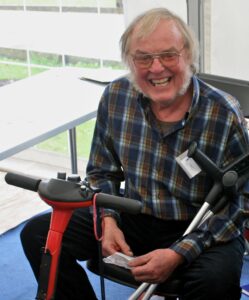
Colin Pillinger
After the official proceedings, Sims offered a thought that was not in the programme. If Colin had known that Beagle had been found before his death, he said, no force on earth would have stopped him going to find it. The image this conjures — Pillinger somehow engineering a return mission to retrieve his lander from the Martian plains — is both absurd and entirely plausible. These are, after all, people who buried a transmitter in a flowerbed at Jodrell Bank to make a test work. They tend to find a way.
Lee, for his part, offered what amounted to an understated manifesto for why the mission deserves its official recognition:”Consider this: not every country has a piece of resilient technology sitting on the surface of another planet — not shattered in pieces, but intact, perhaps a little dishevelled, yet still a symbol of national ambition and capability. That really is an achievement to be proud of.”
The Failure That Wasn’t, and the Method That Won
Dara Patel, Space Expert at the National Space Centre, offered the most precise articulation of what the 2015 revelation had actually rewritten. She noted that in the immediate aftermath of Christmas Day 2003, one American scientist had said — with some relief — that thank God Beagle had failed, because if it had succeeded, how would anyone have justified the multi-billion-dollar missions that followed? What Beagle represented — fast, lean, iterative, minimum viable spacecraft — was not, at the time, how serious space was done.
As Patel put it: “That innovative, new space way of working — in terms of very quick turnover, miniaturisation, working very quickly — wasn’t really deemed as a way of doing space. But we look at space now, and that’s exactly what we’re seeing.” It is one of those historical ironies that takes a moment to absorb: a mission dismissed as a failure was, in its methods, a template for the future; and the future has now arrived without especially acknowledging its debt.
Chris Lee made the same point in different terms, drawing a direct line from the Beagle ethos to what has become a recognisable industry movement. “Today,” he said at the ceremony, “this kind of fast-moving, startup-style innovation is often hailed with a new label. It’s called New Space. And Beagle 2 had to work that way long before the term was ever invented.”
Peers, Not Provinces
There is a version of the story — particularly tempting for a British audience standing in a Leicester exhibition hall — in which the question becomes: but are we really still in the game? NASA has Artemis. SpaceX has rockets that land themselves. The budgets involved make Beagle 2’s famously lean operation look like a well-organised school project. And there is, let us be honest, a danger of mistaking a plaque for a programme.
But the people in that room yesterday did not seem like people celebrating the past at the expense of the present. Sims, who has spent four decades at Leicester doing every job in the space business from code to flight operations, was clear that the relationship with the Americans and the broader international community is one of mutual respect. The collaborations with JPL, with NASA, with ESA run deep. The discovery of Beagle itself was a joint effort between British universities and an American spacecraft. When Sims notes that some of the science Beagle proposed has since been carried out by Curiosity and Perseverance, he does so without bitterness, observing simply that the work gets done, wherever it gets done.
As Sims put it at the panel, “Science moves on, technology moves on. Beagle 2 was a unique moment in time. Some of Colin’s ideas about dating rocks on Mars have been done by Curiosity. The science that we’d hoped Beagle 2 would do has gradually been done.” The large players in space — American, commercial, increasingly Asian — are formidable, and nobody in that room was pretending otherwise. But the sense was of respected peers working in the same field, not of a provincial outpost watching events unfold on television.
Part of what sustains that confidence is the sheer breadth of what the UK space economy has become. Sims noted that it now encompasses far more than scientists and engineers — market analysts, lawyers, accountants, insurers, consultancies. It is an industry rather than a vocation, which means the question is not whether Britain can afford to do space, but whether it can afford not to.
Leicester sits at the spiritual centre of this. The University’s space department produced not only the Beagle 2 team but a generation of scientists, engineers and communicators, including Cosby himself, who arrived at Leicester because he thought pure physics without something interesting would be unendurable and found, at the end of a very long road, that he was now CTO of a ground station on the far tip of Cornwall talking to spacecraft. Patel, for her part, noted that the educational legacy of Beagle 2 had been structural as well as inspirational. The glass wall between the control room and the public — the people looking in at the sleepless engineers, rooting for them — was itself a kind of manifesto.
As Lee put it at the unveiling: “It rewired our relationship between space and the public. Perhaps for the first time, a UK space mission became part of national culture. It wasn’t buried in academic journals — it was on the evening news. It inspired rock bands. It inspired artists. And it captured the public’s imagination.”
The Science That Waited
Colin Pillinger’s central scientific ambition — to look for evidence of past life on Mars by examining the isotopic ratios of carbon in surface samples — was not achieved by Beagle 2. But Sims was carefully, precisely optimistic about where things now stand, and careful to separate the accumulated from the definitive.
As Sims explained: “There’s no definitive evidence yet that there was life three or four billion years ago. There’s accumulated evidence — we see more and more complex organics, we see potentially lots of evidence of water and the environment being ripe. A case is gradually being built. And the landing site we chose — Isidis Basin — would almost be a perfect site to find evidence of life. No science experiment is perfect, and Colin would be the first person to have said that. It’s a question of interpretation, testing again and again and again, in order to get a conclusion as groundbreaking as it would be to say there was life on another planet.”
The European Space Agency’s Rosalind Franklin rover, due for launch in 2028 and arrival around 2030, will drill beneath the Martian surface and analyse organics with a mass spectrometer — very much as Pillinger proposed in the late 1990s. By 2032, when the data has been analysed and verified, they may have the evidence. The science did not die on Christmas Day 2003. It merely waited.
A Note to Young People
Before leaving, Sims had a practical word for anyone young and interested in space. Go to exhibitions, he said — the NEC, the IEC. Show up. The pipeline from visitor to contributor is shorter than it looks. And in answer to the question of why he has spent forty years doing this, his answer was the plainest thing said all day:
Sims: “None of my days are the same. They’re never boring. I’m always doing creative stuff.”
He said this in the same room where, in the small hours of Christmas Day 2003, he walked out to a waiting audience and told them there was no signal. The room has not changed much. The plaque on the wall is new.
Beagle 2 is still out there — intact, on the red plains of Isidis, one panel short of a phone call home, and yet the first British and European spacecraft to land successfully on another planet. It took eleven years for the world to catch up with that fact. These things take the time they take.
Christopher Jackson attended the Beagle 2 plaque unveiling and panel discussion at the National Space Centre, Leicester