


 BBC News
Borrowing was £17.4bn last month, the second highest October figure since monthly records began in 1993.
Finito World
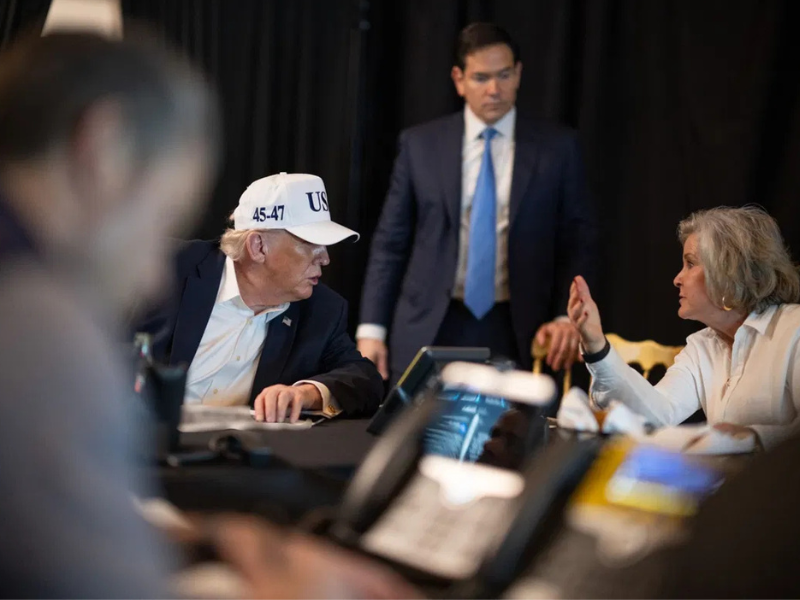
There is something unmistakably modern — and unmistakably Trumpian — about the image.
The president of the United States, in a white “USA” cap, seated not in the White House Situation Room but in a gilded Florida mansion he owns, overseeing air strikes that killed a foreign head of state and reshaped the Middle East overnight. Behind him, a vast map of the region. Around him, cabinet officials and generals, some in business suits, one in casual attire. Outside the secure room: palm trees, club members, the hum of a private resort.
It is not just a military story. It is a style-of-government story.
American presidents have always governed through space as much as through words. The Situation Room in Washington is a symbol as much as a facility — purpose-built, subterranean, disciplined. It speaks of institutional continuity. Even when presidents differed wildly in policy — Kennedy, Nixon, Obama, Bush — the theatre of decision-making was anchored in the architecture of the state.
Trump’s decision to monitor and direct major military operations from Mar-a-Lago, inside a SCIF installed within his private club, subtly shifts that theatre.
Formally, nothing is improper. The facility is secure. Classified information is protected. The chain of command functions. Vice-President JD Vance remained in the Washington Situation Room, connected by secure conference. The military machine did not fracture.
But atmospherics matter in politics.
Ronald Reagan liked to retreat to his California ranch, yet when missiles were launched or crises unfolded, the image returned to Washington — to desks, seals, uniforms. Barack Obama’s presidency was defined visually by the 2011 Situation Room photograph during the bin Laden raid: jackets off, tension etched, a compressed room full of hierarchy and urgency. That image conveyed sobriety and institutional gravity.
By contrast, Mar-a-Lago conveys something else: control fused with ownership. The private and the presidential blur.
In Britain, the comparison is instructive. Prime ministers have long used Chequers as a retreat, and Churchill famously directed aspects of wartime planning from Chartwell. But Downing Street’s Cabinet Office Briefing Rooms — COBR — remain the symbolic locus of crisis authority. Even Boris Johnson, comfortable in informality, returned to the ritual space when decisions demanded it.
Trump, by contrast, seems to delight in collapsing those distinctions. He governs from where he is.
Part of this is practical. Modern communications make geography less decisive. A secure facility in Florida can replicate Washington’s functionality. In an era of distributed work and encrypted networks, perhaps it is naive to imagine power as fixed to one building.
Yet symbolism does not evaporate with broadband.
The Mar-a-Lago images communicate a presidency comfortable with personalisation. The chief of staff, Susie Wiles — not formally a national security figure — sits prominently in the room. The CIA director appears mid-conversation. The Joint Chiefs chairman gestures at a screen in shirtsleeves. The president wears campaign-style headwear rather than suit and tie.
This is not accidental staging. It reinforces Trump’s long-standing argument: that he is not merely occupying the state but bending it toward his own orbit.
Critics will see danger here — a dilution of institutional formality, an erosion of distance between public office and private enterprise. Supporters will see something different: accessibility, decisiveness, a president who does not hide behind bureaucratic walls.
Both interpretations contain truth.
What distinguishes Trump from predecessors is not that he decentralises — presidents have long used Camp David, Air Force One, and overseas bases as temporary command posts — but that he domesticates power. Mar-a-Lago is not neutral terrain. It is a branded environment. A members’ club. A place of loyalty and patronage.
The optics, particularly in moments of lethal decision-making, are therefore charged.
Compare this to George W. Bush on 9/11, initially in a Florida classroom but quickly repositioned into the iconography of command — uniformed generals, sealed rooms, Washington architecture. Or to Obama’s preference for tight, disciplined imagery during crises, conscious of the presidency as an institutional office first, personality second.
Trump reverses the hierarchy. Personality leads; institution follows.
Even Vice-President Vance’s simultaneous presence in the White House Situation Room underscores the duality. There were, in effect, two nerve centres: the traditional Washington command room and the Florida counterpart. Authority was geographically plural but symbolically weighted toward the president’s personal domain.
This is a post-modern presidency in spatial terms.
It also reflects the broader Trump doctrine: scepticism toward entrenched bureaucracies, preference for tight inner circles, trust in loyalty as much as in institutional process. The presence of Wiles — influential, long-serving, but outside formal national security structures — exemplifies this. Influence flows not strictly through departmental hierarchies but through proximity.
Whether this strengthens or weakens governance depends on one’s view of institutionalism. Centralised bureaucracies can become inert; personalised power can become impulsive. The balance between them is the enduring tension of democratic leadership.
The Pentagon has been keen to stress that this operation will not become an “endless war”. The administration projects confidence and control. But the more interesting question may not be strategic but constitutional in tone: what does it mean, symbolically, for American military power to be directed from a private estate?
The answer is not yet clear. It may prove inconsequential. Technology has loosened the link between geography and authority. Or it may mark a deeper shift — the normalisation of a presidency that carries the Situation Room with it, wherever the president chooses to sit.
In an age where work itself is hybrid and distributed, perhaps it was inevitable that the presidency would follow. Yet few previous leaders have so thoroughly fused their personal brand with the machinery of state.
The image of a president in a resort-turned-war-room is not merely aesthetic. It captures a governing philosophy: power unmoored from traditional settings, comfortable in informality, sceptical of ritual.
Whether history judges that as adaptability or erosion will depend less on the wallpaper and more on the outcomes. But the room, and where it is located, tells its own story.