



 BBC News
Borrowing was £17.4bn last month, the second highest October figure since monthly records began in 1993.
Finito World
There is a peculiar sensation that attends contemporary politics: the feeling that events are not merely happening, but accelerating, and that this acceleration exerts a pressure of its own. Crises no longer arrive; they gather pace. They no longer resolve; they demand fulfilment.
We live not in an age of government so much as an age of narrative velocity.
This is not simply a matter of media saturation or shortened attention spans, though both are implicated. It is something deeper and more disquieting: a collective condition in which leaders, institutions, commentators and citizens all become characters inside a rolling story that refuses to slow down — and in which restraint begins to look like abdication.
Crisis as a Shared Performance
What is striking about modern political crises is the extent to which readers are also participants. MPs, journalists, activists, markets, social-media spectators — all are both audience and actor. The story is read, retweeted, speculated upon, then subtly enacted.
At a certain point, the narrative of crisis becomes self-animating. Silence is interpreted as guilt. Process is read as evasion. Apology without sacrifice feels incomplete; sacrifice without absolution feels hollow. The system develops an appetite.
One sees this clearly in the choreography of recent British politics: the fixation on who has resigned, who has not spoken, who has been sent out to defend whom; the obsessive reading of body language, tone, absence. Power is no longer assessed by decision-making capacity alone, but by narrative control — or, more precisely, by the ability to prevent the story from running ahead of the facts.
And once momentum builds, some participants feel an almost moral need to complete the arc. A crisis, left unresolved, feels like bad storytelling.
The Long Rule and the Lost Pause
This helps explain why long periods of stable rule — the kind enjoyed by Thatcher or Blair — now feel almost unimaginable. Not because today’s leaders are necessarily less able, but because the environment no longer permits cooling periods.
Earlier political eras allowed for pauses: moments when the press moved on, Parliament recessed, public attention drifted. Authority could be banked. Errors could be absorbed. Now there is no off-stage. Every misstep is instantly performative, endlessly replicable, and permanently searchable.
Noise has become a form of anti-governance.
It flattens signal, erodes hierarchy, and accelerates decision cycles beyond what deliberation can sustain. Leaders are punished not for being wrong, but for failing to end the story quickly enough.
Trump and the Art of Temporal Dominance
Against this backdrop, Donald Trump appears anomalous — even supernatural. He is often presented as proof that noise politics can be mastered, that unpredictability is strength, that spectacle can substitute for legitimacy. And there is truth here.
Trump’s achievement is not merely rhetorical. Over the past decade — including his current second term — he has reshaped the United States and the wider world in ways that are tangible and enduring: the judiciary, trade doctrine, party realignment, immigration politics, the global posture toward China, the erosion of liberal assumptions about multilateralism. These are not illusions.
But Trump’s deeper innovation lies elsewhere. He does not merely survive narrative acceleration; he outpaces it. By being more dynamic and unpredictable than the combined forces arrayed against him, he denies the system its greatest weapon: anticipation.
He breaks the shared timeline. Critics cannot coordinate. Allies cannot second-guess. Frames dissolve before they harden. Pressure, unable to lock on, disperses.
Crucially, Trump almost never accepts the premise of crisis itself. He attacks the frame — “witch hunt”, “fake news”, “they’re afraid” — converting moral indictment into tribal loyalty tests. Facts become secondary to identity alignment. Outrage becomes fuel.
This is not chaos. It is temporal dominance.
Why This Model Is Not Portable
Yet Trump’s success does not offer a universal template. His method works because it is congruent with his coalition. His supporters expect combat, reward norm-breaking, and accept volatility as authenticity. Permanent mobilisation is not a bug but a feature.
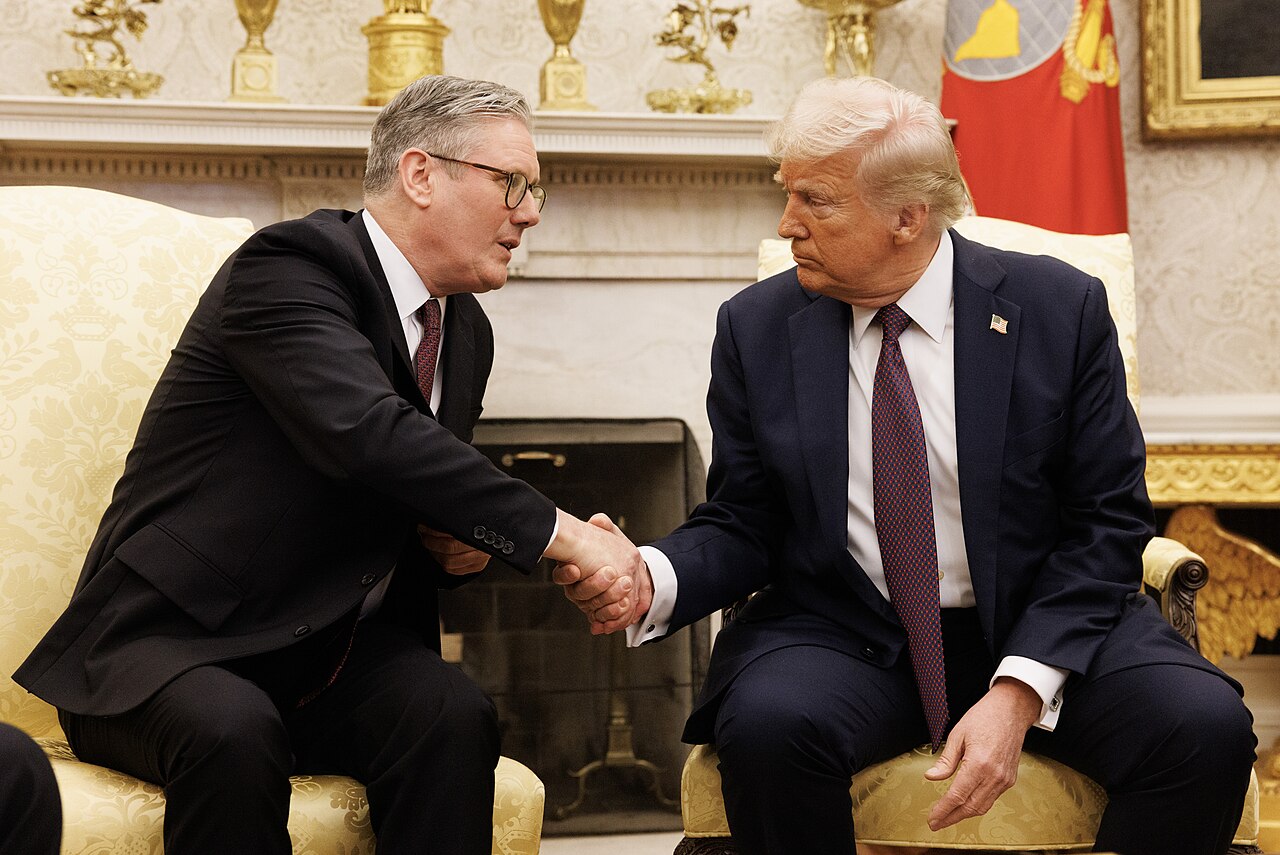
By contrast, leaders like Keir Starmer are built for a different ecology. Their authority rests on seriousness, legality, ethical coherence, and coalition maintenance. They depend on process — and process is legible. In a high-noise environment, legibility becomes vulnerability.
Were Starmer to attempt Trumpian unpredictability, he would not gain resilience; he would lose legitimacy. The load-bearing beams of his authority would collapse.
This is the tragedy of contemporary governance: the leaders best suited to run complex states are often least equipped to dominate the narrative conditions in which those states now operate.
Achievement Without Settlement
Trump’s second term underscores a further paradox. His policies are consequential, but many rely on permanent motion — executive action, rhetorical pressure, institutional exhaustion. Some lock in structurally; others require his continual presence.
He governs not by settlement, but by propulsion.
This raises an uncomfortable question: can a system sustain endless mobilisation without hollowing out its own capacity for the slow, boring, cumulative work on which civilisation depends? Infrastructure, public health, education, administration — these require trust, predictability, and time.
Trump demonstrates that narrative dominance can overpower institutional resistance long enough to produce lasting change. He also demonstrates the cost.
The Age of Unfinished Crises
We are left, then, in a strange interregnum. Narrative acceleration rewards disruption but corrodes governance. Procedural competence is necessary but insufficient. Authority leaks faster than it can be stored.
Crises now want endings, and leaders are judged less on outcomes than on whether they satisfy the story’s appetite.
Perhaps the real question is not whether Trump or Starmer is better suited to this age, but whether the age itself is governable in the way we still expect. Whether we can relearn the value of pause. Whether every story must resolve publicly. Whether power can once again be something other than velocity.
Until then, politics will continue to feel like a sequence of unfinished crises — and leadership like an attempt to stand still in a world that will not stop moving.