



 BBC News
Borrowing was £17.4bn last month, the second highest October figure since monthly records began in 1993.
They think it’s all over. It is now.
So said Kenneth Wolstenholme, almost as an aside, as Geoff Hurst hammered his third goal past Hans Tilkowski in the final seconds of the 1966 World Cup final at Wembley. The words were unrehearsed — a reflex rather than a composition. Wolstenholme had noticed the supporters spilling onto the pitch, assumed the game was over, and improvised. He was right, of course, in ways he could scarcely have imagined. England had won. But something larger had also begun.

Watch the footage today and what strikes you is the almost chamber-music quality of it all: the modest roar, the unassuming stadium, the gentle propriety of the commentary. Wolstenholme spoke as a man who had absorbed the codes of public restraint — the radio presenter’s awareness that to over-emote is to risk absurdity. And yet what he was describing, with such understatement, was the moment when professional football stopped being a Saturday afternoon ritual and began its long, strange metamorphosis into something rather closer to a geopolitical phenomenon.
In 1966, Geoff Hurst — the only man to score a hat-trick in a World Cup final — was earning roughly £80 a week. His teammate George Cohen, England’s right-back, was on a similar wage when a knee injury ended his career three years later. The maximum wage cap for English footballers had only been abolished in 1961, following Jimmy Hill’s landmark campaign as chairman of the Professional Footballers’ Association, and the game was still feeling its way towards the economics of abundance. Johnny Haynes had become the first player to earn £100 a week that same year — a figure treated at the time as a mild scandal.
The contrast with the present is not merely striking. It is vertiginous. Erling Haaland, the current highest earner in the Premier League, is estimated to take home around £525,000 a week — £27.3 million a year. The average Premier League wage now sits at something in the region of £44,000 per week. What happened between Wolstenholme’s measured apostrophe and Haaland’s financial stratosphere is not just the story of a sport. It is the story of globalisation itself: of how a game invented on the playing fields of Victorian England became, by any measure, the largest cultural industry on the face of the earth.
The Scale of the Thing
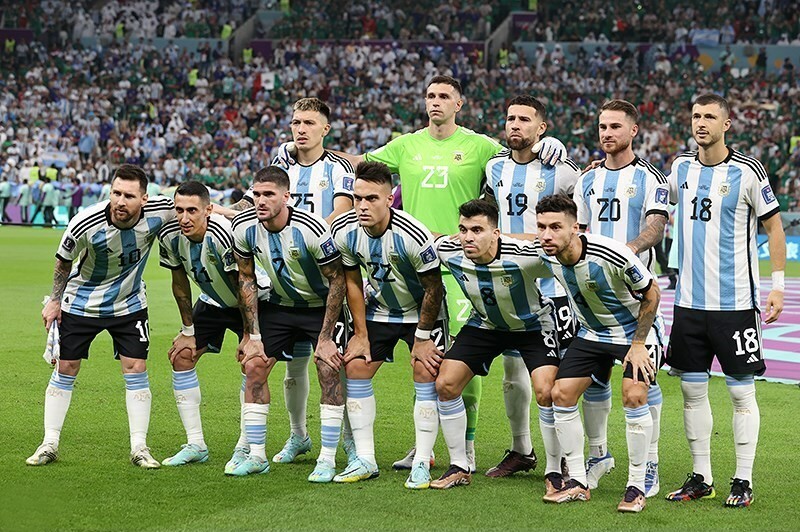
Numbers, in this context, have long since ceased to be numbers in the ordinary sense and have become something more like theology. Consider the 2022 World Cup in Qatar. The Argentina–France final drew an audience of 1.42 billion viewers — not the population of a large country, but of a large continent, watching the same ninety minutes of football at roughly the same time. Across the entire tournament, FIFA estimates that around five billion people engaged with the competition in some form. To place that in context: the Super Bowl — America’s own cathedral of spectacle — draws approximately 120 million viewers globally. The average audience for every single match at the 2018 World Cup in Russia was 191 million people. Not the final. Every match.
FIFA president Gianni Infantino has described the 2026 World Cup, which opens this month across the United States, Canada and Mexico, as “104 Super Bowls in one month.” The hyperbole is, in this case, almost understatement. The 2026 edition is the largest World Cup in history: forty-eight nations, one hundred and four matches, three host countries, and economic projections that read less like a sports event and more like a medium-sized war. Independent consultancy OpenEconomics, commissioned by FIFA in association with the World Trade Organization, estimates that the tournament could generate $80.1 billion in global economic output and $40.9 billion in gross domestic product. Nearly 824,000 full-time equivalent jobs are projected to be created or sustained worldwide as a direct or indirect consequence.
Within the United States alone, the figures are $30.5 billion in gross output, $17.2 billion in GDP, and the equivalent of 185,000 full-time jobs. Canada is projected to see up to CAD 3.8 billion in economic benefit, including CAD 1.3 billion in wages. Mexico, the smallest economy of the three hosts, is in some respects the relative winner: the $3 billion in projected economic benefit represents somewhere between 0.2 and 0.5 percent of the country’s entire GDP, a meaningful uplift for an economy where the influx of international visitors carries disproportionate weight.
The Employability Question
There is a tendency, when discussing events of this magnitude, to speak only in aggregate. The headline number — 824,000 jobs worldwide — lands with satisfying weight but tells us relatively little about the texture of the opportunity. The labour market picture is, in reality, considerably more granular and considerably more interesting than the summary figure suggests.

In the United States, the accommodation sector is the single largest employment beneficiary: an estimated 31,660 jobs created to service the extraordinary volume of international visitors during the tournament’s 39-day window. Air transportation follows at 20,055 positions, driven by the added flight frequencies required to move the projected 1.24 million international arrivals between host cities. Of those visitors, 742,000 are classified by Tourism Economics as “additional” trips — travel that would not have occurred without the tournament, representing genuine new economic activity rather than displacement. Each visitor is expected to stay an average of twelve days.
Beyond the headline sectors, the employment picture spreads wide and deep. Security, logistics, translation and interpretation services, media infrastructure, fan zone operations, merchandise, catering, healthcare provision, digital and broadcasting technology: the World Cup is, in its operational reality, less a football tournament than a temporary civilisation erected in the interstices of the permanent one. The broadcasting footprint alone is instructive. Fox Sports has committed to 340 hours of first-run World Cup programming — more than double its 2022 output. Telemundo will broadcast 92 matches on free-to-air Spanish-language television, the most World Cup games ever shown on a single US network in any language. Behind each of those hours of broadcast lies a supply chain of technical, editorial and support roles that the casual viewer never sees.
It is worth noting, as economists are beginning to do with increasing frequency, that the longer-term employment legacy of hosting a World Cup is more complex and more durable than the tournament-window numbers suggest. The social return on investment calculated by OpenEconomics is 3.64 — meaning that for every dollar invested in hosting, $3.64 of social and economic value is generated. Infrastructure improvements, long-term tourism uplift, accelerated investment in stadium and transport technology: these are the compounding returns that host cities have historically failed to account for in their pre-event calculations, and which tend to re-emerge in the economic literature five to ten years after the final whistle.
The American Complication
And yet, for all the projected billions and the half-billion screens, there remains the persistent American paradox. The United States is, by any conventional measure, the world’s wealthiest and most commercially sophisticated sports market. It is also the only major economy on the planet where football — the world’s game — remains, by domestic preference, an also-ran.
The data here is worth sitting with. A Gallup poll conducted in late 2023 found that 41 percent of American adults name American football as their favourite sport. No other sport comes close. Basketball stands second at roughly 10 percent; baseball at 9 percent. Soccer, in that same survey, is registering at 5 percent. A Pew Research study conducted in early 2024, asking which sport Americans consider to be truly “America’s sport”, found that 53 percent nominated football; 27 percent baseball; 8 percent basketball; and soccer a modest 3 percent. American football has been the dominant spectator sport in the United States since 1972, when it overtook baseball in the polls for the first time. The NFL’s annual revenues have reportedly surpassed $23 billion, and the Super Bowl is, effectively, a national secular holiday, commanding over 100 million domestic viewers.
All of which makes a more recent finding genuinely interesting. A 2025 survey conducted by The Economist found that 10 percent of American sports fans now identify soccer as their favourite sport — edging it past baseball, long considered the sacred pastime of the republic, for the first time. American football retained its commanding 37-percent lead; basketball stood at 17 percent. But soccer’s displacement of baseball in the American cultural hierarchy is a shift with implications that extend well beyond the sports pages.
As Daniel Monaghan of Ampere Analysis has observed, the growth of soccer fandom in the United States derives not only from the expansion of Major League Soccer — now 30 teams, with further franchises planned — but from the accessibility of global competitions and the European leagues, which streaming has placed within reach of any American with a broadband connection. Soccer’s appeal, unlike the NFL’s, extends beyond a single domestic league: it offers the Champions League, the World Cup, the Copa América, the Premier League, La Liga. A fan investing in soccer is investing in a global system, not a domestic franchise.
The demographic dimension is equally significant. Young Americans are, proportionally, the least likely subgroup to name American football as their favourite sport: 28 percent of under-30s nominate it, against 46 percent of those over 50. Soccer’s growth is concentrated precisely in that younger demographic, accelerated by the continued success of the US women’s national team, by the arrival of marquee European players in MLS, and by a cultural shift in which the sport’s global connectivity — once its greatest liability in the American market — has become its most potent selling point.
To put the trajectory in the starkest possible terms: between 1937 and 2004, the percentage of Americans naming soccer as their favourite sport never exceeded 2. It has not fallen below 5 since 2008. It now stands at 10. That is, in the timescale of cultural change in a large democracy, something approaching a revolution.
A Note of Caution, and a Larger Truth
Scepticism, in this context, is not only legitimate but necessary. The economists and journalists at the Financial Study Association Groningen have noted the structural tension in FIFA’s projections: the organisation and its commissioned consultancies have an obvious incentive to forecast optimistically, and the headline figures — $80 billion in global output — incorporate assumptions about tourism and consumer behaviour that may not survive contact with reality. Several economists who have studied previous World Cup hosts have documented the “halo effect” that tends to inflate pre-event projections. Host cities, meanwhile, are expected to absorb hundreds of millions in security, transport and infrastructure costs while FIFA itself is projected to generate approximately $11 billion in profits from the tournament.
None of which changes the fundamental reality. The World Cup is, and has been for several decades, the single most-watched sporting event in
human history. Nothing else approaches it for global simultaneity — the sheer improbable fact of 1.5 billion people watching the same football match at the same moment. The industry that has grown up around that fact is, at this stage, a serious economic force: a generator of employment, a driver of infrastructure, a multiplier of tourism, and an engine of cultural exchange that operates in ways that formal economic modelling consistently struggles to capture.
The Long Shadow of a Summer Afternoon
Return, for a moment, to Wembley in July 1966. Geoff Hurst, in his £80-a-week boots, blasting a hat-trick past a West German keeper in a stadium of 96,000 people. Kenneth Wolstenholme’s steady, slightly amused voice noting that it was, indeed, all over. England’s players receiving a modest bonus and dispersing, as professionals then did, back to their ordinary First Division contracts. The wages of a skilled tradesman. The relative obscurity of men who had, half an hour earlier, been the best footballers in the world.
What the intervening six decades have produced is a transformation so complete that the 1966 final and the 2026 tournament feel less like points on a continuum and more like specimens from different civilisations. The game is recognisably the same: eleven players, two goals, ninety minutes. The industry around it has become something entirely different — a global economic ecosystem generating hundreds of thousands of jobs across hospitality, broadcasting, logistics, technology, security and sport itself. A game in which the top earners are paid, weekly, what Hurst earned in a decade.
And now it arrives on American soil for only the second time, with 48 nations and 104 matches and projections that gesture towards $80 billion. In a country where American football still commands 37 percent of all sporting allegiance, and where baseball — once the sacred pastime — has just been nudged aside in the polls by a sport that many Americans still struggle to call football. The irony, or perhaps the justice, is considerable. The country that most conspicuously declined to call it the world’s game is now being asked, for a summer, to host the world in it.
Wolstenholme, one suspects, would have found the right words. Something calm, exact, and faintly amused. It is, after all, just a game. It is, after all, quite clearly not.