


 BBC News
Borrowing was £17.4bn last month, the second highest October figure since monthly records began in 1993.
Finito World
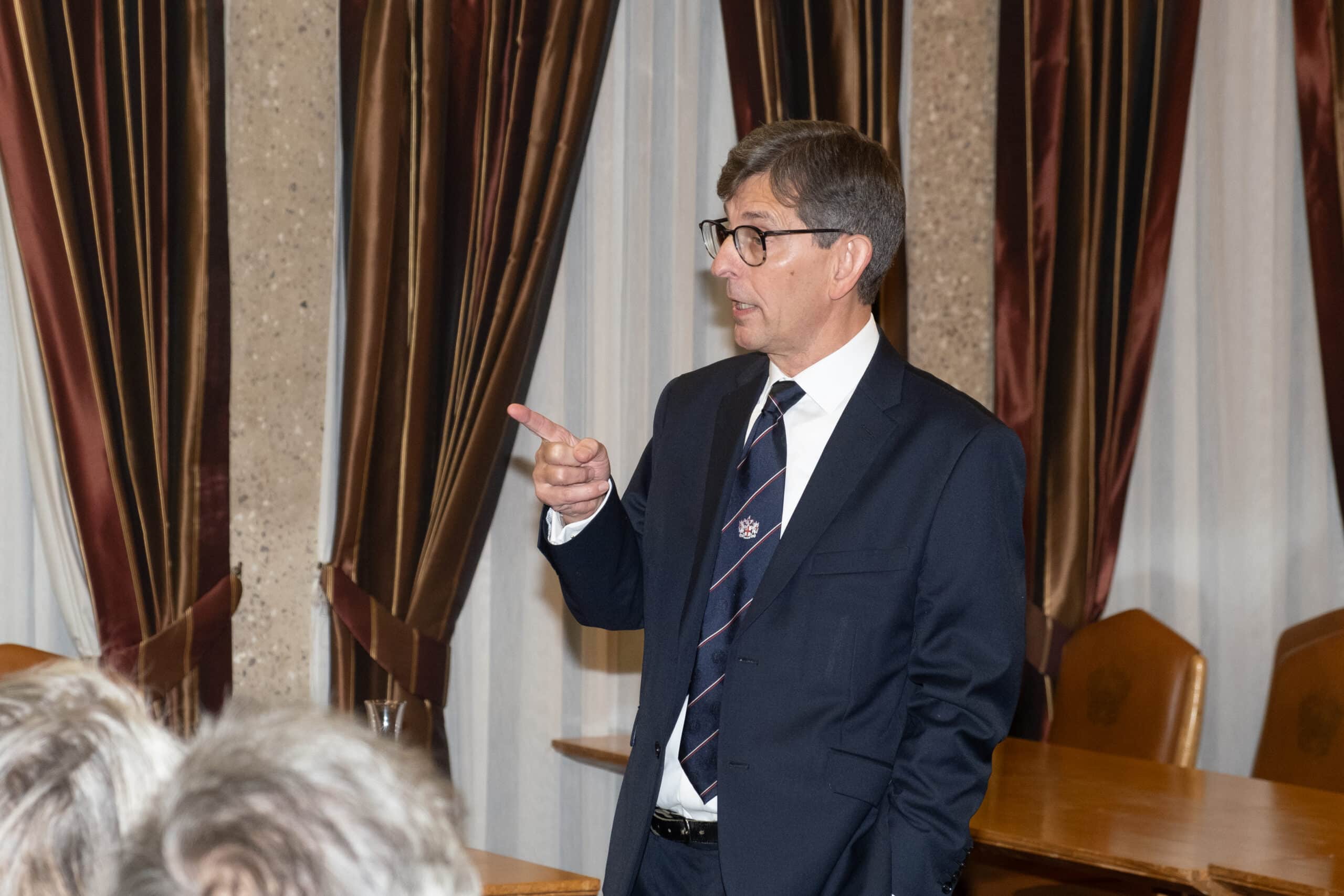
There is a particular pleasure in hearing a former headmaster address a room. He does not need the microphone, he does not need notes, and he is not afraid to ask for a show of hands. So it proved at Simpson’s in the Strand, where Ronel Lehmann, founder of Finito Education, welcomed some eighty guests to the launch of the organisation’s latest report on how schools might better prepare young people for the world of work. “We need good ideas,” he said by way of introduction, “and he is the man who has got them.” What follows is Tim Clark’s address, lightly edited, in his own words.
In 1918 David Lloyd George claimed that the most formidable opponent Britain had faced in the First World War was the German school system, because it was that system which had allowed Germany to become an industrial and military powerhouse. His point was that a school system can transform a country. With a million young people not in education, employment or training, many of them for the long term, we need a transformative school system more than ever.

Tim Clark’s Better Schools 6 Event hosted by Finito at Simpsons in the Strand, London. 7.9.2026 Photographer Sam Pearce
Our research, both in this report and in the work we did earlier this year with the Jobs Foundation, shows that the single biggest factor in preventing a young person from becoming NEET is, unsurprisingly, a good education. The operative word is good. A good education is not necessarily university, or college, or an apprenticeship, though it might be any of those. It is one that allows every individual, regardless of background or ability, to grow, to develop, to mature, and then to play an active and positive part in the workforce, the economy, and society as a whole.
I want to make three points. The first is that this report argues, absolutely unequivocally, that schools can be better equipped and better empowered to prepare young people for work, and most of what we recommend is cost-effective. Yes, we call for ring-fenced funding so that every school can offer first-class careers education, the kind that motivates, that stimulates, that opens eyes. As Ophelia says, “We know what we are, but know not what we may be”. But that is the only recommendation aimed directly at careers. The rest are about giving every young person a good education. We call for a broader range of subjects at fourteen, as we have in every one of our reports, and no, that is not about lowering standards. A broader curriculum raises standards, because by tracking skills, knowledge, attitude and interest it means fewer sixteen-year-olds leave school as failures and more leave with the qualifications and, above all, the motivation to go out and get a job.
Tim Clark’s Better Schools 6 Event hosted by Finito at Simpsons in the Strand, London. 7.9.2026 Photographer Sam Pearce
We also call for far greater emphasis on the application of knowledge, in lessons and in examinations. We call for a non-academic employability certificate that records and evaluates a young person’s attendance, behaviour, attitude and work, because that is exactly what employers need to know, and because there is no better preparation for adult life than making young people responsible and accountable for themselves. And we call, which may seem odd in a report about jobs, for far greater emphasis on the early years. The charity Kindred Squared has shown that by the age of twenty-two months the educational trajectory of most children is already set. For many children in this country, the whole of our compulsory school system is too late, and is about catching up.

Tim Clark’s Better Schools 6 Event hosted by Finito at Simpsons in the Strand, London. 7.9.2026 Photographer Sam Pearce
My second point is that this is emphatically not a call for a sterile, utilitarian school system geared purely to the current economic needs of the country. The report fully supports the traditional academic subjects, the humanities, languages, mathematics and the sciences, the arts, because it is in subjects such as history that young people learn to read, to analyse, to reach conclusions from evidence, to think critically: the very cognitive skills that employers cry out for. It fully supports sport, music, drama and trips, or what the public schools rather better call co-curricular activities, because for many youngsters what they learn on the sports field, in the choir or on the mountainside is of at least equal value to what they learn in the classroom. That is where they learn about risk, leadership, losing, failure, resilience and working together. Again, the very attributes employers pray for.
My third point is to state the obvious: schools cannot operate in a vacuum. However fine the product a school turns out, if there are no jobs for young people to go to, there is a problem. We cannot expect employers to keep taking on and training young people if their sole reward is higher taxation. And we cannot expect young people to leap out of bed with alacrity to find a job if they can earn two thousand pounds a month by staying in it. Those things are beyond the remit of this report, and beyond the control of schools, but they bear massively upon them.
So let me finish with a point that is within our remit, one we have flagged in every report, and on which nothing has happened. Schools cannot deliver if they are hamstrung, and the single biggest thing that hamstrings them is the teacher recruitment and retention crisis. It is a crisis of quantity and it is a crisis of quality. A recent survey found that a quarter of English secondary schools do not have a single qualified physics teacher. Almost half rely on non-specialists to teach mathematics. Despite a manifesto promise of six and a half thousand new teachers, the latest Department for Education figures suggest there are two thousand fewer teachers in the system than two years ago. No school system can be better than the quality of its teachers. I used the word criminal at our last launch and it upset some people, but I think it is the right word. This crisis is resolvable, and no government of any colour in the last twenty years has seized it by the throat and resolved it. Only when we have an adequate supply of highly trained, highly motivated, highly effective classroom teachers will our school system deliver.
I began with Lloyd George. Let me be non-partisan and end with George Lansbury, the Christian socialist who led the Labour Party in the 1920s, who wrote towards the end of his life that if he had his time again he would invest far more in changing people and far less in programmes. That is exactly what this report asks for: a school system that develops every young child and changes every young person for the better. Because if we change young people, we change the economy, we change society, and we change the future.
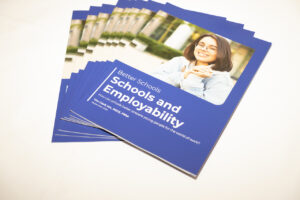
You can read the new report here: https://issuu.com/finitoworld/docs/better_schools_report_embargoed_6.00pm_on_7th_sep