




 BBC News
Borrowing was £17.4bn last month, the second highest October figure since monthly records began in 1993.
Iris Spark
I’m beginning to get quite excited. There is something fundamentally different about the Winter Olympics that sets them apart from their summer siblings –something almost mystical in how they unfold against landscapes of ice and snow, where athletes become temporary gods dancing on the edge of the possible. While summer Games celebrate human achievement in controlled environments, Winter Olympics thrust competitors into an ancient dialogue with the elements themselves, where victory and defeat are measured not just against other humans, but against the raw forces of nature.
As we approach Milano Cortina 2026, scheduled to unfold from February 6-22 across the stunning Alpine amphitheatre of Northern Italy, we stand witness to more than mere sport. Roughly 2,900 of the top winter athletes on the planet will compete for 114 sets of the most prestigious medals in sports, but beneath the statistics lies something more primal: the human impulse to master ice, snow, and mountain – elements that have both nurtured and threatened our species since we first gazed upward at snow-capped peaks.
The Winter Games possess an almost shamanic quality, transforming ordinary mortals into figures of myth. Consider how Eddie the Eagle became not just a ski jumper, but a folk hero precisely because he dared to leap into the void despite his obvious limitations. Or how Torvill and Dean transcended sport entirely, becoming vessels for something approaching the sacred through their perfect communion with ice and music.
Elemental Theatre
Perhaps the Winter Olympics can even bear some light philosophising. Ice represents stillness and clarity. It invites you to explore deeper truths within yourself and connect with nature, spiritual traditions tell us, and perhaps this explains why Winter Olympic moments lodge so deeply in our collective memory. There’s something about the crystalline perfection of a figure skating routine, the balletic grace of a ski jumper suspended against mountain backdrop, or the raw courage of a luge rider hurtling down an ice track at 90 mph that speaks to something older than sport.
Really the Winter Olympics, appropriately perhaps for our vexed species, open up onto the question of survival. Ice has long been associated with resilience and purity in many spiritual belief systems. Its ability to melt and transform represents the impermanence of life and the importance of adaptability in the face of adversity. This transformation becomes literal in winter sport, where athletes must constantly adapt to changing snow conditions, shifting winds, and the capricious moods of mountain weather.
The Summer Olympics, for all their grandeur, seem by comparison to unfold in human-built arenas where conditions can be controlled, temperatures regulated, and variables minimized. Winter Olympics, by contrast, are staged in nature’s own amphitheatre, where wind can destroy a ski jumper’s perfect take-off, where a sudden snow squall can transform a downhill course, where ice conditions change by the hour. Athletes become meteorologists, philosophers of snow density, and students of mountain moods.
Mountain Mystics
Perhaps no addition to the 2026 program better captures this elemental quality than ski mountaineering – or “SkiMo” as practitioners call it – which will make its Olympic debut in the very mountains where the sport was born. Ski mountaineering was part of the programme of the Lausanne 2020 Winter Youth Olympics and will be part of the programme at the Milano Cortina 2026 Winter Olympics. Italy is one of the leading nations in this sport, with several international wins in major competitions over the last 10 years.
It is, like all these new sports, is splendidly odd and it is often curious to be invited to imagine the dedication people have had towards the sport before an Olympic performance was even an option. The sprint discipline is comprised of three distinct phases: running uphill from the start with skis on an athlete’s back, attaching them, and then navigating technical terrain that would challenge even experienced mountaineers.
It might be viewed as a sort of conversation with the mountain itself. As it turns out, ski mountaineering has a vast history in the Alps of northern Italy, so it’s fitting that the sport will make its Olympic debut in Milano and Cortina. The athletes who will compete in these events are descendants of Alpine guides and mountain mystics who first learned to read snow like scripture, to understand avalanche danger like a native language, to move through vertical terrain with the fluid grace of water finding its way downhill.
There will be two types of ski mountaineering races at Milano Cortina 2026 – sprint events for men and women, as well as a mixed team relay. Sprint races can be thought of as having four sections to them, three on the ascent and one on the descent, with transition zones between them. But describing SkiMo in purely technical terms misses its deeper significance: this is the Olympics returning to its roots in human struggle against natural forces.
The Eagle’s Courage
Michael “Eddie the Eagle” Edwards understood something profound about the Winter Olympics that many miss: they’re not really about winning, but about the audacity to attempt. His story resonates not because he succeeded in conventional terms—he finished dead last in both his events at Calgary 1988 – but because he embodied something essential about the winter sport spirit: the willingness to hurl yourself into the void and trust that courage, preparation, and a kind of faithful recklessness will see you through.
Edwards’s journey to Calgary was archetypal in its structure: the unlikely hero, the impossible quest, the moment of truth on the mountain – and the delightful comedy of failure taken lightly. Ice creates frozen landscapes that show elemental energies, and Eddie’s ski jumps became something like performance art, a middle-class plasterer from Cheltenham transforming himself into a humorous deity of flight, if only for the few seconds between takeoff and landing.
His legacy isn’t really about ski jumping technique or athletic achievement. It’s about the democratic possibility that Winter Olympics represent: that anyone, regardless of background or natural talent, can enter into this ancient dialogue with ice and mountain and discover something about themselves that conventional life never reveals. Eddie’s jumps were acts of faith as much as sport, leaps into literal and metaphorical voids that remind us why humans first looked at snow-covered hills and thought, “I wonder if I could slide down that.”
Eddie the Eagle feels also a reminder of something mild about the British: our winters aren’t all that harsh, our mountains not that high, our snow not all that deep. But since at least Chaucer we’ve been laughing at ourselves – and Eddie the Eagle is a reminder we still do.
The Alchemy of Perfection
If Eddie the Eagle represented the democratic accessibility of winter sport dreams, Jayne Torvill and Christopher Dean embodied its aristocratic potential – not in terms of class or privilege, but in the sense of what becomes possible when human beings dedicate themselves completely to mastering an elemental art form.
Their 1984 Sarajevo performance to Ravel’s “Boléro” remains perhaps the most transcendent moment in Olympic history precisely because it achieved something beyond sport: the complete fusion of human intention with natural element. Ice became their medium in the way stone becomes a sculptor’s, and their movements across its surface created something that felt less like athletic performance than like witnessing the physical laws of the universe bend themselves to human will and artistic vision.
The perfect 6.0 scores they received from all nine judges weren’t really about technical skating – they were acknowledgments that something had occurred that transcended the normal categories of evaluation. Each glistening ice formation whispers stories of nature’s harmony, reminding us of the delicate balance that sustains life, and Torvill and Dean had somehow joined that conversation, adding their own whispers to ice’s ancient vocabulary.
Their partnership illustrates another dimension of Winter Olympics that distinguishes them from summer competition: the profound interdependence required to succeed in environments where individual error can mean collective failure. Ice dancing demands not just technical mastery, but a kind of telepathic unity that allows two separate beings to move as one across a surface that offers no forgiveness for mistimed steps or misread intentions.
The Numbers Behind the Magic
The statistical reality of Milano Cortina 2026 tells its own story about human ambition and the democratic reach of Olympic dreams. The Games will feature 16 disciplines across 8 sports, unfolding across venues that stretch from Milan’s architectural elegance to Cortina’s dramatic Alpine landscapes –sites that reflect not just geographical diversity, but humanity’s evolving relationship with snow, ice, and mountains.
Behind every number – every hundredth-of-a-second victory, every technical score, every medal table – lies a personal journey of obsession, grit, and precision. These are athletes who rise before dawn to train on frozen lakes, who study snowpack and wind patterns with the analytical sharpness of scientists, and who spend years chasing the perfect edge, arc, or landing. Their sacrifices and discipline defy the superficial glamour of medals, revealing a deeper story about the human condition in extreme conditions.
Historically, the Winter Olympics have been dominated by countries where winter itself is a way of life. Norway sits at the top of the all-time medal table with over 400 medals, including 148 golds – an astonishing number for a country of just over 5 million people. The United States and Germany follow closely, each excelling in different disciplines: the U.S. in snowboarding, alpine skiing, and speed skating; Germany in luge, bobsleigh, and biathlon. This numerical supremacy reflects not just climate, but also deeply embedded cultural investments in winter sport, infrastructure, and talent development.
On an individual level, names like Marit Bjørgen and Ole Einar Bjørndalen represent the absolute pinnacle of winter achievement. Bjørgen, the Norwegian cross-country skier, is the most decorated Winter Olympian of all time with 15 medals – eight of them gold. Her compatriot Bjørndalen, known as the “King of Biathlon,” amassed 13 medals over a two-decade career, combining endurance, marksmanship, and icy calm under pressure. In speed skating, Dutch athlete Ireen Wüst has etched her name into history with 13 medals, becoming the most decorated speed skater ever and winning golds in five different Olympics – a feat unmatched in any sport, winter or summer.
Yet the magic of the Games does not reside only in dominance, but in surprise. Few will forget Australia’s Steven Bradbury gliding into gold in the 2002 short track speed skating final after all his rivals crashed spectacularly just metres from the finish. His improbable win became a symbol of persistence and being ready when fortune strikes. Similarly, 15-year-old Tara Lipinski’s figure skating triumph in 1998 captivated a global audience, her youthful elegance and competitive nerve redefining what was thought possible at such a young age.
The economic and geographic realities of winter sport create unique barriers – snow, altitude, and costly equipment are not available to everyone. Yet the Games continue to produce stories that challenge those constraints, proving that the Winter Olympics are as much about ingenuity and resilience as they are about wealth or geography. As the Olympic torch prepares to move to Italy, Milano Cortina 2026 promises to build on that legacy, combining architectural grandeur with Alpine purity, and welcoming a new generation of athletes who have shaped their lives around mastering the frozen elements.
In the end, the numbers are only half the story. The rest is written in sweat, snow, silence, and the singular pursuit of greatness.
The Technology of Transcendence
Modern winter sport represents a remarkable fusion of ancient human impulse and precision engineering. The skis that now carry SkiMo athletes up the jagged Alpine faces are built using aerospace-grade carbon fibre and nano-reinforced polymers – materials and design innovations that would seem almost supernatural to the Norwegian farmers who first lashed pine planks to their feet to cross frozen fields. In figure skating, ice surfaces are maintained to thermal tolerances within 0.1°C, regulated by advanced refrigeration systems from companies like Trane Technologies and Engo Ice Arena Equipment, ensuring conditions more stable than any natural lake could offer. On that synthetic clarity, skaters launch into rotations that push the boundaries of human balance and motion.
Yet despite this dazzling technological scaffolding, the Winter Olympics remain rooted in something fundamentally human: the raw capacity for balance, nerve, and moment-to-moment adaptation. A luge rider may ride a sled designed by TobogganTech, which uses computational fluid dynamics to shave milliseconds from a run, but what ultimately matters is the rider’s proprioception—their ability to feel shifts in texture and tilt through ice and steel. The aerodynamic ski suits worn by jumpers, designed by companies like Craft Sportswear and Descente, offer optimal drag coefficients, but they are powerless without the athlete’s willingness to leap into space with nothing but air beneath them and conviction within.
This precarious equilibrium between high technology and primal instinct creates what might be called the technological sublime – moments where material science, biomechanics, psychology, and artistry converge into something greater than the sum of their parts. When Yuzuru Hanyu landed a nearly flawless quadruple loop, he was not merely executing a move; he was navigating a complex choreography of angular momentum, muscle memory, and ice friction, assisted invisibly by Jackson Ultima blades and Edea skates, whose microstructure is optimized for torque absorption and rotational stability.
The companies behind these feats represent a quiet but powerful ecosystem. Fischer Sports, a leader in cross-country and alpine ski manufacturing, employs over 1,500 people globally, exporting to more than 60 countries, and has partnerships with over 80 Olympic athletes. CEO Franz Föttinger described their role succinctly: “Our task is to disappear. If an athlete thinks about their equipment while competing, we’ve failed.” Similarly, Burton, long dominant in snowboarding tech, has invested heavily in AI-powered design tools to tailor boards to individual athlete biomechanics – a collaboration that helped Shaun White and others maintain competitive advantage across multiple Games.
Even arena technology reflects this arms race. Engo, an Italian firm specializing in ice maintenance systems, now builds smart resurfacers that adapt blade pressure based on humidity and usage patterns – part of a broader industry shift toward climate-conscious infrastructure. According to their managing director, “Perfect ice is not a surface. It’s an algorithm.”
Meanwhile, Descente – with its roots in Osaka and its innovation centre in the Alps – reported over $700 million USD in revenue in 2024, driven largely by Olympic partnerships. Its CEO, Shunsuke Nakatake, put it best: “We’re not just making uniforms. We’re engineering confidence under pressure.”
In Milano Cortina 2026, these innovations will once again act as silent partners to the human drama. Cameras will capture the arcs, spirals, and descents—but not the micro-engineered carbon lattices in a ski boot, nor the predictive friction models coded into bobsleigh runners. What the world will see is the moment of transcendence: a twist, a landing, a clean carve through powder. What it won’t see is the extraordinary web of companies, engineers, scientists, and designers whose work underpins that fleeting magic.
Because in the end, what winter sport reveals is not just how far human beings can push their bodies — but how far we can push the materials, machines, and minds that carry us into air, down mountains, and across ice.
The Lessons of Ice and Stone
What do these winter stories teach us about ourselves and our place in the world? First, they remind us that some of life’s most profound experiences come from accepting rather than avoiding risk. Eddie the Eagle’s ski jumps and Torvill and Dean’s perfect synchronization both required complete commitment to uncertainty, the willingness to enter situations where failure was not just possible but likely.
Second, they illustrate the unique satisfactions that come from developing mastery over natural elements rather than artificial environments. The athlete who learns to read snow conditions, to understand how wind affects trajectory, to feel ice texture through their equipment, develops a kind of literacy in the natural world that has become increasingly rare in modern life.
Third, Winter Olympics demonstrate that some achievements can only emerge from long-term dedication to practices that offer no guarantee of external reward. The thousands of hours of training required to compete at Olympic level in winter sports often take place in conditions of solitude, cold, and discomfort that would drive most people indoors. Yet athletes continue because the process itself – the gradual development of intimate relationship with ice and mountain – provides satisfactions that transcend any external validation.
Fire on Ice
As Milano Cortina 2026 approaches, we prepare to witness another chapter in humanity’s ongoing conversation with winter. The athletes who will compete carry forward traditions that stretch back to the first humans who looked at snowy slopes and icy surfaces and saw not obstacles but opportunities – chances to discover what becomes possible when human ingenuity meets natural challenge.
The stories we’ll witness in Milano Cortina – new Eddie Edwards finding courage to attempt the impossible, new Torvill and Dean partnerships discovering perfect synchronization, SkiMo pioneers writing the first chapters of their sport’s Olympic story – will remind us that winter offers unique lessons about resilience, adaptation, and the rewards that come to those willing to embrace rather than avoid challenge.
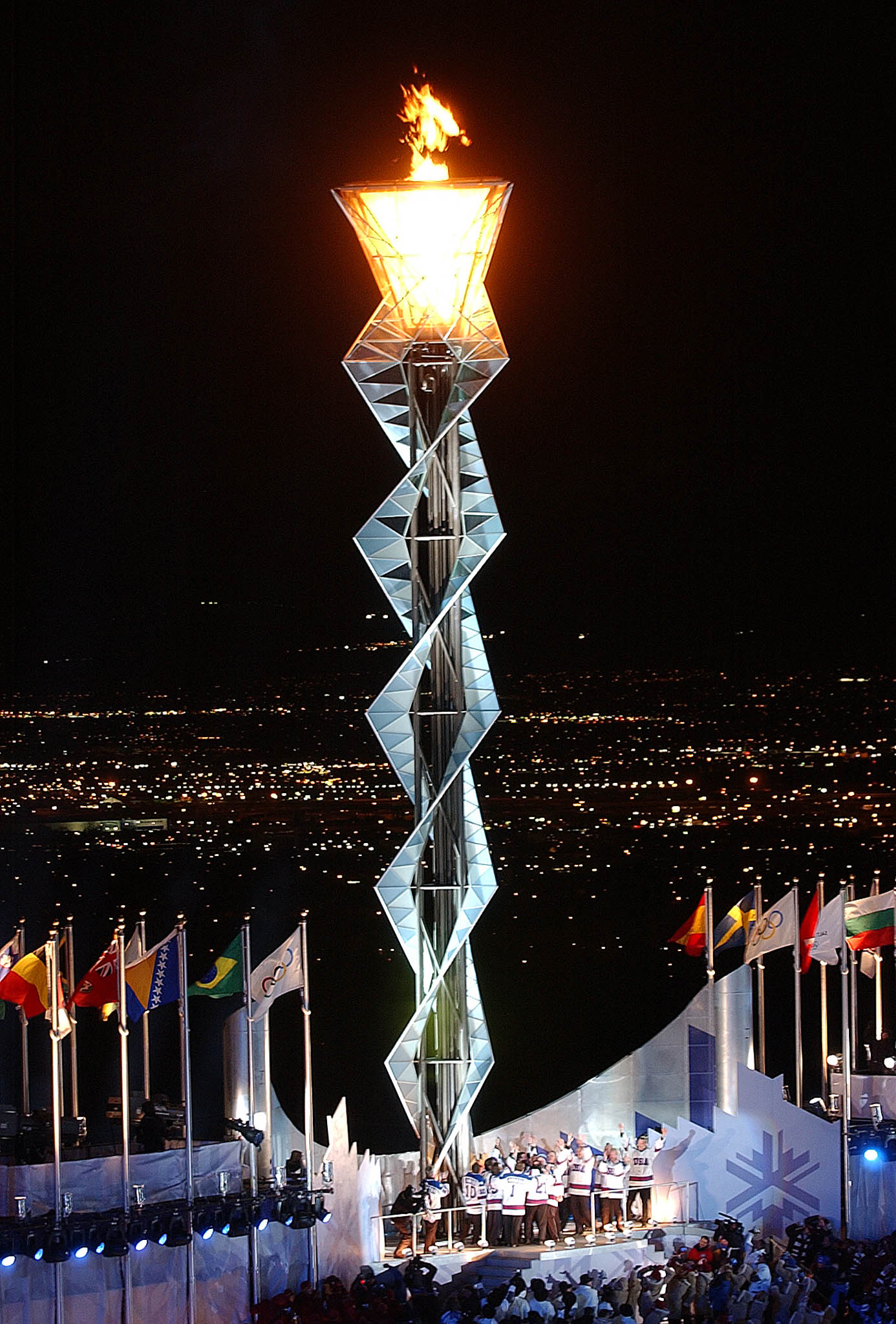
In watching these Games, we don’t just witness sport – we see reflected our own capacity for growth through adversity, our ability to find grace under pressure, our potential for transcendence through the patient development of skill applied to natural challenges. The flame that will burn in Milan and Cortina will illuminate not just Olympic competition, but the endless human capacity for transformation through dialogue with the elemental forces that shaped our world and continue to shape our souls.
The Winter Olympics remain humanity’s most beautiful argument for the value of difficulty voluntarily embraced, of skills developed not for practical necessity but for the pure satisfaction of mastery, of dreams pursued not because they’re easy or profitable but because they call to something essential in human nature. As Milano Cortina 2026 unfolds across Italy’s winter landscape, it will offer yet another opportunity to witness what becomes possible when humans decide to dance with mountains, to find their own poetry in ice, and to discover what lies beyond the edge of the possible.